
Could space-based data centers help power U.S. military missions in the future?
Data centers in space, and perhaps even on the moon, could become crucial to U.S. national security.


America finds itself in Space Race 2.0 as humanity grows ever more dependent on the advanced technology in orbit and the lines between civil operations and national security are increasingly blurred. Threat Status at The Washington Times delivers in-depth and exclusive coverage as the great power competition for dominance accelerates across the 21st Century Frontier, with China, Russia and others challenging the United States as the world leader in the futuristic domain.
Data centers in space, and perhaps even on the moon, could become crucial to U.S. national security.

The Space Force announced it is spending $3.2 billion through 12 defense contractors to rapidly build the first U.S. system of high-technology, space-based anti-missile interceptors.


China is rapidly building up space-warfare capabilities and by 2040 will be conducting low-level warfare powered by advanced technology aimed at weakening the United States, according to a new Space Force report.

The U.S. is developing a nuclear-powered spaceship designed by technology critical to deep-space exploration and national security, NASA Administrator Jared Isaacman told The Washington Times in an exclusive interview this week.

NASA’s Artemis II crew, recently returned to Earth, checked the obligatory boxes of identity inclusivity: experience in space, military service and scientific expertise.

It’s crucial that the U.S. establish a permanent base on the moon — including a nuclear reactor on the lunar surface — before China or Russia does, top Trump administration officials said Tuesday at a major space conference.

The accelerating race among global powers for dominance in space will hang in the backdrop next week as leaders from across the space industry and the U.S. military converge on Colorado for the 2026 Space Symposium.

Drawing ever closer to Earth, the Artemis II astronauts tidied up their lunar cruiser for the upcoming “fireball” return and reflected on their historic journey around the moon, describing it as surreal and profound.

Four government security agencies are warning that low-Earth orbit satellite communications, such as SpaceX’s Starlink system, are vulnerable to hostile cyber hacking operations.

With the moon now filling their windows, the Artemis II astronauts set a record Monday as the farthest humans from Earth during a lunar flyby promising magnificent views of the far side never before witnessed.

NASA’s Artemis II astronauts fired their engines and blazed toward the moon Thursday night, breaking free of the chains that have trapped humanity in shallow laps around Earth in the decades since Apollo.

NASA is halting plans to create a moon-orbiting space station and instead is seeking to establish a base on the lunar surface.

As citizens and taxpayers, we want Artemis II to succeed, but success alone is not a winning strategy when you’re an American.

The U.S. Space Force is accelerating the deployment of counterspace weapons under a new Trump administration policy aimed at reasserting and ensuring American dominance over China and Russia in any potential orbital conflict.

The Air & Space Forces Association and the Space Force Association, along with their leaders, stressed they believe the organizations can work together to advance American space power. However, sources familiar with the matter described behind-the-scenes dynamics that have at times bordered on acrimony.

The head of the U.S. Space Force says his job is to “think about worst-case scenarios” when it comes to potential threats in space from America’s adversaries, whether they’re Russian “nesting doll” satellites or Chinese “grappling arm” tactics that could suddenly become weaponized.

National Security Editor Guy Taylor goes inside the Pentagon for a sit-down interview with U.S. Space Force Chief of Space Operations Gen. B. Chance Saltzman on how the newest branch of the U.S. military is responding to fast-evolving threats in space at a time when humanity is increasingly dependent on earth-orbiting satellites. (Jan. 22, 2026)

Bill Woolf, the president and founder of the Space Force Association, joins the show to talk about the future of the U.S. Space Force, the Pentagon’s relationship with commercial satellites, and how soon the Space Force will station humans in orbit.

This scenario seems highly likely in a major 21st-century conflict: An adversary destroys some of the commercial space satellites on which the U.S. military relies.
![Final assembly photo of a HawkEye 360 satellite cluster similar to the ones now under development. [Credit: HawkEye 360]](https://twt-thumbs.washtimes.com/media/image/2025/09/10/SFL_Missions_HE360_Graphic_c0-104-2500-1561_s652x380.jpg?cd89448e51f7ce5481b66bc85955c4468bc94a87)
Herndon, Virginia-based signals intelligence firm HawkEye 360, a U.S. commercial satellite company that collects communications from space, has acquired surveillance data company Innovative Signal Analysis to increase its military and intelligence capabilities.

John Bentivegna, the chief master sergeant of the U.S. Space Force, joins the show to talk about the future of the Space Force, the weaponization of space, and how America and its allies can work together in space.

Then-United Launch Alliance CEO Tory Bruno joined National Security Editor Guy Taylor and National Security Correspondent John T. Seward for an exclusive video interview at the 2025 Reagan National Defense Forum, discussing the urgency of space operations in the great power competition between the U.S., China, Russia and more.

The U.S. is amid a high-stakes second space race, and its chief adversary, communist China, is “overwhelmingly” achieving its goals up there, top Pentagon officials warned at a major conference Thursday.

National Security Editor Guy Taylor sits down with Eric Fanning, president and CEO of the Aerospace Industries Association (AIA) for a discussion on challenges and opportunities at play within the evolving transformation of how the government acquires and delivers new tech for the U.S. military. (Dec. 11, 2025)
Space Force Association leaders announced Thursday the creation of a space-focused think tank and research center.

It’s gone from science fiction to a matter of serious military planning in a remarkably short time.

President Trump’s Golden Dome czar says he has held “one-vs.-one” talks with more than 300 private companies in recent months to hash out the secretive architecture of the futuristic missile defense shield that the administration is determined to put into operation over the entire U.S. homeland by mid-2028.

Jared Isaacman, the original and now resubmitted Trump administration nominee to lead NASA, told senators Wednesday that lunar-focused missions are critical to “national security value on the lunar surface.”
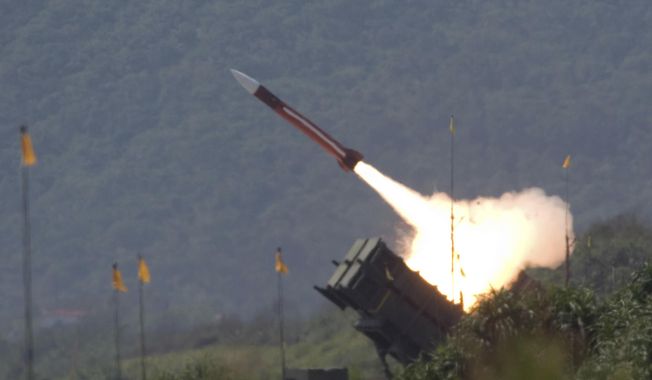
Global demand for arms in an increasingly fractious world and an alarmingly depleted U.S. stockpile of long-range weapons are driving a dramatic surge in the American defense industry’s production of rockets and missiles.
China’s military has deployed multiple space warfare systems capable of destroying and disrupting U.S. satellites vital for military operations, while the U.S. Space Force so far remains constrained from developing its own space weapons in response, according to a congressional report made public Tuesday.

Robert Lightfoot, president of Lockheed Martin Space, joins the show to talk about the weaponization of space, the future of space exploration, and the Golden Dome missile shield.

Audrey Schaffer, a space policy expert and the vice president of strategy and policy at Slingshot Aerospace, joins the show to talk about the growing amount of space traffic and whether the federal government should establish a department of space.

National Security Editor Guy Taylor sits down with Tory Bruno, president and CEO of United Launch Alliance (ULA), a top developer of some of the biggest and most advanced rockets in the world and a key player in the race for missile defense superiority. (May 6, 2025)

National Security Editor Guy Taylor sits down with Ed Zoiss, the head of Space and Airborne Systems at L3Harris Technologies, for an in-depth discussion on the company’s pursuit of disruptive and innovative solutions. This video was sponsored by L3Harris. (Mar. 24, 2025)
