


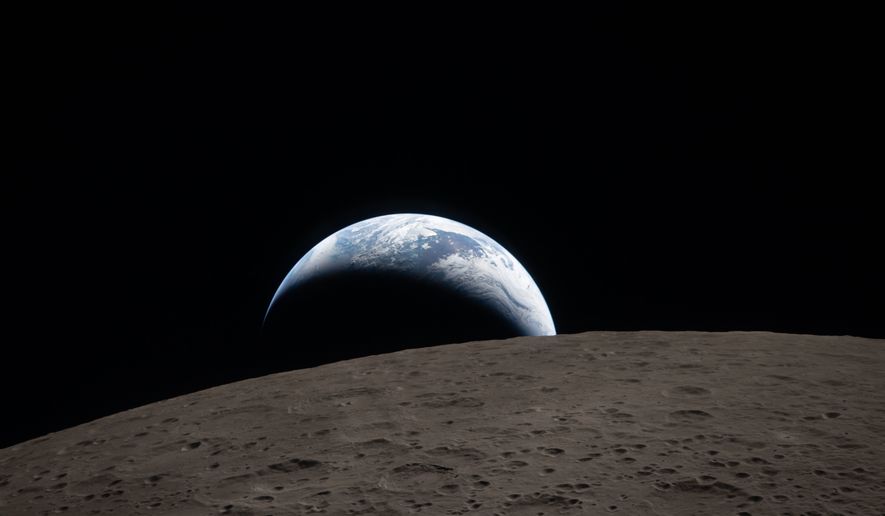

COLORADO SPRINGS, Colorado — Establishing a permanent U.S. base on the moon, including a nuclear reactor, is crucial before China or Russia does, top Trump administration officials said Tuesday at a major space conference.
The recent success of the Artemis II lunar mission, officials said, catapulted the U.S. ahead of its adversaries in a critical national security priority: space dominance. The Trump administration says it is taking a whole-of-government approach to developing technology that will support deep-space exploration and a long-term lunar presence.
Artemis’ trip around the moon was a “true test mission,” NASA Administrator Jared Isaacman told an audience at the annual Space Symposium, one of the country’s largest space-related conferences.
It “validated the critical hardware, navigation and life support systems necessary for America’s return to the lunar surface, to build the moon base, so this time we stay,” Mr. Isaacman said.
“American leadership in the high ground of space is not optional,” he said. “Now, even as we celebrate Artemis II success, NASA is already underway on what comes next.”
Michael Kratsios, director of the White House Office of Science and Technology Policy, said from the Space Symposium stage Tuesday that development of small, transportable nuclear power for use on the moon’s surface involves multiple federal agencies, including the Department of Energy, the Department of Defense and NASA. Mr. Kratsios also announced a White House policy directing those departments to develop space nuclear power systems that could launch as soon as 2028.
That technology will power exploration, fuel operations on the lunar surface and ultimately pave the way for missions to Mars, officials said.
“There is a new vision for American space superiority in the national security context,” Mr. Kratsios said during a panel discussion with Mr. Isaacman and Space Foundation CEO Heather Pringle, a retired Air Force general.
Mr. Isaacman said $10 billion in recent NASA funding passed by Congress will be used to “ensure that we never give up the moon again.” That comment reflects the belief across government and inside the defense industry that the moon is crucial to U.S. space dominance.
“I don’t know how we can achieve superiority if we come in second place,” Mr. Isaacman said.
Race to the moon
China’s manned space program is racing to reach the moon first. In October, a Chinese government official confirmed that the country’s space program was “on track” for a crewed moon landing by 2030. In the interim, China is sending multiple missions to complete its own Tiangong space station.
“Currently, each program of the research and development work of putting a person on the moon is progressing smoothly,” said Zhang Jingbo, a spokesperson for the China Manned Space Program, citing the Long March 10 rocket, moon landing suits and exploration vehicle as fruitful efforts of that work.
“Our fixed goal of China landing a person on the moon by 2030 is firm,” the spokesperson said in October.
China began work on the Tiangong, or “Heavenly Palace,” after being excluded from the International Space Station. That exclusion stemmed from U.S. concerns about the Chinese space program’s direct link to the country’s military, the People’s Liberation Army.
Analysts view the moon as a crucial piece of the broader U.S.-China space competition. They argue that dominating the lunar surface would enable the U.S. to conduct even more ambitious space operations.
“The Artemis program, the United States’ return to the moon, is step one of a long-term vision that envisions humans living beyond Earth orbit,” Clayton Swope, deputy director of the Aerospace Security Project at the Center for Strategic and International Studies, wrote in a recent analysis.
“The moon is the central element of that plan because of its location. All roads to the cosmos naturally lead through the moon,” Mr. Swope said. “The moon is the best place for NASA to test new technologies and figure out how to sustain human life far from Earth, preparing for future missions to Mars and beyond.”
NASA’s current schedule has Americans setting foot on the moon in 2028. The plans to get to that point include “near monthly” drone missions to the surface beginning early next year.
“We are also investing in the next giant leap, launching the first of its kind nuclear-powered, interplanetary spaceship,” said Mr. Isaacman, describing the SR1-Freedom program, a government interagency program to build such a spaceship.
“Freedom will launch in 2028, and for the first time, America will get underway on nuclear power in space,” Mr. Isaacman said.
“The last time we actually put a nuclear reactor in space, I want to say, was close to 60 years ago,” he said. “We’re drawing on the playbook that worked very well for the Navy with the nuclear reactor office. We’re not trying to nail the 100% solution.”
Part of a lasting U.S. presence in space will include capabilities such as 3D printing, which would allow the military and private companies to print their own replacement parts on the lunar surface, for example, rather than rely on deliveries from Earth.
“When you’re going forward deployed, you can never take everything you need. You take all the things you think you might need to maintain your fleet, but you always get it wrong and something breaks you don’t have. FedEx doesn’t exist on the moon,” said Jeff Thornburg, a former Air Force officer and CEO and co-founder of Portal Space Systems, a company developing a maneuverable, solar-thermal spacecraft.
“As long as you’ve got metal or plastic powder and a computer, you can build the parts you need, which is going be the key to, I think, human survival and thriving in some of these very extreme environments,” Mr. Thornburg told The Washington Times’ “Threat Status” weekly podcast on an episode to be released Friday.
• John T. Seward can be reached at jseward@washingtontimes.com.
• Ben Wolfgang can be reached at bwolfgang@washingtontimes.com.

Please read our comment policy before commenting.