


War_Conflict
Latest Stories

CH-47_CHINOOK
NUMBER 5. BOEING CH-47 CHINOOK is a twin-engine, tandem rotor heavy-lift helicopter. Its primary roles are troop movement, artillery placement and battlefield resupply. It has a wide loading ramp at the rear of the fuselage and three external-cargo hooks. With a top speed of 170 knots (196 mph, 315 km/h) the helicopter is faster than contemporary 1960s utility and attack helicopters. The CH-47 is among the heaviest lifting Western helicopters. Its name is from the Native American Chinook people. Soldiers from the 4th Battalion, 27th Field Artillery Regiment, 2nd Brigade Combat Team, 1st Armored Division, conduct sling-load operations during the Network Integration Evaluation 12.2 at White Sands Missile Range, N.M. on May 15, 2012. Soldiers loaded an M777 Howitzer using cables attached to the underside of a CH47 Chinook helicopter, assigned to 2-501st General Aviation Support Battalion, Combat Aviation Brigade, 1st Armored Division, which transported the weapon to another location. The NIE, as part of the Agile Process, is a series of semi-annual evaluations designed to integrate and mature the Army's tactical network. The NIE assesses potential Network capabilities in a robust operational environment to determine whether they perform as needed, conform to the Network architecture and are interoperable with existing systems. The NIE also ensures that the Network satisfies the functional requirements of the force, and it relieves the end user of the technology integration burden. U.S. Army Photo by Spc. Jeanita C. Pisachubbe, HHC, Combat Aviation Brigade, 1st Armored Division.

SIKORSKY-UH-60_BLACKHAWK
NUMBER 3. SIKORSKY UH-60 BLACK HAWK is a four-bladed, twin-engine, medium-lift utility helicopter manufactured by Sikorsky Aircraft. Sikorsky submitted the S-70 design for the United States Army's Utility Tactical Transport Aircraft System (UTTAS) competition in 1972. The Army designated the prototype as the YUH-60A and selected the Black Hawk as the winner of the program in 1976, after a fly-off competition with the Boeing Vertol YUH-61.The UH-60A entered service with the U.S. Army in 1979, to replace the Bell UH-1 Iroquois as the Army's tactical transport helicopter. This was followed by the fielding of electronic warfare and special operations variants of the Black Hawk. Improved UH-60L and UH-60M utility variants have also been developed. Modified versions have also been developed for the U.S. Navy, Air Force, and Coast Guard. Black Hawks have served in combat during conflicts in Grenada, Panama, Iraq, Somalia, the Balkans, Afghanistan, and other areas in the Middle East. Six UH-60L Black Hawks and two CH-47F Chinooks, assigned to Task Force Brawler, 4th Battalion, 3rd Aviation Regiment, Task Force Falcon, simultaneously launch a daytime mission Jan. 18 from Multinational Base Tarin Kowt.
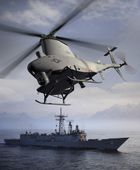
MQ-8B
NUMBER 3. MQ-8 FIRE SCOUT is an unmanned autonomous helicopter developed by Northrop Grumman for use by the United States Armed Forces. The Fire Scout is designed to provide reconnaissance, situational awareness, aerial fire support and precision targeting support for ground, air and sea forces. The initial RQ-8A version was based on the Schweizer 330, while the enhanced MQ-8B was derived from the Schweizer 333. The larger MQ-8C variant is based on the Bell 407. (Photo Illustration)

MH_6-Little_Bird
NUMBER 9. HUGHES MH-6 LITTLE BIRD, nicknamed the Killer Egg, and its attack variant AH-6, are light helicopters used for special operations in the United States Army. This little helicopter has proved its worth in Grenada, Nicaragua, Panama, Somalia and Iraq. They fulfilled a multitude of roles from observation, transport, to attack. Two US Army (USA) AH-6J Little Bird helicopters take off for a mission at a forward deployed location in southern Iraq during Operation IRAQI FREEDOM.
CH-47_CHINOOK
NUMBER 5. BOEING CH-47 CHINOOK is a twin-engine, tandem rotor heavy-lift helicopter. Its primary roles are troop movement, artillery placement and battlefield resupply. It has a wide loading ramp at the rear of the fuselage and three external-cargo hooks. With a top speed of 170 knots (196 mph, 315 km/h) the helicopter is faster than contemporary 1960s utility and attack helicopters. The CH-47 is among the heaviest lifting Western helicopters. Its name is from the Native American Chinook people. Soldiers from the 4th Battalion, 27th Field Artillery Regiment, 2nd Brigade Combat Team, 1st Armored Division, conduct sling-load operations during the Network Integration Evaluation 12.2 at White Sands Missile Range, N.M. on May 15, 2012. Soldiers loaded an M777 Howitzer using cables attached to the underside of a CH47 Chinook helicopter, assigned to 2-501st General Aviation Support Battalion, Combat Aviation Brigade, 1st Armored Division, which transported the weapon to another location. The NIE, as part of the Agile Process, is a series of semi-annual evaluations designed to integrate and mature the Army's tactical network. The NIE assesses potential Network capabilities in a robust operational environment to determine whether they perform as needed, conform to the Network architecture and are interoperable with existing systems. The NIE also ensures that the Network satisfies the functional requirements of the force, and it relieves the end user of the technology integration burden. U.S. Army Photo by Spc. Jeanita C. Pisachubbe, HHC, Combat Aviation Brigade, 1st Armored Division.
SIKORSKY-UH-60_BLACKHAWK
NUMBER 4. SIKORSKY UH-60 BLACK HAWK is a four-bladed, twin-engine, medium-lift utility helicopter manufactured by Sikorsky Aircraft. Sikorsky submitted the S-70 design for the United States Army's Utility Tactical Transport Aircraft System (UTTAS) competition in 1972. The Army designated the prototype as the YUH-60A and selected the Black Hawk as the winner of the program in 1976, after a fly-off competition with the Boeing Vertol YUH-61.The UH-60A entered service with the U.S. Army in 1979, to replace the Bell UH-1 Iroquois as the Army's tactical transport helicopter. This was followed by the fielding of electronic warfare and special operations variants of the Black Hawk. Improved UH-60L and UH-60M utility variants have also been developed. Modified versions have also been developed for the U.S. Navy, Air Force, and Coast Guard. Black Hawks have served in combat during conflicts in Grenada, Panama, Iraq, Somalia, the Balkans, Afghanistan, and other areas in the Middle East. Six UH-60L Black Hawks and two CH-47F Chinooks, assigned to Task Force Brawler, 4th Battalion, 3rd Aviation Regiment, Task Force Falcon, simultaneously launch a daytime mission Jan. 18 from Multinational Base Tarin Kowt.
MQ-8B
NUMBER 3. MQ-8 FIRE SCOUT is an unmanned autonomous helicopter developed by Northrop Grumman for use by the United States Armed Forces. The Fire Scout is designed to provide reconnaissance, situational awareness, aerial fire support and precision targeting support for ground, air and sea forces. The initial RQ-8A version was based on the Schweizer 330, while the enhanced MQ-8B was derived from the Schweizer 333. The larger MQ-8C variant is based on the Bell 407. (Photo Illustration)
MH_6-Little_Bird
NUMBER 9. HUGHES MH-6 LITTLE BIRD, nicknamed the Killer Egg, and its attack variant AH-6, are light helicopters used for special operations in the United States Army. This little helicopter has proved its worth in Grenada, Nicaragua, Panama, Somalia and Iraq. They fulfilled a multitude of roles from observation, transport, to attack. Two US Army (USA) AH-6J Little Bird helicopters take off for a mission at a forward deployed location in southern Iraq during Operation IRAQI FREEDOM.
CH-47_CHINOOK
NUMBER 5. BOEING CH-47 CHINOOK is a twin-engine, tandem rotor heavy-lift helicopter. Its primary roles are troop movement, artillery placement and battlefield resupply. It has a wide loading ramp at the rear of the fuselage and three external-cargo hooks. With a top speed of 170 knots (196 mph, 315 km/h) the helicopter is faster than contemporary 1960s utility and attack helicopters. The CH-47 is among the heaviest lifting Western helicopters. Its name is from the Native American Chinook people. Soldiers from the 4th Battalion, 27th Field Artillery Regiment, 2nd Brigade Combat Team, 1st Armored Division, conduct sling-load operations during the Network Integration Evaluation 12.2 at White Sands Missile Range, N.M. on May 15, 2012. Soldiers loaded an M777 Howitzer using cables attached to the underside of a CH47 Chinook helicopter, assigned to 2-501st General Aviation Support Battalion, Combat Aviation Brigade, 1st Armored Division, which transported the weapon to another location. The NIE, as part of the Agile Process, is a series of semi-annual evaluations designed to integrate and mature the Army's tactical network. The NIE assesses potential Network capabilities in a robust operational environment to determine whether they perform as needed, conform to the Network architecture and are interoperable with existing systems. The NIE also ensures that the Network satisfies the functional requirements of the force, and it relieves the end user of the technology integration burden. U.S. Army Photo by Spc. Jeanita C. Pisachubbe, HHC, Combat Aviation Brigade, 1st Armored Division.

Tracers Army.jpg
Soldiers assigned to 3rd Battalion, 157th Field Artillery, Colorado Army National Guard fire tracer rounds from the M240B at Fort Hood, Texas. (Image: U.S. Army)
