


War_Conflict
Latest Stories

ecuador_1026
Ecuador's President Rafael Correa, sitting in a wheelchair and wearing a gas mask, is rescued from a hospital where he was holed up by protesting police in Quito, Ecuador, Thursday Sept. 30, 2010. The army rescued Correa from a hospital where he had been trapped by rebellious police for more than 12 hours while he was being treated for tear-gas fired by hundreds of police angry over a law that they claim would cut their benefits. (AP Photo/Dolores Ochoa)

ecuador_1025
Soldiers enter the police hospital where Ecuador's President Rafael Correa is being holed up by protesting police in Quito, Ecuador, Thursday Sept. 30, 2010. The army rescued Correa from the hospital where he had been trapped by rebellious police for more than 12 hours while he was being treated for tear-gas fired by hundreds of police angry over a law that they claim would cut their benefits. (AP Photo/Dolores Ochoa)

ecuador_1024
An injured police officer, front, lies in the emergency room at the police hospital as the body of another officer lies covered with an Ecuadorian flag in Quito, Ecuador, Thursday Sept. 30, 2010. The two officers were injured and killed apparently during protests by insurgent police angered by a new law that they claim would cut their benefits and clashes with supporters of Ecuador's President Rafael Correa. (Dolores Ochoa)

ecuador_1023
Soldiers arrive to enter the police hospital where Ecuador's President Rafael Correa is being holed up by protesting police in Quito, Ecuador, Thursday Sept. 30, 2010. The army rescued Correa from the hospital where he had been trapped by rebellious police for more than 12 hours while he was being treated for tear-gas fired by hundreds of police angry over a law that they claim would cut their benefits. (AP Photo/Dolores Ochoa)

ecuador_1021
A supporter of Ecuador's President Rafael Correa waves a picture of Correa as tires burn in Quito, Ecuador, Thursday Sept. 30, 2010. Ecuador's government declared a state of siege Thursday after rebellious police, angry over a law that would cut their benefits, plunged Ecuador into chaos, roughing up Correa, shutting down airports and blocking highways in a nationwide strike. (AP Photo/Patricio Realpe)
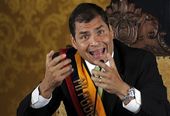
ecuador_1020
Ecuador's President Rafael Correa speaks to the press in the government palace in Quito, Ecuador, late Thursday Sept. 30, 2010. The army rescued Correa from a hospital where he had been trapped by rebellious police for more than 12 hours while he was being treated for tear-gas fired by hundreds of police angry over a law that they claim would cut their benefits. (AP Photo/Patricio Realpe)

ecuador_1019
Soldiers guard the government palace in Quito, Ecuador, Friday, Oct. 1, 2010. Ecuador is under a state of siege, with the military in charge of public order, after soldiers rescued Ecuador's President Rafael Correa from a hospital where he'd been surrounded by police who roughed him up and tear-gassed him earlier. (AP Photo/Patricio Realpe)

nigeria_999
An unidentified man wearing a face mask stands in front of the shells of burnt cars after a car bomb exploded in Abuja, Nigeria, Friday, Oct. 1, 2010. Two car bombs blew up on Friday as Nigeria celebrated its 50th independence anniversary, killing a number of people in an unprecedented attack on the capital by suspected militants from the country's oil region. (AP Photo/Sunday Alamba)

nigeria_998
Nigerian soldiers stand by the burnt shells of cars after a car bomb exploded in Abuja, Nigeria, Friday, Oct. 1, 2010. Two car bombs blew up on Friday as Nigeria celebrated its 50th independence anniversary, killing a number people in an unprecedented attack on the capital by suspected militants from the country's oil region. (AP Photo/Sunday Alamba)

nigeria_997
People walk past burnt cars and debris after a car bomb exploded in Abuja, Nigeria, Friday, Oct. 1, 2010. Two car bombs blew up on Friday as Nigeria celebrated its 50th independence anniversary, killing a number of people in an unprecedented attack on the capital by suspected militants from the country's oil region. (AP Photo/Sunday Alamba)

nigeria_996
Nigerian police stand near wreckage after a car bomb exploded in Abuja, Nigeria, Friday, Oct. 1, 2010. Two car bombs blew up on Friday as Nigeria celebrated its 50th independence anniversary, killing a number of people in an unprecedented attack on the capital by suspected militants from the country's oil region. (AP Photo/Sunday Alamba)

nigeria_995
Nigerian police inspect the shells of burnt cars after a car bomb exploded in Abuja, Nigeria, Friday, Oct. 1, 2010. Two car bombs blew up on Friday as Nigeria celebrated its 50th independence anniversary, killing a number of people in an unprecedented attack on the capital by suspected militants from the country's oil region. (AP Photo/Sunday Alamba)

nigeria_994
Nigerian officials inspect the remains of a car after a car bomb exploded in Abuja, Nigeria, Friday, Oct. 1, 2010. Two car bombs blew up on Friday as Nigeria celebrated its 50th independence anniversary, killing a number of people in an unprecedented attack on the capital by suspected militants from the country's oil region. (AP Photo/Sunday Alamba)

nigeria_993
A Nigerian police officer walks past the burnt out shell of a car, after a car bomb exploded in Abuja, Nigeria, Friday, Oct 1, 2010. Two car bombs blew up on as Nigeria celebrated its 50th independence anniversary, killing at least seven people in an unprecedented attack on the capital by suspected militants from the country's oil region. (AP Photo/Sunday Alamba)

20100930-201824-pic-379356872.jpg
A policeman demonstrates Thursday at a police base in Quito, Ecuador, next to a bonfire during a protest of police officers and soldiers against a new law that cuts their benefits. President Rafael Correa tried to speak to a group of protesting police officers but was shouted down. (Associated Press)
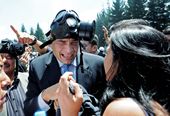
20100930-201824-pic-917113624.jpg
With a gas mask on his head, Ecuadorean President Rafael Correa moves away from tear gas used on him during the protest of police officers and soldiers in Quito. (Associated Press)
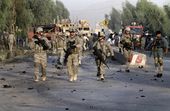
Afghanistan_Thir.jpg
U.S. Army soldiers secure a road at the scene of a suicide attack in Kandahar, Afghanistan, Saturday, Sept. 4, 2010. (AP Photo/Allauddin Khan)

india_6913
India's Rapid Action Force soldiers patrol in front of a mosque in Mumbai, India, Thursday, Sept. 30, 2010. An Indian court ruled Thursday that a disputed holy site in Ayodhya that has sparked bloody communal riots across the country in the past should be divided between the Hindu and Muslim communities, a lawyer involved in the suit said. The Muslim community said it would appeal the ruling in the 60-year-old case to the Supreme Court. Muslims revere the compound in Ayodhya as the site of the now-demolished 16th century Babri Mosque, while Hindus say it is the birthplace of the god Rama. (AP Photo/Rajanish Kakade)
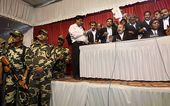
india_6912
Indian security personnel stand guard as lawyers briefing the media after Ayodhya verdict in Lucknow, India, Thursday, Sept. 30, 2010. An Indian court ruled Thursday that a disputed holy site that sparked bloody riots in the past should now be divided between the Hindu and Muslim communities. But in its compromise ruling, the court gave Hindus control over the area where the now-demolished Babri Mosque stood - and where a makeshift tent-shrine to the Hindu god Rama now rests.(AP Photo)

india_6911
A sadhu, or Hindu holy man, argues with policemen in Ayodhya, India, Thursday, Sept. 30, 2010. India braced for a spasm of violence Thursday ahead of a potentially explosive court verdict on whether Hindus or Muslims should control a disputed holy site over which deadly riots have broken out in the past. The 16th-century Babri Mosque in the town of Ayodhya was razed by Hindu hard-liners in 1992, setting off violence that killed 2,000 nationwide. (AP Photo/Rajesh Kumar Singh)
