



Maryland officials are disputing a new report identifying the Potomac River as the nation’s most endangered waterway, while leaders in the District admitted they were unaware the Potomac had earned such a lowly title.
The conservation nonprofit American Rivers reported this week that a regional boom in data centers and their high demand for water helped push the Potomac to the top spot.
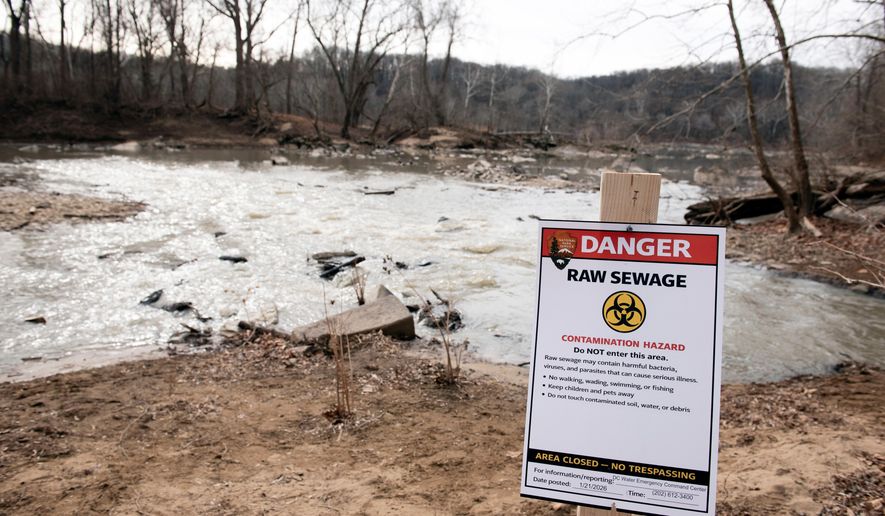
But the Maryland Department of the Environment says the Potomac is “healthier today than it was a generation ago,” barely three months after a crucial sewer line split open and flooded the river with close to 250 million gallons of untreated human waste.
Maryland leaders said the American Rivers report ignored the state’s ability to rebound from the Potomac Interceptor rupture in January, which is thought to have caused the largest sewage spill in U.S. history.
“While the Potomac Interceptor collapse was serious and required immediate response, it was an acute, localized incident,” the state agency said in a statement to The Washington Times. “Water quality monitoring shows conditions improving as repairs and cleanup continue.”
A slurry filled with disease-carrying bacteria breached the water near the rupture site in Montgomery County. Toxic levels of E. coli, an antibiotic-resistant strain of MRSA and Staphylococcus aureus, the bacteria that cause staph infections, were detected in the river.
Local authorities warned residents to avoid touching the water for weeks after the pipe burst. Recreational activity resumed last month after extensive cleanups and temporary repairs plugged the fractured section of the sewer line.
With boating and kayaking allowed once again, and a permanent replacement for the pipe expected by the end of this year, it appears leaders in the District had turned their attention away from the river.
D.C. Mayor Muriel Bowser said Wednesday that she wasn’t familiar with the new report about the Potomac’s endangered status.
The Times contacted the D.C. Department of Energy and Environment and D.C. Council member Charles Allen, the Ward 6 Democrat who provides oversight of the agency, but neither could be reached for comment.
The seemingly non-urgent response to the sewage spill in February generated friction between the White House and local politicians, who are mostly Democrats.
President Trump blasted the region’s leadership for dragging their feet in decontaminating the river, while Maryland Gov. Wes Moore pinned the blame on the Trump administration for not leading the cleanup sooner.
The issue subsided after Mr. Trump declared a federal emergency and the Environmental Protection Agency began coordinating the cleanup.
The American Rivers report said engineering efforts should focus on updating sewage pipelines in the national capital area, most of which were installed in the mid-20th century.
“Many of the region’s wastewater pipes, particularly in and around Washington, D.C., are approaching or have passed their 50-year service life. The Potomac Interceptor sewage pipe is over 60 years old,” said the report, which was cowritten by Potomac Riverkeeper Network and Nature Forward. “Failure to address aging wastewater infrastructure on the Potomac puts the river at risk of ongoing contamination and threatens public health, local businesses, and wildlife.”
Compounding the immediate issues presented by the Potomac’s cleanup are the side effects of the D.C. area becoming a hub for data centers.
More than 300 data centers are already situated within the river’s watershed in Virginia and Maryland, American Rivers said, with plans for roughly 1,000 total facilities to be built in the region over the coming years.
Data centers, which house the information technology infrastructure that powers the internet and artificial intelligence programs, require a large volume of water to cool the machinery. American Rivers said proposed sites are located upstream from the sewer line collapse and put greater stress on the D.C. area’s supply of drinking water.
The organization noted the presence of contaminants from the data centers’ hardware that could enter the Potomac, urging local governments to take greater interest in the river’s welfare while making decisions.
“This lack of oversight creates dangerous gaps in understanding how these facilities affect downstream communities, ecosystems, and drinking water treatment costs,” the report said.
That message resonated with Virginia state Sen. Russet Perry, a Democrat in Loudoun County, which has scores of data centers.
“The designation of the Potomac River as the most endangered river in America should be a wake-up call,” Ms. Perry said in a statement to The Times. “This is a critical source of drinking water for millions and it’s under critical threat, in large part due to the rapid expansion of water-intensive data centers.”
Ms. Perry said the commonwealth needs enforceable guardrails to reduce the strain on water resources, and to make sure data center projects are completed at a responsible pace so there is no spike in energy prices either.
American Rivers said lawmakers on Capitol Hill and in the states surrounding the Potomac can provide a big boost to the river’s health through funding and environmental reviews.
The organization said Congress should reauthorize the State Revolving Fund bill, which expires at the end of the federal fiscal year on Sept. 30. The bill sends federal dollars to states to use toward updating their water infrastructure, in hopes of preventing a calamity such as the Potomac Interceptor rupture.
Congress should also reauthorize the Sewer Overflow and Stormwater Grant program, which helps fill in the funding gaps not covered by the Revolving Fund bill, American Rivers said.
As for state leaders in Virginia and Maryland, the organization recommended making sure the rate of newly constructed data centers is not overburdening the Potomac.
“By prioritizing transparency, coordinated planning, and public engagement, decision-makers can ensure that economic development does not come at the expense of clean drinking water and the health of the region’s rivers and communities,” the report said.
• Matt Delaney can be reached at mdelaney@washingtontimes.com.

Please read our comment policy before commenting.