



OPINION:
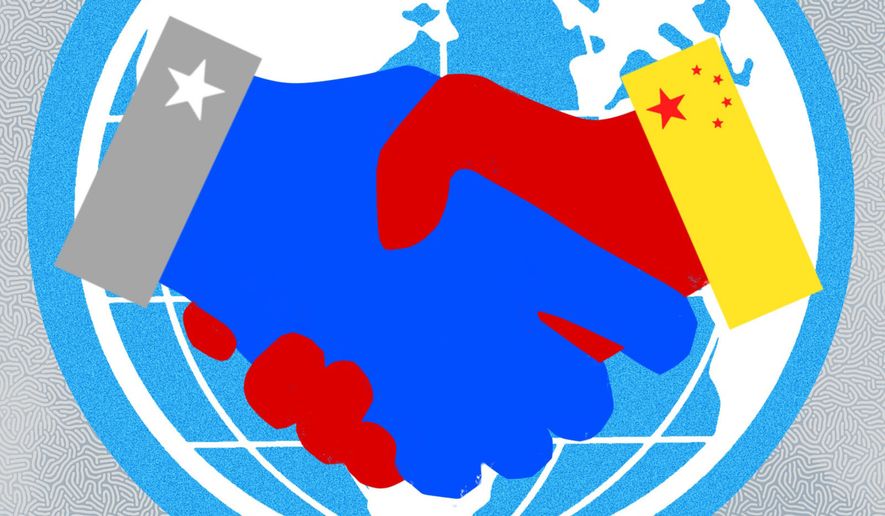
Let’s hope the May summit between Presidents Trump and Xi Jinping is uplifting, giving the world hope that these great powers can cooperate for the common good.
The global community is distraught and fatigued with the wars in Ukraine, the Gaza Strip and Iran and the sense that war has now become accepted behavior.
The meeting of the U.S. and China is an opportunity to change the narrative and instill hope that the two countries can work through the many issues that divide us and focus instead on the issues that can lead to the betterment of humankind.
The summit will be an opportunity to discuss the many economic and trade issues that continue to irritate the bilateral relationship. These include the U.S. trade imbalance with China; the industrial subsidies and cheap financing China provides to state-owned enterprises; U.S.-restricted exports to China of advanced semiconductors and chipmaking equipment and technologies related to artificial intelligence; intellectual property theft and industrial espionage by China; U.S. tariffs and de-risking efforts with rare earths, batteries and pharmaceuticals; U.S. investment restrictions and China’s efforts to keep the yuan undervalued to boost exports; and U.S. human-rights-related trade restrictions and sanctions on Chinese companies.
China has strong views on each of these issues and accuses the U.S. of economic containment. Each should be addressed routinely, in diplomatic and trade negotiations. They should be mentioned and discussed at the summit but left to the diplomats and trade negotiators to resolve during routine annual meetings in Beijing and Washington.
What the world needs now to hear is how the U.S. and China can cooperate to end wars and make the world more habitable.
So conflict resolutions should be high on the list of issues to discuss. We must ensure that we do not have a repeat of the Belgrade embassy bombing of 1999, when the U.S. accidentally bombed the Chinese Embassy, or the EP-3 incident of 2001, when a U.S. reconnaissance aircraft collided with a Chinese jet in international airspace, killing the Chinese pilot.
In each case, the president of China refused to accept the U.S. president’s apology calls.
It is important that our leaders communicate in a timely and secure manner to make certain that incidents of this type do not escalate. The hotline between our military leaders is equally important for avoiding inadvertent escalation and potential conflict.
Taiwan is a matter requiring immediate presidential attention, as it could escalate quickly and potentially lead to conflict. The Taiwan Relations Act of 1979 clearly states that the issue of Taiwan should be resolved peacefully between the People’s Republic of China and Taiwan, while the U.S. provides Taiwan with defensive arms.
Mr. Xi has said he wants a peaceful resolution of issues with Taiwan, but also that China is prepared to use military force if necessary.
The April 10 meeting between Taiwan’s opposition leader, Cheng Li-wun, chairman of Taiwan’s Kuomintang, and Mr. Xi was the first such meeting in a decade. Mr. Xi has increased military pressure around Taiwan and sees reunification with it as an important part of his legacy.
The South China Sea is another potential flash point between China and the U.S. China’s island-building activity has been found illegal under the United Nations Convention on the Law of the Sea. Yet from 2013 to 2015, China engaged in extensive land reclamation in the Spratly Islands, building artificial islands in areas claimed by the Philippines and Vietnam.
Though an arbitral tribunal ruled in 2016 that China was in violation of the convention, it persists, insisting, based on dated maps dating back to the Qing Dynasty, that China has sovereignty over the South China Sea islands.
The U.S. position is that China’s claim to sovereignty of the South China Sea islands is unlawful and that freedom of the seas is consistent with international law.
The U.S. and China must discuss Taiwan and the South China Sea, but both are long-established points of contention that require close and continued diplomatic and military dialogue between the countries. A two-day leadership session in Beijing likely will not resolve either issue.
Here is what the world wants to see from this summit: how the U.S. and China are prepared to cooperate to resolve conflicts and cooperate on global issues requiring immediate attention. These include pandemics, climate change, nuclear proliferation, biosecurity, counterterrorism and counternarcotics.
The summit next month is an opportunity to show the world that two great powers can coexist peacefully and cooperate to make the world a better place for all.
• The author is a former associate director of national intelligence. All statements of fact, opinion or analysis expressed are those of the author and do not reflect the official positions or views of the U.S. government. Nothing in the contents should be construed as asserting or implying U.S. government authentication of information or endorsement of the author’s views.

Please read our comment policy before commenting.