



OPINION:
As the Trump administration engages in negotiations with Iran that seem to vacillate daily between prospects of a begrudging agreement and the risk of renewed military confrontation, preserving the relatively newfound stability in Iran’s next-door neighbor Iraq becomes a strategic priority for the United States that should not be overlooked.
Iraq has enjoyed a solid relationship with the United States in recent years. Government relations have been reasonably good and with the considerable stability that has taken hold in the last three or four years, large American-based companies are seeing the advantage of doing business with Baghdad. Simultaneously, Iraq has maintained a working relationship with Iran. It’s practical and reasonable for them to do so.
Iraq held elections last November. The sitting prime minister’s supporters won more seats than any other party. There weren’t enough seats, however, to immediately return him to office. Instead, Iraq’s convoluted process for choosing a prime minister has dragged on for months. They are now in the home stretch. A new president, largely ceremonial, was chosen from the Kurds, as is modern Iraq’s custom. As a result, the countdown toward selecting a new prime minister is now underway. It’s expected that a decision will be finalized in less than two weeks.
Having an Iraqi prime minister with a clear understanding of America will be more important than ever after things are settled with Iran. The right choice is important for further developing a solid relationship with the United States and how that relationship will help shape Iraq’s trajectory in a turbulent Middle East regional environment.
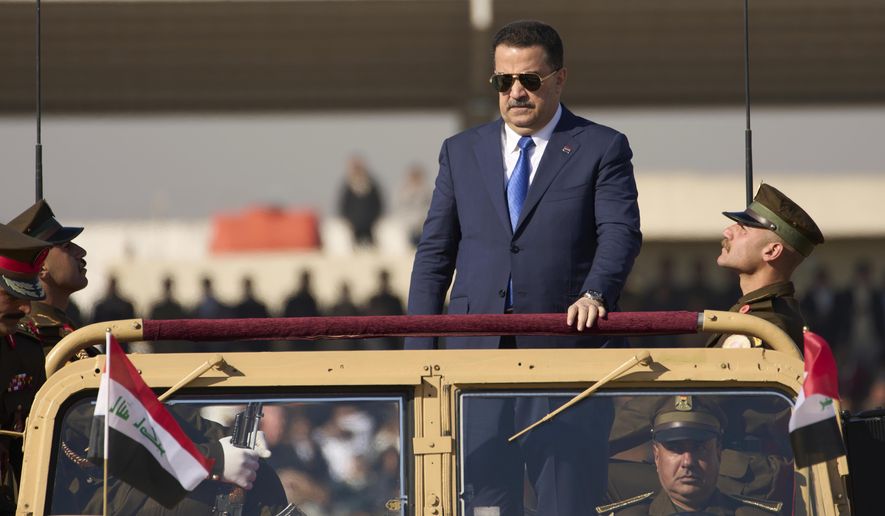
In this context, the sitting prime minister, Mohammed Shia al-Sudani, emerges as a reliable partner. He has neither drifted into excessive accommodation with Iran, nor pushed Iraq into the mix of escalation. Instead, he has pursued a carefully balanced approach that protects Iraq’s interests while preventing it from being drawn into open conflict, adopting a clear policy of noninterference in the affairs of other states — a policy also evident in his balanced handling of developments in Syria.
In 2025, during the 12-day war between Israel and Iran, Mr. al-Sudani’s government played a decisive role in preventing Iraq from being pulled into confrontation. This year, his administration has contributed to protecting U.S. interests within Iraq by halting dozens of operations targeting American assets. This was achieved despite his government operating in a caretaker capacity with limited powers since the November election, and amid a complex security environment in which one militia, the Popular Mobilization Forces (PMF) found themselves in explosive disagreements with the United States.
America’s troubled relationship with the PMF demonstrates that the issue of Iraqi armed factions and weapons outside state authority remains a serious challenge. Many believe it is not one that can be resolved through force, but rather through complex political and diplomatic pathways, an approach that Mr. al-Sudani continues to pursue.
The prime minister has demonstrated his ability to keep Iraq out of war and prevent internal escalation. He also showed political flexibility in securing the release of a kidnapped American journalist within days, an action that reflects his capacity to manage crises with pragmatism and control.
Some simplistic narratives portray Iraq as merely a regional pawn caught between Washington and Tehran. Iraq today is not an empty vessel to be shaped according to external will. It is a state with a complex internal fabric, where political, social, and ideological variants are woven together in a truly unique way. This reality makes every strategic decision subject to careful and nuanced calculation.
International relations are managed through shared interests and the management of differences. Former Prime Minister Nouri al-Maliki (2006-2014) has been mentioned as a potential choice for prime minister, but Iraq would be ill-advised to return him to its top office, considering U.S. President Trump said in January that if Mr. al-Maliki were selected, “The United States of America will no longer help Iraq.” Mr. al-Maliki fell out with Washington during his previous term due to his growing ties with Iran, and Mr. Trump clearly has no tolerance for that.
Contrast that with the current Iraqi administration. Mr. al-Sudani does not appear isolated or lacking trust. Rather, he is a leader managing a complex balance between internal pressures and external expectations. He operates within a narrow margin, but with caution and pragmatism, preserving a fragile stability in an environment that, if handled differently, could ignite at any moment.
The United States should view Mr. al-Sudani’s experience as three things: a model for managing balance, a safeguard against Iraq drifting into a single axis, and an opportunity to maintain a stable partnership in a turbulent environment.
As the world watches the struggle between the United States and Iran, it might be easy for some to blink and miss Iraq’s choice for prime minister, but ultimately, whenever the Washington-Tehran conflict winds down, the person in charge in Baghdad may be a key element to assuring long-term peace and stability.

Please read our comment policy before commenting.