



OPINION:
After the 12-day war in June, President Trump probably thought something along these lines: “We gave those guys a good thrashing. They won’t want to repeat the experience anytime soon.”
If Iran’s rulers were what we call “rational actors,” then that assessment would have been accurate. Yet they’re not. They are not peace-loving. They don’t prefer compromise over conflict. They are not concerned that the people they rule face an “affordability crisis.” They don’t worry about elections.
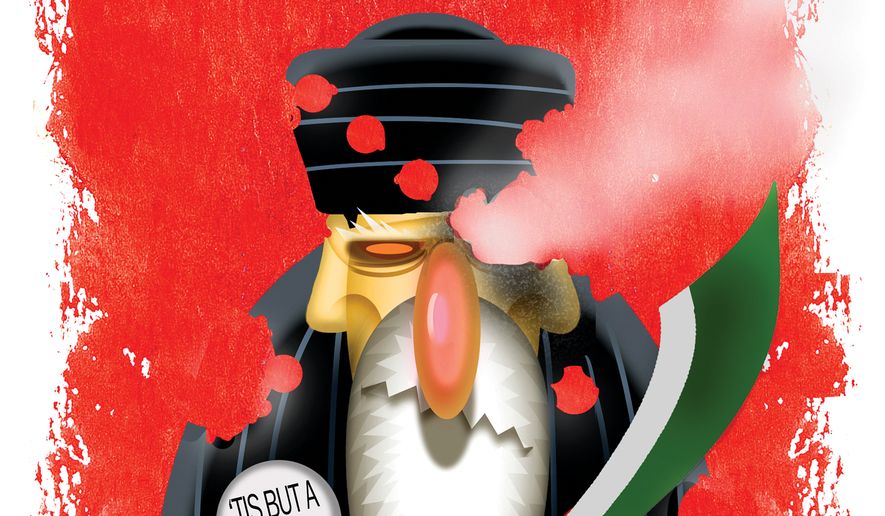
Iran’s rulers believe — literally, not metaphorically — that they are on a mission from God.
Ruhollah Khomeini, leader of the 1979 Islamic Revolution, proclaimed himself the Rahbar‑e Mo’azzam, usually and inadequately translated as “supreme leader.
The title implies that he is the divinely ordained guardian of Iran and steward of Islam.
After his death in 1989, he was succeeded by Ali Khamenei, who took the same title and assumed the same authority.
On Feb. 28, Ayatollah Khamenei was killed in an airstrike. On March 8, the Assembly of Experts, an 88-member clerical body, selected his son Mojtaba Khamenei as the new supreme leader, despite his reportedly being severely wounded during the same attack.
After the 12-day war, the Islamic Revolutionary Guard Corps, assisted by China, built up its missile and drone stockpiles and stored them in subterranean “missile cities.” They also dug under Pickaxe Mountain with the aim of installing nuclear facilities so deep underground that not even Massive Ordnance Penetrators dropped from B-2s could reach them.
Did U.S. intelligence analysts underestimate the magnitude of the regime’s rearmament? If so, it would be an argument for, not against, Mr. Trump’s decision to initiate what is now being called the 40-day war.
For nearly half a century, every American president pledged that Iran’s theocrats would be prevented from acquiring the nuclear capabilities that could lead to the fulfillment of their grand ambition: “Death to America!”
Yet no serious actions were ever taken. President Obama’s Joint Comprehensive Plan of Action allowed enrichment, left Tehran’s nuclear infrastructure intact, imposed time-limited restrictions and legitimized a pathway to nuclear weapons.
If Mr. Trump had not struck when he did, then Tehran might have acquired nukes while continuing to build up an enormous arsenal of drones and missiles. The war that past presidents concluded was unnecessary would then become a war that future presidents could not win, or could win only at an exorbitant cost in blood and treasure.
More likely, to keep the peace, Americans would make concessions to Iran’s rulers as well as to its allies in Beijing, Moscow and Pyongyang.
At that point, the sunset of American greatness would be visible on the horizon.
Last week, Mr. Trump agreed to a ceasefire and negotiations in exchange for the regime’s promise to open the Strait of Hormuz, an international waterway, subject to international law and freedom of navigation.
Talks in Islamabad over the weekend ended without an agreement. Tehran’s envoys offered no serious concessions, not on nuclear weapons and missile programs or support for terrorist proxies. They refused to recognize that the Strait of Hormuz is not an Iranian river.
They presented their own list of demands, including a “right” to enrich uranium, the lifting of sanctions and even reparations. They were betting Mr. Trump would be eager for an “exit ramp.” They lost their bet.
Back in Tehran, will Iran’s rulers now gaze up at the skies they no longer can defend and decide that, at this point, a bad deal is better than no deal? Probably not, but if they do, we shouldn’t call whatever they propose “peace.”
Their hatred of America, Israel and the West will not have abated. They will continue to believe it is their duty to wage jihad. Their intentions may even harden, though what could be harder than “Death to America!” is not apparent to me.
The U.S. military can clear their mines, but not their minds.
To those who shout: “Then what the hell was the point of this war?” I will state the obvious: This conflict was about degrading an American enemy’s capabilities, not its intentions.
Gen. Dan Caine, chairman of the Joint Chiefs of Staff, put numbers to the damage: 80% of Iran’s nuclear industrial base was struck, along with 80% of its missile facilities. Every Shahed drone factory is gone.
The regime’s economy, largely controlled by the IRGC, has been crippled, and Mr. Trump plans to increase the pain. The U.S. Navy has begun clearing mines from the Strait of Hormuz and preventing Iranian vessels from entering and exiting. More than 90% of Iran’s seaborne trade has been transiting that passage.
No one yet knows how badly the regime’s domestic repression apparatus has been weakened. Sooner or later, inshallah, the Iranian people may succeed in bringing down their oppressors.
If not, then it’s likely to take years for the theocrats to get back to where they were prior to the 12- and 40-day wars. Russia and China will assist them. There is evidence they already are.
The U.S., Israel and other nations, unwilling to bow to Islamist terrorists, not yet a large coalition, can continue to blunt the regime’s claws as necessary.
There are those on the left and the right still urging Mr. Trump to go wobbly. If they fail to persuade him, then history will record that he did more than any past American leader to diminish a nuclear/terrorist/jihadi national security threat that had been metastasizing for nearly half a century.
That will anger many people, including a few we generally think of as “rational actors.”
• Clifford D. May is the founder and president of the Foundation for Defense of Democracies, a columnist for The Washington Times and host of the “Foreign Podicy” podcast.

Please read our comment policy before commenting.