


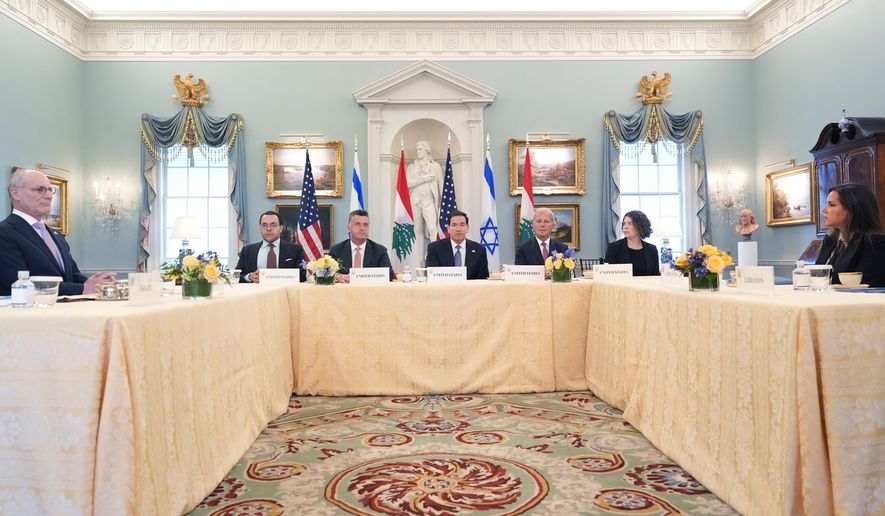

Israeli and Lebanese representatives met in Washington on Tuesday for the first set of in-person talks in decades to find a diplomatic solution to Israel’s war with the Iran-backed Hezbollah terrorists in Lebanon.
Israel’s Ambassador to the U.S. Yechiel Leiter and Lebanon’s Ambassador to the U.S. Nada Hamadeh Moawad met at the State Department building in Washington just after 11 a.m.
They posed for pictures with Secretary of State Marco Rubio, State Department Counselor Michael Needham, U.N. Ambassador Mike Waltz and U.S. Ambassador to Lebanon Michael Issa.
Israel and Lebanon do not maintain diplomatic ties, and the talks are the first in-person negotiations between the two nations since the Oslo Accords process in the 1990s.
Mr. Rubio adjusted expectations regarding a swift ceasefire, emphasizing that the focus of the talks is on “bringing a permanent end” to Hezbollah’s power in Lebanon.
“We have to remember the Lebanese people are victims of Hezbollah. The Lebanese people are victims of Iranian aggression. And this needs to stop,” Mr. Rubio said ahead of the meeting. “This will be a process, OK? All of the complexities of this matter are not going to be resolved in the next six hours. But we can begin to move forward to create the framework where something can happen, something very positive.”
The two sides are deeply divided on goals. Lebanon wants Israel to agree to a ceasefire, during which diplomats could begin negotiations to reach a comprehensive peace agreement. Lebanese President Joseph Aoun said Monday in a statement that his nation is looking for a “sustainable solution” to the conflict that isn’t “one-sided.”
Israel launched fresh rounds of airstrikes on two cities in southern Lebanon just hours before the talks were slated to begin, according to Lebanon’s state-affiliated National News Agency.
Hezbollah launched several rocket attacks against targets in northern Israel on Tuesday as well.
Israeli Prime Minister Benjamin Netanyahu has rejected calls for a ceasefire and has insisted that Israel will continue its efforts to destroy Hezbollah forces in Lebanon.
The Lebanese government does not control Hezbollah, an Iranian-backed political organization with a paramilitary wing, and cannot guarantee that the group would adhere to any terms agreed to at Tuesday’s meeting.
Hezbollah leader Naim Qassem on Monday called on Lebanon to cancel the scheduled talks, arguing that agreeing to meet with Israel would be the same as “capitulation and surrender.” Additionally, senior Hezbollah political council member Wafiq Safa told The Associated Press that the organization would not abide by any agreements signed as a result of Tuesday’s talks.
The war between Hezbollah and Israel has raged for nearly a month after the militant group launched missiles and drone attacks on Israeli targets in support of Iran. The Israeli military says Hezbollah has fired more than 6,500 missiles and drones in the past month.
In response, Israel’s military campaign has devastated Lebanon. At least 2,000 people have been killed and more than 6,700 injured as of this week, according to the Lebanese Ministry of Public Health. Israeli strikes have displaced nearly 1 million people, according to the U.N. Children’s Fund.
Israel’s assault on Lebanon also threatens a fragile U.S.-Iran ceasefire initiated last week.
Iran insists that the agreement, brokered by Pakistan, includes Lebanon and has repeatedly accused Israel of violating the ceasefire. Israel says the agreement does not include Lebanon and has upped its strikes on the country over the past week.
• Vaughn Cockayne can be reached at vcockayne@washingtontimes.com.

Please read our comment policy before commenting.