


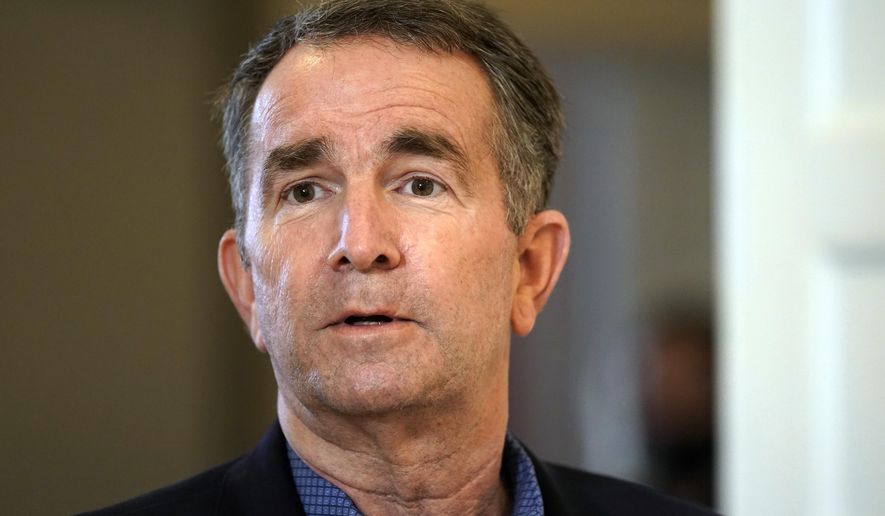

Gov. Ralph Northam on Wednesday signed legislation banning the death penalty, making Virginia the first state in the South and the 23rd nationally to abolish capital punishment.
“There is no place today for the death penalty in this commonwealth, in the South or in this nation,” Mr. Northam said at a press conference.
The Democratic governor toured the death chamber at the Greensville Correctional Center in Jarratt before signing the bill into law. He viewed the electric chair, the gurney where inmates had been given lethal injections and the holding cells where they awaited their execution.
“I know that experience will stay with me for the rest of my life, and it reinforced [to] me that signing this new law is the right thing to do,” Mr. Northam said.
The correctional facility houses the state’s only two inmates on death row, Thomas Porter and Anthony Juniper, who were scheduled to be executed within the next three years for capital murder convictions.
Under the new law, their sentences have been commuted to life in prison without the possibility of parole — which is now the state’s maximum penalty. The sentences can be amended by a judge.
The commonwealth has the nation’s highest rate of executions, with nearly 1,400 executions during its Colonial days and 113 executions since capital punishment was reestablished by the Supreme Court in 1976.
Virginia most recently executed two men convicted of capital murder in 2017. Mr. Northam won his election that year after the executions and said repealing the death penalty would be among his priorities.
The Democrat-controlled General Assembly passed the legislation last month.
Before signing the bill, Mr. Northam said “[w]e can’t give out the ultimate punishment without being 100% sure that we’re right, and we can’t sentence people to that ultimate punishment knowing that the system doesn’t work the same for everyone.”
He noted that more than 170 people on death row nationwide have been exonerated and released in light of new evidence since 1973. He also said 296 of the 377 people put to death by the state in the 20th century were Black.
The bill’s sponsor in the House, Delegate Mike Mullin, Newport News Democrat, said Wednesday that repealing the death penalty has been “long overdue.”
“The evidence is clear. Use of the death penalty is riddled with wrongful convictions, inadequate representation, and racial bias,” Mr. Mullin said in a statement.
The ACLU of Virginia echoed his sentiments, saying the death penalty “has always been about race” and called its abolishment “a victory in the pursuit of racial justice.”
But opponents of abolishing capital punishment say that certain crimes are so abhorrent that execution is the only way for victims to obtain justice.
M. Wayne Huggins, executive director of the Virginia State Police Association, said this year that ending the death penalty would be an insult to the families of murdered officers. He also expressed concern over the possibility of certain criminals being released.
Only three Republicans in the General Assembly voted in favor of ending executions, which the advocacy group Conservatives Concerned About the Death Penalty said is “a strong statement about the failures of the death penalty.”
“They felt that the death penalty did not align with their conservative principles of valuing limited government, fiscal conservatism, and life,” senior manager Hannah Cox said Wednesday in a statement.
Robert Dunham, executive director of the Death Penalty Information Center, said Wednesday that the commonwealth’s death penalty was “deeply rooted in slavery, lynchings and Jim Crow segregation.”
“The symbolic value of dismantling this tool that has been used historically as a mechanism for racial oppression by a legislature sitting in the former capital of the Confederacy can’t be overstated,” Mr. Dunham said.
• Emily Zantow can be reached at ezantow@washingtontimes.com.

Please read our comment policy before commenting.