


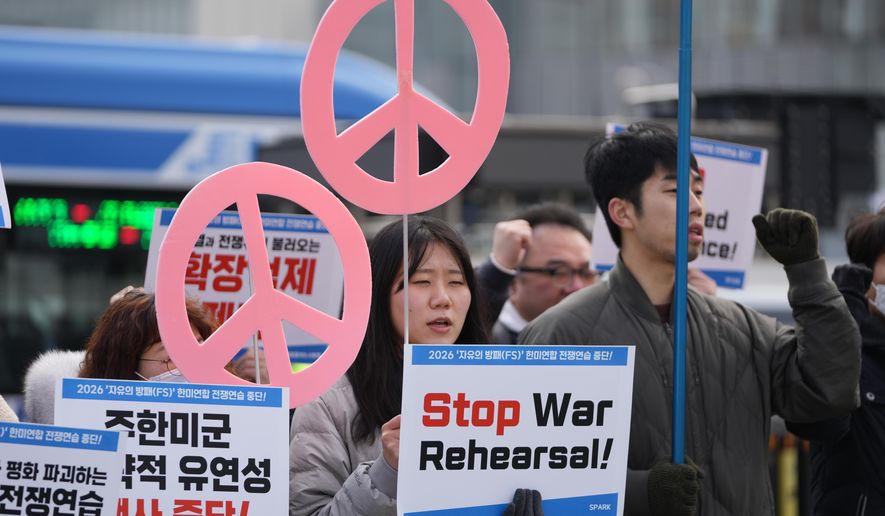

SEOUL, South Korea — The annual spring war games involving South Korean and American forces began Monday against the backdrop of a very real conflict in the Middle East.
The collateral damage spreading outward from the joint U.S.-Israeli war on Iran is not limited to the Gulf states defending themselves against Iranian missile barrages and drone fusillades.
East Asian manufacturing powerhouses, dependent on the Persian Gulf’s energy producers, are on edge as oil prices soar.
The strategic Strait of Hormuz, through which tankers must pass to reach international shipping lanes, is de facto closed to international shipping. Insurers, ship owners and crews are unprepared to run the maritime chokepoint gauntlet as the battle rages.
The strait, just 21 miles wide at its narrowest point, is lined by Iran on its eastern littoral.
South Korea’s annual “Freedom Shield” drills — which encompass command-post computer simulations and “Warrior Shield” field exercises with live troops — run through March 19.
In addition to U.S. and South Korean troops, small units from nations that fought with the two allies during the 1950-53 Korean War will join.
In a press release sent to foreign reporters, a U.S. official from Combined Forces Command called the drills “a shared commitment to deterrence.”
Though monitored by military observers from Sweden and Switzerland, North Korea customarily counters the exercise with rhetorical broadsides accusing the allies of “war preparations,” and sometimes, with missile tests.
Pyongyang has some ground for its suspicions. Russia used winter military exercises as cover to mass forces along the Ukrainian frontier ahead of its 2022 invasion, and retired U.S. officers admit drills do include counter-attack scenarios.
Global media frequently report that the war games “raise tensions” on the flashpoint peninsula. However, those tensions are largely limited to official offices, military bunkers and newsrooms; few citizens take much notice.
Seoul and Washington classify the drills as defensive, and the exercises have not led to any shooting incidents since North Korean leader Kim Jong-un took power in 2011.
In Seoul, more angst is being generated by the real conflict underway in the Middle East.
Reports in local media speculate that key U.S. assets, notably THAAD anti-ballistic missile launchers and Patriot air-defense systems, may be shifted from Korea to the Gulf, where Iranian missiles and drones remain unsuppressed.
Yonhap News Agency, citing open-source flight data, found unusual numbers of U.S. cargo aircraft landing and taking off from Osan Air Base over the last week. There are also reports that U.S. Patriot batteries in the country were centralized at the giant base, south of Seoul.
Unconfirmed reports from the Middle East, some citing unconfirmed images, state that Iran has damaged or destroyed as many as three U.S. air-defense radars. At least one of them appears to be an AN/TPY-2 X-band mobile radar. A hugely sophisticated and expensive piece of equipment, it is usually used with THAAD ballistic missile interceptors.
According to the Military Watch website, only 15 of the radar systems exist.
That has led to conservations in Seoul over whether the THAAD radar permanently based in South Korea may be redeployed to the Gulf, possibly with interceptors. U.S. Forces Korea has declined comment.
East Asia’s heavy manufacturing economies rely on global trade and are sensitive to political risk.
They have expanded their energy mixes in recent years to ameliorate environmental concerns, and diversified away from Middle Eastern oil to eliminate over-dependency on the volatile region.
Even so, dependencies on crude passing through the strait remain significant.
Fortune India, and other outlets, in infographics citing Bloomberg data, last week analyzed China’s dependency on Gulf energy at 38% of total, India at 15%, South Korea at 12% and Japan 11%.
According to Fitch Ratings, of the Asia economies, it is South Korea that has the highest dependence on oil in its energy mix, at just under 40%.
As oil prices soar, the nation is vulnerable to rocketing inflation.
President Lee Jae-myung announced Monday at an inter-governmental crisis response meeting that a price cap on petroleum products will take effect this week.
He called the conflict, “a significant burden on our economy, which is highly dependent on global trade and energy imports from the Middle East.”
The government’s announcement looks designed to preclude a run on petroleum, though Seoul retains oil reserves sufficient to cover 208 days of consumption, according to Reuters.
Capital markets are trembling.
The Korean currency, the won, on Wednesday dipped below the psychologically important 1,500 won level against the U.S. dollar — the won’s weakest level since 2009, in the wake of the global financial crisis. It has strengthened — very slightly — to 1,487 to the dollar.
That devaluation will hit ordinary Koreans, but may be quietly welcomed by the giant conglomerates that form Korea’s economic backbone. They will be positioned to expand sales by selling exports — chips, cars, smartphones, ships, petrochemicals, steel — at cheaper prices internationally.
Even so, investor sentiment is plunging. The main stock market, the KOSPI, was down a whopping 6% on Monday.
• Andrew Salmon can be reached at asalmon@washingtontimes.com.

Please read our comment policy before commenting.