



U.S. military forces launched joint operations with Ecuador this week to dismantle international narcotics trafficking networks that have been designated as terrorist organizations.
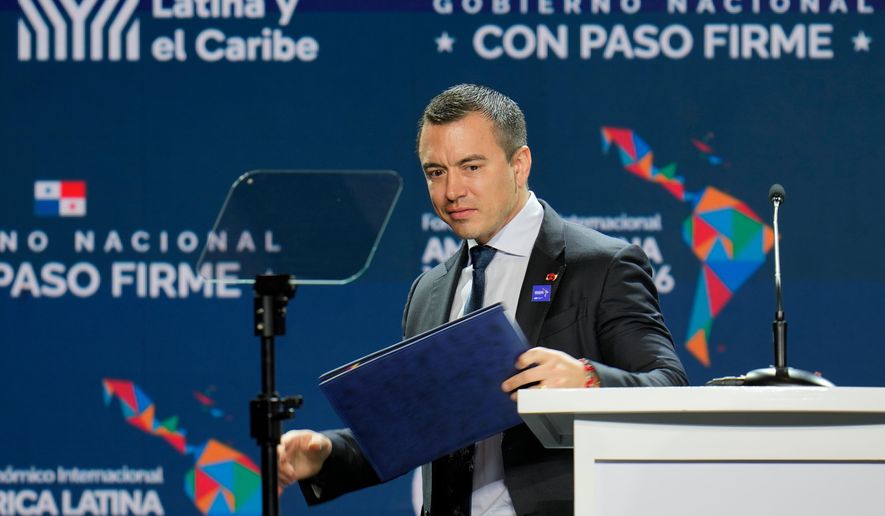
The mission began shortly after Marine Corps Gen. Francis L. Donovan, commander of U.S. Southern Command, met with Ecuador’s President Daniel Noboa on Monday in Quito, the South American nation’s capital.
U.S. officials said the joint mission was aimed at confronting narcoterrorists who have long inflicted terror and violence on communities throughout Latin America.
“Ecuador is one of the United States’ strongest partners in disrupting and dismantling Designated Terrorist Organizations in the region,” Gen. Donovan said following his meeting with Mr. Noboa. “The Ecuadorian people have witnessed firsthand the terror, violence and corruption that these narco-terrorists inflict on communities across the region.”
Gen. Donovan said the most effective way to defeat narcotics trafficking is through collaboration among regional allies and partners.
“Ecuadorian forces have consistently exemplified this commitment through their actions against narco-terrorists on their streets and in their communities,” he said.
The Trump administration’s has said its highest priority is the defense of the homeland, which means a greater emphasis on narcotics trafficking coming through Latin America. The Trump Corollary to the Monroe Doctrine, or Donroe Doctrine, argues that the Western Hemisphere is a U.S. sphere of influence where potential foreign adversaries, like China, are no longer welcome.
The defining moment of the Trump Corollary was the Jan. 3 military raid on Caracas, Venezuela, in which U.S. forces captured former leader Nicolas Maduro. He is being held in the Metropolitan Detention Center in Brooklyn, New York, where he faces federal charges for drug trafficking and conspiracy.
The Trump administration’s willingness to use American military capabilities in South America and around the globe has drawn sharp criticism at home and abroad, but previous administrations have put boots on the ground when necessary.
In 2011, then-President Barack Obama signed off on Operation Odyssey Dawn, which used cruise missile strikes and an air campaign that eventually led to the fall of Muammar Gaddafi’s regime in Libya. Mr. Obama launched Operation Inherent Resolve in 2014 following the rapid rise of ISIS. It involved more than 20,000 airstrikes across both Iraq and Syria and marked a return of U.S. combat power to Iraq after the 2011 withdrawal.
According to a 2023 Brown University study, the Biden administration conducted counterterrorism operations in at least 78 countries, including ground combat in nine.
But Mr. Trump’s use of American troops directly in Ecuador is highly unusual and a radical departure for a South American country that for decades prided itself on strictly prohibiting foreign military forces operating inside its borders. It marks a new phase in regional security, a shift from advisory support to active, joint kinetic operations.
In 2009, then-President Rafael expelled the U.S. military from Manta Air Base and added a clause to the Ecuadorian Constitution that strictly prohibits foreign military bases or facilities in the country. As recently as late 2024, Ecuadorian voters rejected a referendum proposal that would have overturned the ban on foreign bases.
Mr. Noboa said earlier this week that his government was beginning joint actions with other countries as part of a new phase in the fight against organized crime, as Ecuador faces a sustained wave of violence linked to drug trafficking and illegal mining.
“Ecuador demands security, our people need to live in peace,” said Noboa, adding that military and police forces will be involved in the operations he described as “very important.”
Ecuador maintains good relations with the United States, Israel and Italy, among other countries, often collaborating on security issues.
Authorities identify Ecuador as a critical logistical hub in the global drug trade, where drugs — particularly cocaine — are stockpiled, stored and distributed, especially from the northern border with Colombia. The shipments are transported from its ports to Central America, the United States and Europe.
This article is based in part on wire service reports.
• Mike Glenn can be reached at mglenn@washingtontimes.com.

Please read our comment policy before commenting.