



OPINION:
Chinese state media have seized on the Transportation Security Administration’s pay crisis as emblematic of American political dysfunction.
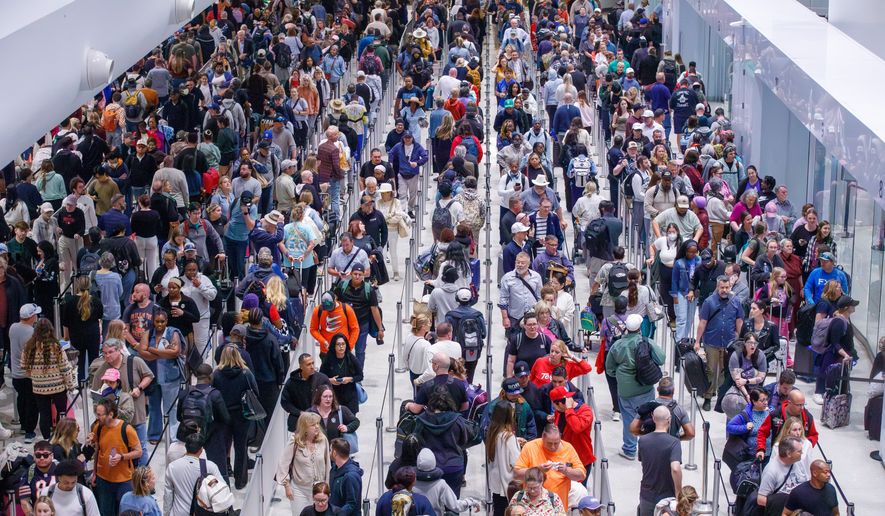
The long delays, up to four hours, for passengers at major U.S. airports are, according to Chinese media, visible symbols of political gridlock and systemic weakness.
Beijing is using this issue and others to make the case that its system of governance, an autocracy with one man and one party in control, is far superior to the liberal democracy in the U.S.
Yet the hundreds of thousands of people seeking permission to enter the U.S. each year is a testament to the opportunities and form of governance that are most appealing. Indeed, there is a reason there is no large-scale migration to China. That’s because people understand that the U.S. is a land of opportunity, with the Constitution and Bill of Rights protecting individual liberties and rights, such as speech, religion and the press, while ensuring legal due process.
In the 1980s and 1990s, China had leaders who advocated a democratic form of governance with elections, the rule of law and guaranteed rights for the people. Communist Party Secretaries Hu Yaobang and Zhao Ziyang were removed from their leadership positions because they favored a democratic form of governance, as did former Premiers Wen Jiabao and Zhu Rongji.
Yet democracies are inherently fragile. The Founding Fathers feared a democracy could devolve into the tyranny of the majority; thus, they penned the Constitution with checks and balances. James Madison, in Federalist No. 10, cautioned against factions that could tyrannize minorities, noting the importance of elected officials.
The U.S. will celebrate its 250th anniversary of independence on July 4, marking 250 years since the signing of the Declaration of Independence. What followed was the signing of the Constitution on Sept. 17, 1787, with the Bill of Rights ratified on Dec. 15, 1791.
These are important dates not only for Americans but also for our allies and partners who work with us to protect the vulnerable worldwide.
When the U.S. was established, it was an idealistic new nation. It eventually experienced its own bloody civil war but evolved to become a world leader. It was there for Europe with the Marshall Plan after World War II, and it was the U.S. that defeated communism and the Soviet Union, bringing an end to the Cold War in 1991.
The U.S. continues to be a world leader in foreign assistance, dispensing over $82 billion to more than 160 countries in 2024 and over $19 billion in 2025. Countries used this aid for health, humanitarian and development projects.
U.S. allies and partners, as well as others, continue to look to the U.S. for leadership.
What’s concerning, however, is the 2026 World Happiness Report, a reputable publication on global well-being, which ranks 147 countries using data from the Gallup World Poll. In it, the U.S. ranked 23rd (after Saudi Arabia, at 22nd), continuing a long-term decline from its peak of 11th in 2011. The key drivers of well-being in the report are trust in institutions and quality of life.
President George Washington, in his 1796 farewell address, strongly warned against political polarization and partisan factionalism and their impact on national unity.
The TSA pay crisis should be a wake-up call that government institutions and elected officials are here to serve the people.
• The author is a former associate director of national intelligence. All statements of fact, opinion or analysis expressed are those of the author and do not reflect the official positions or views of the U.S. government. Nothing in the contents should be construed as asserting or implying U.S. government authentication of information or endorsement of the author’s views.

Please read our comment policy before commenting.