



SEOUL, South Korea – In what looks to be a landmark ruling against religious freedom in Japan, a Tokyo court Wednesday upheld the dissolution of the Family Federation for World Peace and Unification, the religious organization formerly known as the Unification Church, on claims that it solicited major donations.
The decision by the Tokyo High Court ends a one-year appeal brought by the Family Federation against an earlier decision by the Tokyo District Court.
A liquidator will be assigned to dissolve the organization’s assets and pay victims with the proceeds.
The case against the church was brought by Tokyo’s Ministry of Education, Culture, Sports, Science and Technology.
Some 1,559 persons, backed by a group of activist lawyers and with widespread media support, claim damages against the Family Federation.
They argue that worshippers were coerced into making major donations of some 20.4 billion yen, or $130 million, over 40 years and were victimized by so-called “spiritual sales” – i.e. pressured to purchase pricey talismans.
No crime was alleged against the Family Federation, but the ruling was the first time a Japanese religious dissolution order has been issued based on illegal acts under the Civil Code.
The Rev. Masaichi Hori, the president of Family Federation Japan, called the ruling extreme.
“We have not committed any crime as a religious corporation. Our members are sincere believers who practice their faith peacefully and strive to contribute positively to society,” he said in a statement.
“We deeply regret this extreme decision imposed without criminal conviction. We will continue to uphold our beliefs lawfully and peacefully, confident that truth and justice will ultimately prevail,” he said.
The grounds for dissolution are not criminal but alleged harm to “public welfare” and to breaches of loosely defined “social norms,” he noted.
Early reaction from the U.S. was shock.
“It is unbelievable that a democracy would dissolve a legitimate faith community that has not been convicted of a crime,” said former Kansas Gov. Sam Brownback, who served as ambassador-at-large for religious freedom in the first Trump administration.
“Religious communities are often out of step with shifting cultural attitudes and political winds. As such, they can be viewed as controversial, polarizing or even strange, but that doesn’t change their right to exist in a free society.”
Believers state that they will be unable to convert to a home-church structure, given the small size of Japanese homes, and given widespread social prejudices that prevent them renting public locations for services.
They also say “spiritual sales” are no longer conducted, and that they returned some donations made by family members of those claiming to be victims.
They further state that worshippers have been subjected to forcible “de-programming” sessions that include renditions and de facto imprisonment.
The most prominent beneficiary of returned donations is the convicted killer of former Premier Shinzo Abe, who brought the church into widespread disrepute in Japan in a high-profile affair that mingled family finances, murder, religion and top-level politics.
A murder, a church and Japan’s ruling party
Tetsuya Yamagami, then 41, was a disaffected ex-serviceman who used an improvised firearm to shoot Abe during an outdoor campaign rally in 2022. Mr. Abe, an icon of right-wing Japanese politics, died of his wounds.
Yamagami, post-arrest, stated that his mother had donated most of her assets to the Family Federation, bankrupting his family.
His motivation for the shooting, he said, was his simmering anger at Abe’s links to the group.
Abe had spoken at Family Federation events. Subsequent investigations found widespread ties between the Family Federation and Abe’s Liberal Democratic Party.
Those ties gained widespread publicity.
Prime Minister Fumio Kishida, who hailed from a more moderate wing of the party than the right-wing Mr. Abe, oversaw a de-linking of the party and the Family Federation, which had previously assisted the LDP in electioneering.
The Ministry of Education, Culture, Sports, Science and Technology swung into action.
There are no Japanese regulations preventing religious groups engaging in politics. Indeed, the LDP’s coalition partner at the time, Komeito, was a Buddhist party.
The Family Federation, a conservative group that focuses on family values, has long been active in anti-communist movements, and had openly supported the LDP.
In the heated social atmosphere following Abe’s murder, the church was compelled to deploy security guards at its main church, set in a quiet backstreet near Tokyo’s bustling Shibuya district.
In fact, the Family Federation had voluntarily returned half the donations made by Yamagami’s mother - a matter that went under-reported in Japan.
Yamagami is serving a life sentence. His mother remains a believer.
The LDP under Mr. Kishida was subsequently assailed by a slush-fund scandal. With the party beset by record-low ratings, Mr. Kishida stepped back from the leadership.
The LDP’s fortunes fell further under his successor, Shigeru Ishiba, who lost the party’s majority in both houses of the Diet.
The current head of the LDP is right-wing Prime Minister Sanae Takacihi.
She reversed the steep popularity decline the party had suffered via Japan’s largest-ever election win in the Lower House in February.
A strong conservative, she is widely seen as Abe’s political heir.
The Family Federation addressed the connection between today’s court decision and his murder.
The court decision, “can be seen as fulfilling the desire of the terrorist responsible for the shooting of the former prime minister: ‘to resent and strike at the Family Federation,’” the organization’s headquarters said in a statement.
“This judicial decision will not only incite new political terrorism but also undermine Japan’s credibility in the international community and will remain a stain on our nation’s history,” the Federation stated.
Americans concurred.
“This move by the Japanese government violates the Universal Declaration of Human Rights’ fundamental right to freedom of conscience,” said Mr. Brownback, who also served as a Republican U.S. senator from Kansas.
“This will have a chilling effect on all religions in Japan and throughout Asia. This decision should be reversed,” he said.
Before Wednesday’s ruling, some prominent U.S. political figures expressed hope that Ms. Takaichi could take a fresh look at the case. They warned that Japan could deal a significant blow to principles of religious freedom.
“This is a terrible problem, because it goes to the very heart of our system. We believe that rights come from God, not from bureaucrats, not from lawyers, not from politicians, from God,” former House Speaker Newt Gingrich said in video address to the International Religious Freedom Summit in Washington last month. “If a politician thinks that they have the power to come between God and the people, then you’ve just undermined the entire process.”
Attacks on all fronts
The Unification Church was founded in 1954 by the Rev. Sun Myung Moon, a charismatic Christian who had grown up under the oppressive rule of communist North Korea.
The Rev. Moon fled to the South during the 1950-53 Korean War and set up a tiny church.
It became active in Japan in the late-1950s, and later expanded into a global spiritual movement that seeks the unification of religions, backed by an affiliated commercial empire.
One of its properties is The Washington Times.
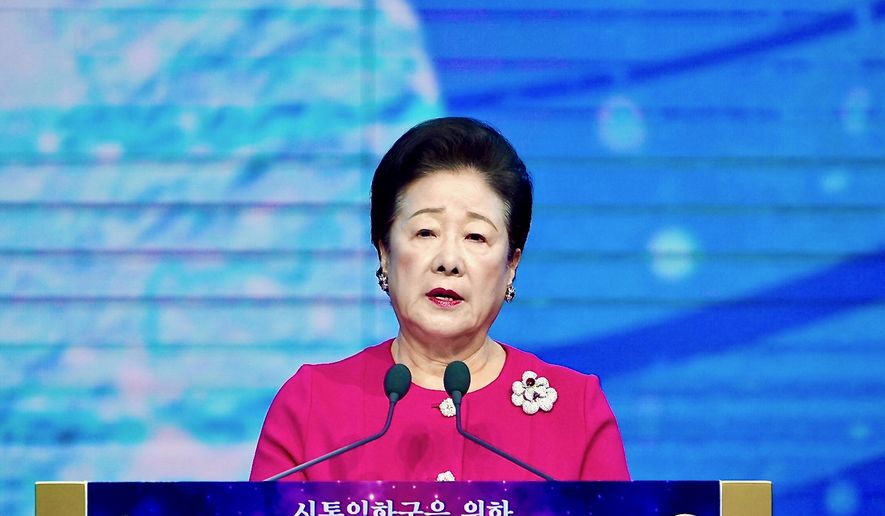
The movement is currently led by the Rev. Moon’s wife, Dr. Hak Ja Han Moon, following her husband’s passing in 2012.
The targeting of the Family Federation has spread beyond Japan.
Mrs. Han is currently in jail in South Korea following her arrest last September on grounds that she might destroy evidence connected to a bribery case involving former first lady, Kim Keon Hee.
Mrs. Han stands accused of illegally seeking to gain influence during the tenure of former conservative President Yoon Suk-yeol.
Yoon has been sentenced to life imprisonment for insurrection, following his botched attempt to institute martial law in December 2024.
Mrs. Han and her former chief secretary were indicted on charges of bribery, violating political funding laws, embezzling church funds, and instructing the destruction of evidence.
They strongly deny the allegations. Mrs. Han’s trial is ongoing in Seoul Central District Court, where she appeared in a wheelchair at a hearing last December.
• Andrew Salmon can be reached at asalmon@washingtontimes.com.

Please read our comment policy before commenting.