



President Trump is keeping a list of allies who aren’t supporting the U.S. in its war with Iran.
Mr. Trump on Tuesday effusively thanked German Chancellor Friedrich Merz for his country’s assistance in the war against Iran, while blasting other allies that have not supported the effort. He even threatened to halt trade with nations such as Spain that don’t cooperate.
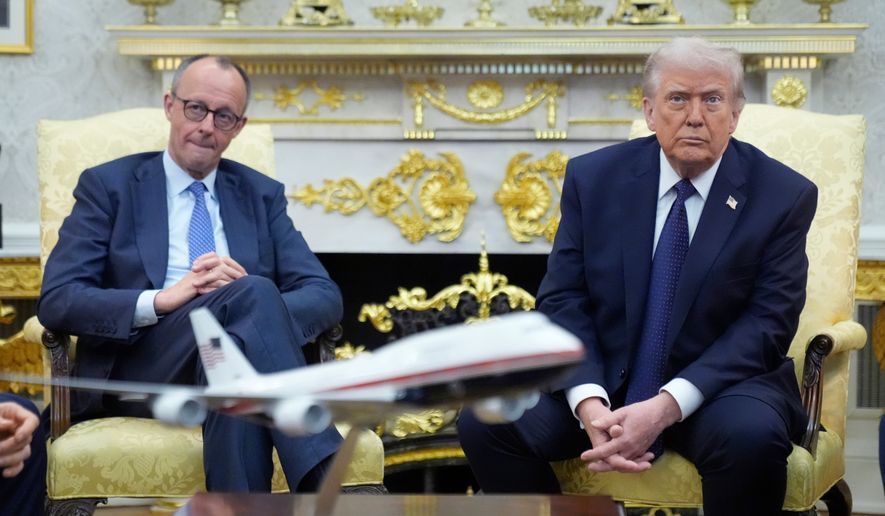
The meeting, which took place at the White House, was Mr. Trump’s first face-to-face meeting with a world leader since the U.S. and Israel launched strikes on Iran.
Although the meeting was scheduled before the joint U.S.-Israeli attacks on Iran, the conflict in the Middle East was the main topic, overshadowing Mr. Merz’s goal of pressing his U.S. counterpart on trade and the war in Ukraine.
“We have to talk about our trade agreement, which I would like to be in place as soon as possible and we have to talk about Ukraine,” Mr. Merz told Mr. Trump in the Oval Office. “There are too many bad guys in this world, actually, and this is an issue we have to talk about because we all want this war coming to an end as soon as possible.”
But Mr. Trump made it clear that he wanted to keep the focus on Iran, thanking Mr. Merz for supporting the U.S. mission there.
“We’ll obviously be talking a little bit about Iran today and he’s been helping us out. He’s been very nice actually,” Mr. Trump said of Mr. Merz.
The German chancellor has not been critical of the military effort against Iran, but has not endorsed it, either. Mr. Merz has said the strikes that killed Iran’s Supreme Leader Ayatollah Ali Khamenei were justified and has criticized Tehran for retaliatory strikes.
Other European leaders have condemned the U.S.’s actions.
“We are on the same page in terms of getting this terrible regime in Tehran out of the way,” Mr. Merz said.
However, Mr. Trump unloaded on Spain and the United Kingdom, which have blocked the U.S. from using its bases to launch strikes against Iran.
“They were unfriendly. Spain has absolutely nothing that we need. They have great people, but they don’t have great leadership,” Mr. Trump said. “We’re gonna cut off all trade with Spain, we don’t want anything to do with Spain.” Mr. Mr. Trump also turned his fury on the United Kingdom, telling the media he is not happy with Great Britain.
“This is not Winston Churchill we’re dealing with,” Mr. Trump said of U.K. Prime Minister Keir Starmer.
The president also has embarked on a flurry of media interviews in which he has offered mixed messages on the ultimate goal of the strikes.
Mr. Trump told NBC he wanted to get rid of Iran’s “whole group of killers and thugs,” though he also told Fox News’s Bret Baier he wanted to deploy the Venezuelan model, in which he left top lieutenants in place after capturing President Nicolas Maduro on drug-related charges.
In notable comments to ABC’s Jonathan Karl, he said the top choices to succeed Khamenei were killed in the initial strikes, too. He also alluded to an alleged 2024 assassination plot against him.
“I got him before he got me. They tried twice. Well, I got him first,” Mr. Trump said.
Mr. Merz’s stance on Iran is somewhat striking. He criticized Mr. Trump and Israeli Prime Minister Benjamin Netanyahu for targeting Iranian nuclear facilities last June.
Germany had also helped to negotiate the 2015 nuclear deal with Tehran under the Obama administration, a deal which Mr. Trump has often criticized.
The Iranian talk overshadowed much of what Mr. Merz arrived in Washington to discuss with Mr. Trump. A spokesperson for the German leader said the main goals were to get more clarity on U.S. trade policy and press Mr. Trump to get tougher on Russia.
Last month, the U.S. Supreme Court struck down Mr. Trump’s use of emergency tariff powers, creating uncertainty for European nations exporting their goods to America, the world’s biggest economy.
Mr. Merz also planned to push Mr. Trump to take a tougher stance against Russian President Vladimir Putin to end the four-year war against Ukraine. On Monday, the German chancellor called Ukrainian President Volodymyr Zelenskyy to discuss U.S.-Russian negotiations. They also discussed concerns that the Iran conflict could impact the military supplies such as air defense interceptors it had been sending to Kyiv.
“Everyone understands that for Ukraine these Patriot missiles are key to its defence and survival,” Mr. Zelenskyy said after the call with Mr. Merz. “We also co-ordinated efforts ahead of the chancellor’s meeting with President Trump.”
— Tom Howell Jr. contributed to this article.
• Jeff Mordock can be reached at jmordock@washingtontimes.com.

Please read our comment policy before commenting.