


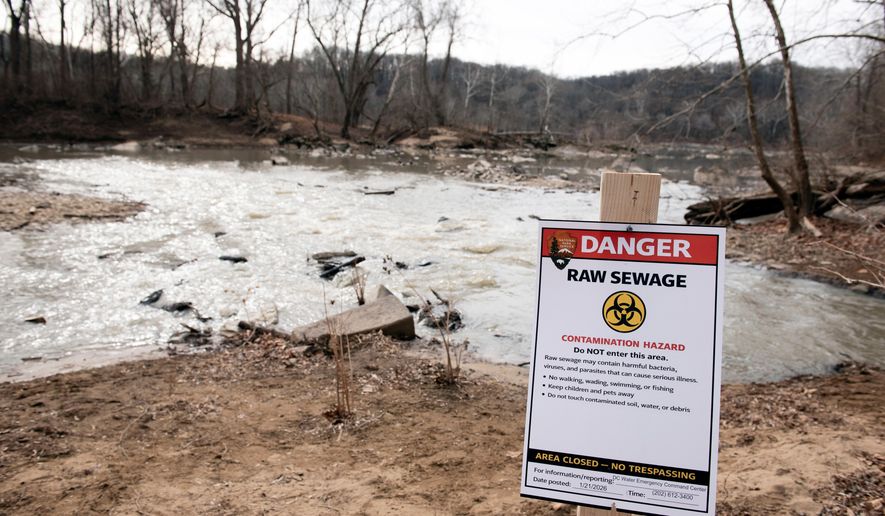

DC Water began drone flights Thursday to inspect the 54-mile sewer line that ruptured this winter and sent hundreds of millions of gallons of wastewater into the Potomac River.
The utility company said the aerial surveillance aims to spot potentially troublesome rocks and boulders near the pipeline.
Large rocks fell into the pipe after the Jan. 19 collapse and blocked the ability to move sewage from Loudoun and Fairfax counties in Virginia through Montgomery County, Maryland. The sewage’s final destination is the Blue Plains Advanced Wastewater Treatment Plant in the District.
The blockage caused an overflow and delayed DC Water’s timeline in patching up the broken pipe that sent roughly 250 million gallons of raw sewage into the river. The fractured Potomac Interceptor pipe was fixed this month.
Officials said the drone inspections will also help DC Water have better topographical data on the pipeline than what can be provided through satellite imaging.
The utility company said several drone flights will take place over the next week to beat the springtime bloom and vegetation growth.
Elsewhere in the sewer system, DC Water said it completed sludge removal in parts of the Chesapeake & Ohio Canal, which was used as a bypass during the Potomac Interceptor repairs.
Authorities said they will begin removing soil from around locks 13 and 14 on the canal and will inspect the soil to see if it has been tainted by sewage overflows.
The Potomac Riverkeeper Network said it detected contamination from human waste in an unnamed tributary that runs beneath the C&O Canal.
A nonprofit published a report saying water was dripping from the sewage-filled canal into the tributary, which feeds into the Potomac River. The organization said that “fecal bacteria in the stream increased by at least two orders of magnitude” after it passed under the canal.
The pipe burst flooded the river with disease-carrying bacteria in January. Multiple analyses of the water detected high levels of E. coli, as well as Staphylococcus aureus, the bacteria that cause staph infections, and an antibiotic-resistant strain of MRSA near the broken pipe.
The sewage spill is thought to be one of the largest in the nation’s history.
But clean-up efforts in the river have progressed to the point that the District, Maryland and Virginia have deemed the water safe enough for boating, kayaking and canoeing.
The Environmental Protection Agency took over water quality sampling this month and provides daily updates on the D.C. Department of Energy and Environment’s website.
President Trump declared a federal emergency over the Potomac River rupture last month, ending a short-lived political brawl about whose responsibility it was to lead efforts cleaning up the waterway.
Mr. Trump accused local leaders around the national capital region — all of whom are Democrats — for their sluggish response to the crisis, while Maryland Gov. Wes Moore said the president could have activated federal resources much sooner than he did.
DC Water said fully replacing the Potomac Interceptor pipe, which was first installed in the 1960s, will take most of this year.
• Matt Delaney can be reached at mdelaney@washingtontimes.com.

Please read our comment policy before commenting.