



OPINION:
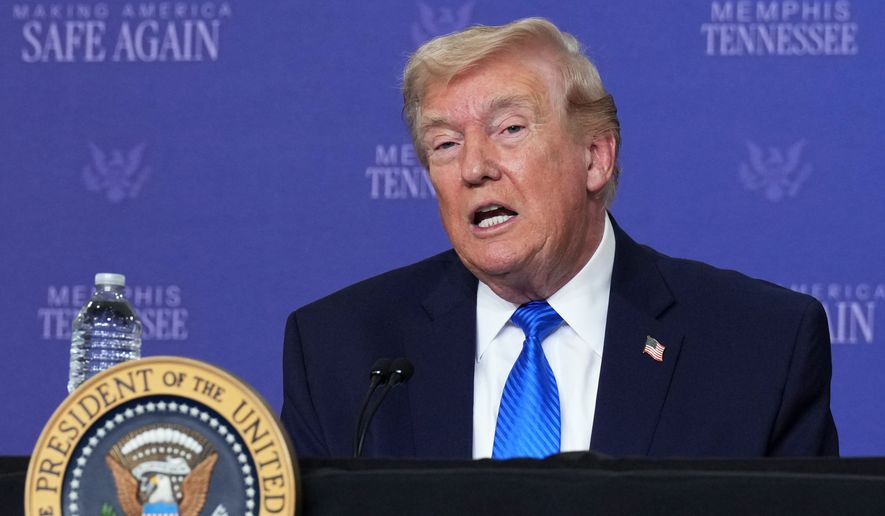
President Trump went to Memphis, Tennessee, at the top of this week to talk about law and order and crime and punishment.
His friends and aides rightly pointed out that, with respect to crime, things have gotten better in Memphis over the past few years, in part because of the Memphis Safe Task Force, which the president established.
That is correct but perhaps not complete. According to the administration, the activities of the Memphis Safe Task Force have resulted in 7,240 arrests. Charges from those arrests include 44 homicides, 798 controlled substance offenses, 93 sex offenses, 203 juveniles detained and 44 known gang members taken into custody.
Data collected by the city indicates that crime in Memphis is down 43% from last year, according to the Memphis Safer Communities Dashboard.
That all sounds pretty good, and it probably is pretty good. Some of the success associated with law and order is dependent on locking away all the criminals, hence the emphasis on enforcement measures such as arrests and convictions.
Some of it, perhaps the most important part, is helping potential criminals understand that there are paths they can take that don’t lead to criminality and the inevitability of either incarceration or death.
Enter Memphis Allies, a group that works to inform young men, almost uniformly Black, that there is a better way, one that allows them to move into the future with opportunity and purpose, without anger, regret or a criminal record.
The group’s efforts are based on the accurate idea that the temptations of violence and chaos can be reduced when people work in an intensive, personal way with those most likely to be tangled in the spiral of violence.
In policing circles, it is a fairly well-known data point that each shooting results in four more shootings, as cycles of recrimination, revenge and retribution perpetuate. If you can prevent or avoid even one shooting, then that produces a virtuous cycle in which additional violence, bloodshed and criminal behavior can be avoided.
Memphis Allies’ unique approach is that its outreach and mentoring are done by men who grew up in Memphis neighborhoods. I recently had the opportunity to spend time with one of these remarkable men.
Tito Porter’s story is, unfortunately, not uncommon. He was raised by various family members. The first bed he could call his own was in his first jail cell. Early on, he realized that if he did not change, his life was likely to be much shorter and more unhappy than it should be.
It is difficult and perhaps impossible for those of us who enjoyed the most meaningful and durable privilege — that of being raised by two parents under one roof — to imagine the difficult path Tito had to travel more or less on his own.
It would have been easy for him to turn inward and let others figure out what he had to learn by himself, but that was not the path he chose. Instead, he became a life coach — a life raft — for young men in Memphis.
Through his work at Memphis Allies, he is a father, brother, mentor, teacher, adviser and friend to many young men who struggle with a world that often seems random, cruel and very difficult to navigate. For many of the young people in the program, Memphis Allies and men like Tito are the last exit off a road that leads inexorably toward either death or prison.
How is it going? Since the program launched in 2022, more than 90% of participants have not had a new gun charge. Perhaps not coincidentally, the city’s homicide rate has steadily decreased. In 2023, there were 351 homicides in Memphis; in 2024, there were 301. Last year, there were 235. So far this year, there have been just 34 homicides.
Make no mistake: Memphis and its allies still have a way to go. As recently as 2024, the city had the nation’s highest rate of violent crime (about three times above the national average). The cycles of violence and criminality didn’t start overnight, and they won’t be extinguished overnight either. Real change in people or cities or nations occurs only when individuals resolve to change.
That brings us back to Tito Porter. His life could have been just another tragedy, an unfortunate byproduct of the American experiment. It didn’t turn out that way. Tito’s realization — his conversion moment, if you will — that he didn’t want to live his life in and out of prison led to a better path. He is married and has six children; he has an adopted niece currently in college, and in addition to his work saving lives at Memphis Allies, he is a mechanic.
President Trump is doing what he needs to be doing in Memphis. So are men like Tito Porter. Let’s hope that they are both successful.
• Michael McKenna is a contributing editor at The Washington Times.

Please read our comment policy before commenting.