



OPINION:
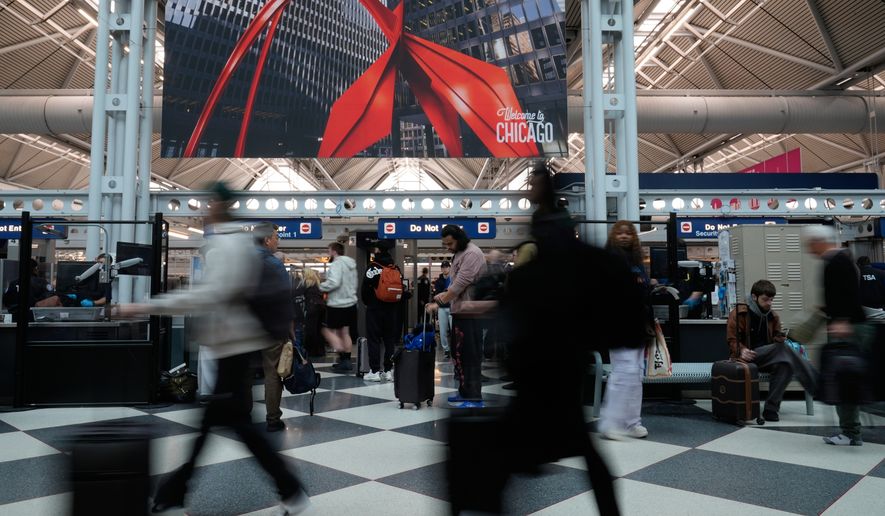
Chicago’s O’Hare International Airport, the busiest airport in the United States, is heading into what could be its most strained summer yet.
Even minor disruptions at O’Hare, a major hub for American Airlines and United Airlines, can ripple across the entire national air system.
Recently, United indicated it would dramatically increase the number of takeoffs and landings at O’Hare, a move that would exceed the airport’s capacity. The Federal Aviation Administration has warned that if this happens, O’Hare’s runways, terminals and air traffic control system will be pushed beyond their limits.
Given that airport capacity has not meaningfully increased, delays will increase during the airport’s peak times. When severe weather occurs, cancellations will be more frequent, longer and more widespread.
Because O’Hare is a hub for two major airlines (and two smaller ones), those disruptions will cascade and affect the entire country.
This concern is not hypothetical. O’Hare recorded the highest number of delays among U.S. airports in 2025, and ongoing construction projects and a denser summer schedule leave the system with no margin for error.
In such an environment, overscheduling is not just inefficient; it is also destabilizing.
To its credit, the FAA has taken a proactive stance on this matter. After meeting with airline representatives, both it and the Department of Transportation proposed using summer 2025 schedules as a baseline to guide proportional flight reductions for the coming summer.
The logic is simple: Airlines that scheduled the most flights will scale back the most. That puts United Airlines squarely in focus. As the largest carrier at O’Hare with a 30% market share (and the airline that added the most flights for this summer), United stands to face the largest reductions.
In some ways, this aligns with the airline’s own evolving strategy. Amid rising fuel costs tied to geopolitical tensions, United CEO Scott Kirby has previously signaled a willingness to cut less profitable flights, such as red-eye routes and off-peak departures on traditionally weaker travel days.
That raises a bigger question: Why expand so aggressively in the first place?
Mr. Kirby himself offered a candid answer: “In 2026, we’re drawing a line in the sand. … We are not going to allow [American Airlines] to win a single gate at our expense. … We’re going to add as many flights as are required to keep our gate count the same in Chicago.”
This is not the language of a consumer-demand-driven move. It is the language of competitive positioning.
At O’Hare, gate access, a scarce and valuable resource, is tied to an airline’s prior-year flight activity. By increasing flights, United is not just selling more tickets; it is also protecting its long-term dominance at the airport and trying to drive out American Airlines.
In essence, flight schedules aren’t set to benefit consumers. They have a strategic, anticompetitive tool to limit competitors’ access.
This strategy carries real consequences for consumers. In the short run, overscheduling contributes to congestion, increasing the likelihood of delays and cancellations for all travelers, not just United’s passengers. In the long run, reducing competition can drive up fares. Economic evidence supports this concern: Competition helps drive down ticket prices.
O’Hare is unusual among major U.S. airports in that it houses multiple large hub carriers. That competition appears to benefit Chicago travelers by keeping ticket prices at O’Hare stable (and relatively low). By contrast, United’s fortress hubs, such as Washington Dulles International Airport and San Francisco International Airport, have ranked among the most expensive U.S. airports for four consecutive years.
If United marginalizes American Airlines at O’Hare, then higher prices and fewer choices would likely be inevitable.
The FAA’s intervention is not just operationally prudent; it is also consumer-centric. Scaling back schedules reduces the risk of systemwide disruptions while preserving competitive balance at one of the country’s most important airports.
The benefits extend beyond the hub carriers. Congestion at O’Hare affects all carriers, including Delta and smaller airlines that rely on access to its airspace and infrastructure. A more disciplined schedule improves reliability across the board.
Ultimately, this is a case where less flying means a better system. By curbing overscheduling, regulators are not constraining the market. They are preventing it from undermining itself.
• Johnny Chuang is a professor at Northwest Missouri State University.

Please read our comment policy before commenting.