


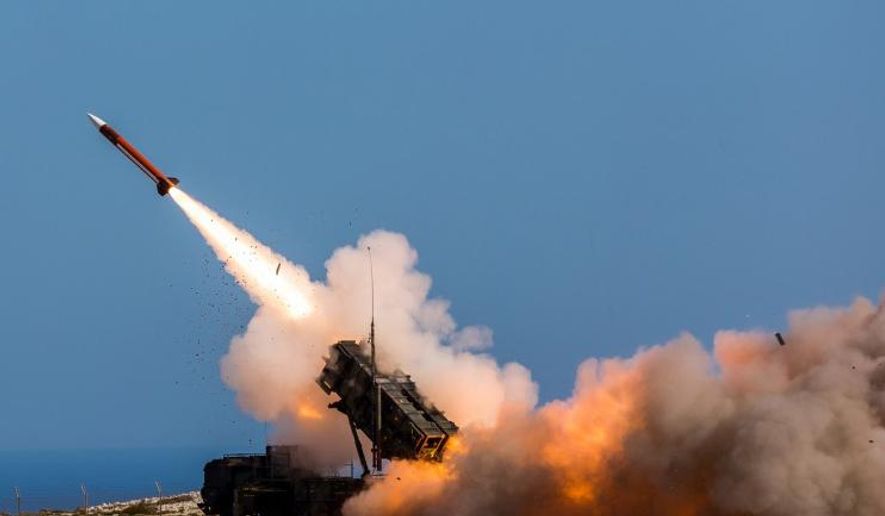

Low-cost alternatives to the multimillion-dollar missiles the U.S. is using in its war against Iran are still years away, key Pentagon officials said Tuesday, leaving the military reliant on high-cost munitions that are increasingly in short supply.
The U.S.-Israel campaign against Iran has burned through complex weapons that cannot be replaced quickly or affordably enough to maintain the Pentagon’s usual stockpiles. Military officials said at a Senate Armed Services Committee briefing that cheaper munitions are on the long-term horizon, but the U.S. industrial base still needs time to scale up to the Defense Department’s increasing needs.
Expanding the American industrial base is critical to refill rocket and missile stockpiles. Even before the campaign against Iran began late last month, arms transfers to Ukraine and Israel dwindled American reserves. Precision strike and air defense stockpiles were drawn down to support those two U.S. allies.
The U.S. is relying heavily on expensive missiles to shoot down cheap Iranian Shahed drones in the conflict, which presents a major cost problem.
“We’ve got to figure out a way to stop using multimillion-dollar defense ordnance to stop cheap attack vehicles,” said Sen. Rick Scott, Florida Republican.
Mr. Scott pointed to changes in last year’s National Defense Authorization Act, such as longer-term munitions contracts, as part of the solution, but the measure was passed only months before the current Persian Gulf conflict.
“We’ve allowed the Department of War to do longer-term contracts, which allows the contractors to invest more capital,” Mr. Scott said.
The Pentagon has requested $200 billion to pay for the Iran campaign. That figure could suggest that the conflict will drag on, even though President Trump said Monday that the U.S. was in direct talks with a top Iranian official about a deal to stop the fighting.
Iran has denied any negotiations and pledged to fight “until complete victory.” Pakistan, Egypt and Gulf Arab nations are trying behind the scenes to arrange talks, but their efforts still seem preliminary. Israel is vowing to keep up its attacks in the meantime.
Despite the diplomatic outreach, the U.S. is ramping up its military presence in the Middle East.
The 82nd Airborne Division’s Immediate Response Force is in a state of “high readiness” for any potential mission, including an operation to seize Kharg Island, Iran’s critical oil hub.
Military officials said Tuesday that more than 3,000 Army paratroopers of the IRF remain ready to deploy within 18 hours after receiving an order. Military officials told The Associated Press on Tuesday that about 1,000 troops from the 82nd Airborne were preparing to deploy to the region.
Meanwhile, the 31st Marine Expeditionary Unit is expected to arrive in the Middle East by the end of the week.
Defense Secretary Pete Hegseth last week stressed that the $200 billion price tag could increase depending on how the situation unfolds.
“That number could move obviously,” Mr. Hegseth said. “It takes money to kill bad guys. We’re going back to Congress and folks there to ensure we’re properly funded for what’s been done, what we may have to do in the future.”
Escalating price tag
Congress provided some money for rockets and missiles this past fiscal year, but that investment was closer to $500 million, not the $200 billion lawmakers now have to negotiate to meet what the Pentagon says it needs.
“We need to continue to work on the defense industrial base,” Sen. Joni Ernst, Iowa Republican, told The Washington Times.
Many potential lower-cost munitions are in the research phase. Familiar defense industry names such as Lockheed Martin and up-and-coming industry titans such as Anduril are racing to build such capabilities. Ms. Ernst wants all those companies to pull their weight.
“It’s not just the primes, it’s a lot of startup businesses, small businesses, and we’ll see a lot of that in the future, and it’ll drive costs down,” she said.
The U.S. defense industry is dealing with more demand than it can support right now, especially when the U.S. and its allies in the Persian Gulf region are using more and more of those expensive munitions.
“We look a lot at how difficult air defense is, and how expensive air defense is,” said Emily Harding, director of the Intelligence, National Security, and Technology Program at the Center for Strategic and International Studies.
“If I’m putting myself in the shoes of the Saudis, for example, who are trying to decide where I put the few Patriot [missiles] I have. … What decisions do you make?” she said at an event hosted by the think tank Tuesday.
Iranian attacks have been hitting not only military targets but also key pieces of energy infrastructure and other nonmilitary sites across the region. Specialists said that this has left some American allies in the difficult position of rationing expensive air defenses.
“We’re already seeing evidence that they are having to ration their air defenses,” Mona Yacoubian, the Middle East Program director at CSIS, said at Tuesday’s event. “What do we protect? Do we protect this or do we protect that?”
As worries grow about shrinking U.S. stockpiles, cheaper alternatives are being touted as a possible solution to help lighten the load.
“You’re seeing China in particular, they’re already doing this stuff. Low-cost, autonomous weapon systems,” Sen. Eric Schmitt, Missouri Republican, told The Times. “We’ve always been better at innovation, but we have to be able to mass-produce this stuff.”
Pentagon officials testified that the military is actively lowering barriers for more nontraditional and “dual-use” companies to supply the military. Vice Adm. Elizabeth Okano told the committee that the Navy has shrunk its prime munitions contractor base from more than 50 to just five over the past three decades. She said it is now working to reverse that consolidation.
Lt. Gen. Francisco Lozano said a venture-capital-backed startup is developing low-cost systems for a precision-strike weapon.
Not everyone is convinced that the dynamics will change anytime soon.
“We’re still forced to buy the very expensive munitions,” Sen. Jack Reed, Rhode Island Democrat and his party’s ranking member on the Armed Services Committee, told The Times. He said those cheaper solutions are “designed as a complement to the really expensive systems.”
“I don’t see any slacking off in those expensive acquisitions,” he said.
• Mike Glenn contributed to this article, which is based in part on wire service reports.
• John T. Seward can be reached at jseward@washingtontimes.com.

Please read our comment policy before commenting.