



OPINION:
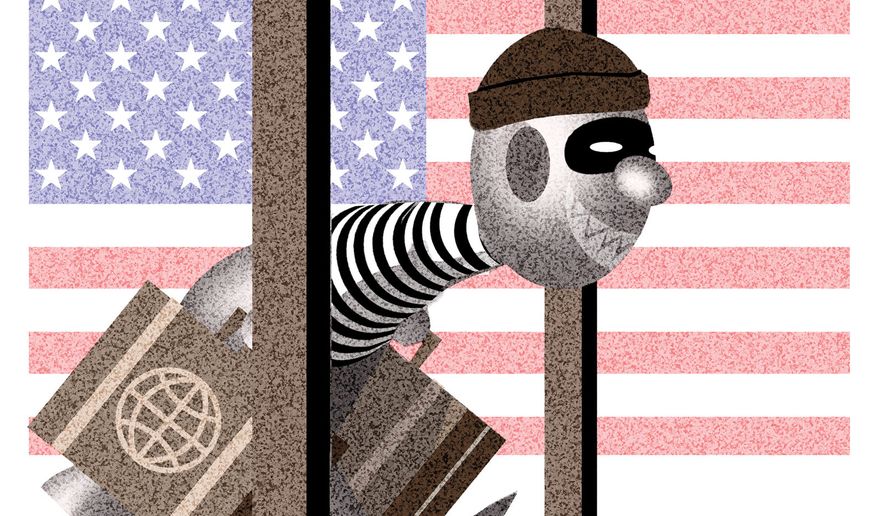
In addition to the mounting toll of crimes committed by foreign nationals who entered this country illegally, some foreigners come legally and then commit crimes.
This includes organized gangs from Chile and recidivist criminals from Ireland, both of which are visa-exempt countries, as well as nations requiring visas, such as Colombia and India.
Whether traveling under a visa or a visa waiver, all people entering the United States legally undergo screening. The process of screening for terrorism was greatly enhanced after 9/11, but screening for serious criminal activity has not kept up for some reason.
The Visa Waiver Program exempts citizens of 42 countries from obtaining a physical visa, but it doesn’t exempt them from screening. They still need approval through the Electronic System for Travel Authorization.
An application will run a person’s information — name, date of birth, and so on — through the same U.S. database that checks visa applicants. The Visa Waiver Program doesn’t require a personal interview, though arrivals are enrolled in biometric databases (photos and fingerprints) upon arrival in the U.S.
To enter the Visa Waiver Program, a country must agree to share with the U.S. information on the criminal histories of its citizens. If a foreign national has a criminal record, then it usually means they are ineligible for a visa to come here under the Immigration and Nationality Act.
Most of those agreements don’t require countries to check their records for every case.
Ideally, when a foreigner applies for the Visa Waiver Program, their home country would check their national crime records automatically when we check ours. That way, someone with a criminal record wouldn’t be able to slip through the cracks. That happens only in a few countries where information-sharing agreements specifically require automatic checking for every case, and where the U.S. ensures they do.
For the rest of the program, aliens’ home countries check only when we ask them to. That’s a big loophole. It’s the same for countries outside the Visa Waiver Program. Unless a specific agreement is in place, the screening process is significantly lacking.
Through continuous vetting, the U.S. has canceled more than 100,000 visas since President Trump took office. That’s great, but it’s backward. In those cases, we learned something new about the visa holders (after they got the visas) that made them ineligible. Being overseas means they can’t come here without obtaining a new visa, which would be difficult.
If they are already in the U.S., then U.S. Immigration and Customs Enforcement must locate them and initiate deportation proceedings. Americans now realize how hard and slow that is. We can’t even remove someone such as Kilmar Abrego Garcia, an alleged gang member, wife abuser and alien trafficker.
Visa Waiver Program and non-program travelers to the United States are on the order of more than 70 million visitors per year. For the vast majority, no check is made of their home country’s criminal records. This is a huge liability. As I have testified to Congress, the NINO rule of database vetting is “Nothing in, nothing out.”
Let’s say a wealthy, well-established visa applicant from Azerbaijan or Zambia has multiple burglary convictions back home. Unless our local embassy staff somehow know this, a consular officer could easily issue them a visa if they are otherwise qualified.
The good news is that, along with the scary impact of artificial intelligence, there are some fantastic benefits. One is the speed at which we can access and analyze information.
When I did my first tour in India in 2000, only the rich had cellphones. Now everyone does.
It wouldn’t be that hard for even poor countries with only paper records to digitize them, centralize them in a national database and share them with the U.S. for visa purposes. We have already done this with some countries. Since Chile allowed the Homeland Security Department to check criminal records in real time, 4,200 potential travelers have been denied approval through the Electronic System for Travel Authorization because of ineligibilities.
That makes Americans safer. If we got that much from just one small country, then imagine how many criminally ineligible travelers we could screen out if we had access to every country’s records.
The U.S. should establish clear timelines for signing agreements to automatically share criminal records of visa applicants from every country. This isn’t just technically possible; it’s also dangerous not to do. If countries fail to meet their target dates for information sharing, then we should stop issuing visas there. A pragmatic rollout would begin with countries having the strongest links to transnational criminal organizations.
Every crime committed by a foreign national who had a criminal record before arriving here is preventable. This is one thing on which both political parties should agree.
• Simon Hankinson is a senior research fellow in The Heritage Foundation’s Border Security and Immigration Center and author of “The Ten Woke Commandments (You Must Not Obey).”

Please read our comment policy before commenting.