


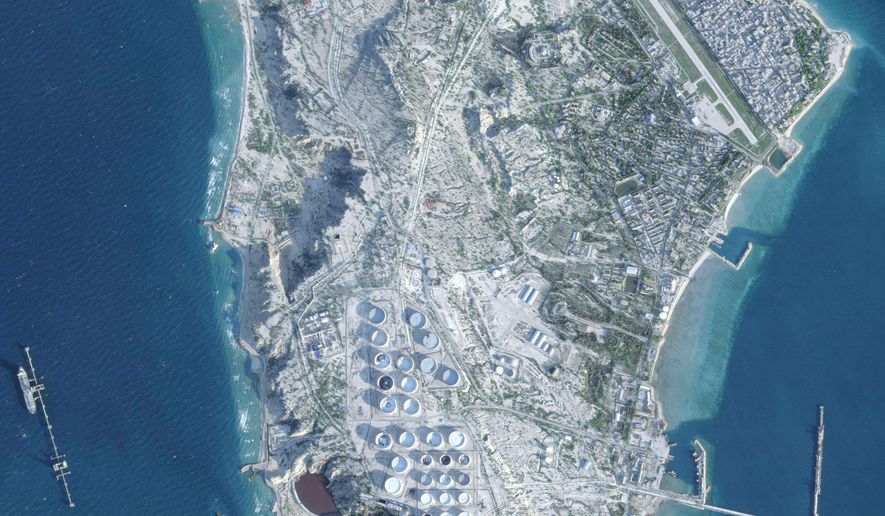

The 82nd Airborne Division’s Immediate Response Force is in a state of “high readiness” for any potential mission, including taking part in an operation to seize Kharg Island, Iran’s critical oil hub.
The 3,000 to 4,000 Army paratroopers of the IRF remain ready to deploy within 18 hours if the order is given, officials said.
Meanwhile, the 31st Marine Expeditionary Unit is expected to arrive in the Middle East about the time President Trump’s moratorium on striking Tehran’s oil and electricity infrastructure lapses on Friday. The five-day pause was announced on Monday after Mr. Trump said negotiations could bring an end to the war.
While Israel said it would hold off on targeting civilian energy and power plants, the Israel Defense Forces confirmed Tuesday that it struck more than 50 targets in Iran the previous night. They include Islamic Revolutionary Guard Corps command centers, air defense sites, and ballistic missile storage depots, IDF officials said.
On Monday, U.S. Central Command officials said their forces have struck more than 9,000 targets, including in excess of 140 military vessels, since Operation Epic Fury commenced Feb. 28.
Because the U.S. doesn’t have “boots on the ground” in Iran, which Mr. Trump said was a non-starter, military officials are relying on a mixture of high-tech assets such as satellites and signal intelligence, and even informed intuition for a “battle damage assessment,” known as a BDA.
The key to BDA is not only to determine if a tank is “on fire,” but also whether a tank can still fire, analysts said.
“Battle damage assessment is essentially the means by which the military determines whether it’s achieving its tactical objectives,” said Brad Bowman, senior director of the Center on Military and Political Power at the Foundation for Defense of Democracies think tank.
He said it’s important to decipher the terms often used by officials to describe the impact of a battle, such as “targets struck,” or whether a target has been “damaged” or “destroyed.”
“If it’s ’damaged,’ it can still be repaired: sometimes easy, sometimes hard; sometimes quick, sometimes slow. But, ’damaged’ is not ’destroyed,’” Mr. Bowman told The Washington Times. “These are all very distinct and different things.”
A BDA is supposed to help determine whether a subsequent attack is necessary, or if the mission has been accomplished.
“America has extraordinary satellite intelligence capabilities, and that is systematically and habitually used, in part, to do battle damage assessment. But, there is a limit to what you can do with BDA from the air,” Mr. Bowman said.
He said some targets simply can’t be effectively assessed without employing other means, including direct eyes on the target.
“But when you’re in an active war zone, or you’re talking about a place like Iran, putting people on the ground is very, very dangerous,” Mr. Bowman said.
The Strait of Hormuz is functionally closed to Western and “hostile” traffic, resulting in a massive backlog of 400 to 500 vessels forming on either side of the key waterway in a giant “maritime parking lot.”
Most of the vessels are tankers and bulk carriers that have been ordered by their companies to “loiter and wait” for the outcome of Mr. Trump’s Friday deadline rather than commit to an expensive and dangerous journey around the Cape of Good Hope.
The congestion of ships has also created a new security danger, as the stationary vessels are “sitting ducks” for piracy or stray drone activity, analysts said.
Iran has established an approved transit corridor hugging the Strait’s northern coastline and threading through Iran’s controlled Qeshm and Larak Islands. Supervised by the Islamic Revolutionary Guard Corps, Iran is allowing a small, select trickle of tankers under specific, and often expensive, conditions.
The primary ships using the corridor are from India, Pakistan, China, and Malaysia. According to the Lloyd’s List maritime intelligence forum, at least one operator paid $2 million for a single safe transit through the Strait.
• Mike Glenn can be reached at mglenn@washingtontimes.com.

Please read our comment policy before commenting.