


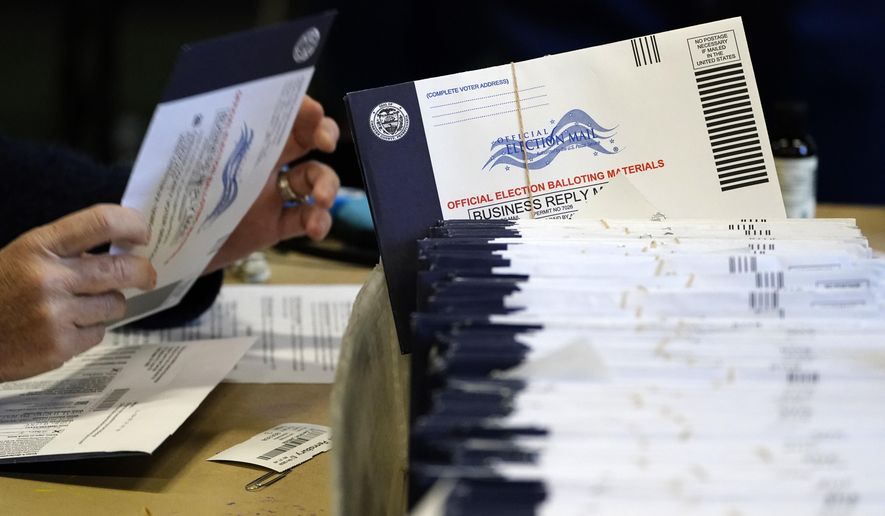

Several Supreme Court justices expressed skepticism Monday about states that allow ballots to be received and counted days after Election Day, though they worried about where to draw the line and whether tossing out late-arriving ballots also would eliminate early voting.
The justices grappled with the morass that has become voting, with some states allowing ballots to be cast six weeks or more before Election Day and others allowing them to be received weeks afterward.
In the specific case before the justices, ballots in Mississippi can be counted if received up to five days after Election Day, as long as they were mailed or sent by a “common carrier,” such as FedEx, by Election Day.
Opponents said that violates the idea that an election is “consummated” on Election Day.
“If somebody in Gulfport asks, the day after the election, is the election over, the commonsense answer is, ‘No it’s not.’ The ballots are still coming in. And someone asks who won, the truthful answer is we don’t know yet,” said Paul Clement, who argued the case on behalf of the Republican National Committee, which challenged the late-arriving ballots.
He told the justices, “The ballots are still coming in. And they may trickle in for weeks or months. And, in fact, they may trickle in for weeks or months with or without a postmark in differing ways in differing states. That reality gives the lie to the idea that we have a uniform national Election Day.”
All sides agreed that Congress has the power to set rules for federal elections. The question is whether Congress, when it first set a single, uniform date in 1845 for Election Day, meant to forbid state experimentation with the timing of ballot casting and receipt.
Scott Stewart, Mississippi’s solicitor general, said it did not.
“This is ultimately a federalism case,” he told the justices. “Did Congress in 1845 block states from adopting a practice that no one had wide reason to consider at the time? Congress wasn’t thinking about that. It didn’t decide it, it didn’t wall states off from doing that.”
Several of the court’s Republican appointees sympathized with those who said elections had spiraled beyond recognition.
“We don’t have Election Day anymore, we have election month. Or election months,” said Justice Samuel A. Alito Jr., a George W. Bush appointee.
Justice Alito noted that there’s “Labor Day, Memorial Day, George Washington’s Birthday, Independence Day, birthday and Election Day.”
“And they’re all particular days. So, if we start with that, if I have nothing more to look at than the phrase ‘Election Day,’ I think this is the day in which everything is going to take place,” he said.
Mississippi adopted its rule for the 2020 elections amid the COVID-19 pandemic emergency. At that time, all ballots had to be collected by the U.S. Postal Service by Election Day.
In 2024, the state added other common carriers as acceptable ballot recipients.
Justice Brett M. Kavanaugh said the balloting changes were not necessarily rooted in history.
“It only became widespread to allow it to be mailed by Election Day in more recent years, and that the predominant approach was to require receipt by Election Day throughout the historical practice you cite, until very recently,” he said.
Justice Neil M. Gorsuch, a Trump appointee, wondered whether states could even allow a ballot to be turned over to a notary public, or a neighbor who, as long as they certified that they collected the ballot by Election Day, could then deliver it within five days and have it still count.
He said FedEx allows people to recall something they have sent. He said that opens the possibility that a voter sends a ballot on Election Day, sees a scandal in the news the next day about their choice, and asks the company not to deliver it.
“Did the election happen on Election Day?” he said.
Congress first enacted a federal Election Day in 1845 and firmed it up in 1872, bookending the Civil War. That loomed large in the arguments Monday.
Justice Sonia Sotomayor said states made provisions to allow troops on the battlefield to cast ballots outside Election Day. Some states even allowed military officers to collect ballots from their troops, circumventing the usual requirement that an election official be involved.
Mr. Clement said those states made “herculean” efforts to make sure ballots were cast by Election Day.
“People literally went into harm’s way in order to do field voting,” he said.
Bringing the dispute back to the present time, Mr. Clement informed the justices that a post office in Chicago stays open 24/7, while polling places close at 8 p.m.
“Now, I’m not here to say that there could ever be voting fraud in Chicago,” he said, which drew laughter.
The case hinted at the current morass of state voting rules.
Voting can begin as early as five days before Election Day in some parts of Pennsylvania. Two states allow voting 46 days ahead, and three allow 45 days.
Ballots will be counted if received weeks late in some states, including up to 21 days after Election Day in Washington. Eight states allow ballots to arrive without postmarks.
Justice Sotomayor, who lives in the District of Columbia, said she casts her ballot at an unmanned ballot box and has no idea when it reaches election officials.
Justice Elena Kagan said if the high court adhered to the exact wording of the federal law, early voting also would have to fall.
“It just seems inconceivable that, on the basis of this kind of evidence, we would reject this practice in 30 states,” she said.
The Trump administration sided with the RNC and against Mississippi. Solicitor General D. John Sauer said history confirmed Congress’ idea of a limited Election Day.
Justice Sotomayor scolded Mr. Sauer for “selectively” quoting from history.
“I am a little upset — not a little, a lot upset — by many of the statements in your brief quoting historical sources out of context,” she said.
Mr. Sauer bristled at the accusation and said he stood by his reading of the history.
• Stephen Dinan can be reached at sdinan@washingtontimes.com.
• Alex Swoyer can be reached at aswoyer@washingtontimes.com.

Please read our comment policy before commenting.