


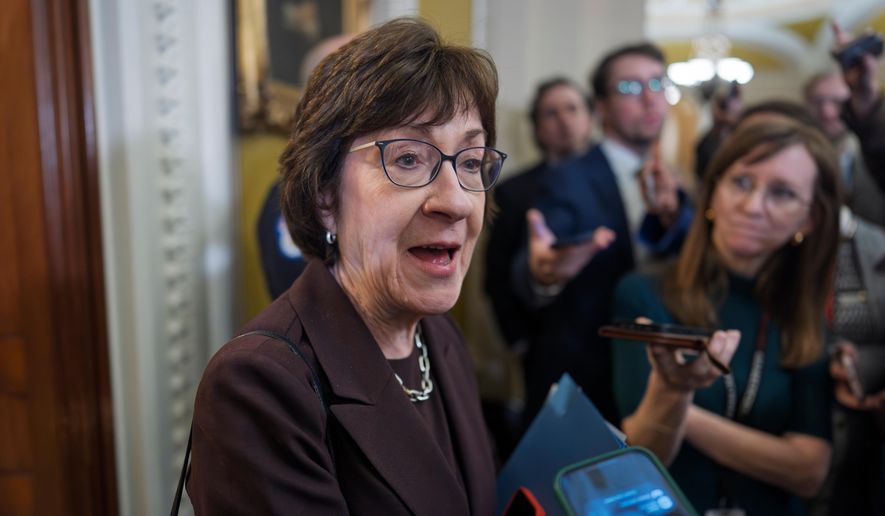

FORT KENT, Maine — Sen. Susan Collins visited her childhood stomping grounds along the Canadian border on her first real campaign swing since launching her reelection bid, reminding voters how her seat atop the Senate Appropriations Committee has steered billions of federal dollars back home.
For a day last weekend, it seemed a world away from Washington.
She celebrated Job Corps graduates at a VFW hall in her native Caribou and touted her role in saving the free training program for low-income young adults from the Trump administration’s chopping block, all while catching up with family, friends, and longtime supporters who have backed her since her first Senate run in 1996.
Then, at 3:45 a.m. the next day, she learned in a group email from a fellow senator that President Trump had launched major military operations against Iran. A little over six hours later, she was riding a dog sled past cheering spectators here at the 33rd annual Can-Am Crown International Dog Sled Races, near her family’s lumber business — and playfully showcasing her French language skills to the cross-border crowd.
At the same time, one of her Democratic rivals, Graham Platner, was mingling with the crowd, fresh off demanding that voters drive her out of Congress if she does not stop men and women from being sent off to “another stupid war.”
Navigating those two worlds, the 73-year-old Ms. Collins told The Washington Times, is part of the job.
“It is a jarring juxtaposition in many ways,” Ms. Collins said after the dog sled races, which include a 250‑mile Iditarod qualifier. “Here I am at this wonderful community event in northern Maine, and my staff experts are sending me emails with the latest on troop deployments, on the locations of [Iranian Supreme Leader Ayatollah Ali] Khamenei, and on what the reaction is nationwide.”
She paused. “It takes a lot of balance.”
Over five terms, few balancing acts have been trickier than her relationship with Mr. Trump.
He has called her a “disaster” and has not endorsed her, yet he remains the dominant force in national Republican politics.
Maine voters, however, have charted their own course: Mr. Trump lost the state by 7 points in 2024 and by 9 points in 2020. That same year, Ms. Collins won reelection by nearly 9 points, overcoming vocal opposition to her support for Supreme Court Justice Brett Kavanaugh and the tens of millions of dollars that Senate Democratic Leader Charles Schumer and allied groups spent against her.
She’s well aware of the split.
“Mainers are fiercely independent in the way that they vote,” she said, noting the big spread between her and Mr. Trump the last time they shared the ballot. “They want results, and that’s what I provide.”
A point of pride: a streak of 9,896 consecutive Senate votes without a miss — the longest perfect voting record in Senate history.
A challenge from the left
Maine voters will judge her record again this fall, when she’ll be the only sitting Republican running in a state that did not back Mr. Trump in 2024. Democrats will need to flip the seat to have any chance of taking control of the Senate.
She’s also running in a moment of deep polarization that has energized anti‑establishment candidates.
Enter Mr. Platner — an oyster farmer and former Marine who has won Sen. Bernie Sanders’ endorsement and become a progressive rockstar who has risen seemingly overnight. He’s generating national buzz, raising serious money, and leading recent primary polls as he challenges Gov. Janet Mills for the Democratic nomination.
A recent survey also showed him besting Ms. Collins in a hypothetical general election matchup.
Both Mr. Platner and Ms. Mills are looking to convince voters in a state that has supported Ms. Collins for nearly three decades — making her the longest-serving Republican woman in Senate history — that it is time to turn the page.
Mr. Platner said Ms. Collins’ time has come and gone.
“A lot of people are now beginning to realize that she is much closer to D.C. than she is to Caribou at this point,” he told The Times.
Former Gov. Paul LePage, a Republican who is running for the House seat in Maine’s 2nd Congressional District, had a blunt take on Democrats’ efforts to unseat the head of one of Washington’s most powerful committees.
“They’re having a brain cramp,” he told The Times. “The chairman of the Appropriations Committee — you’re trying to take her out? How stupid is that? That is plain stupid. Just this year alone, she brought $190 million into the state. Why would you want to get rid of her?”
A familiar criticism of Ms. Collins is that she wavers publicly on major issues but ultimately sides with her party.
For some voters, including former supporters, her 2018 vote for Justice Kavanaugh was the last straw, particularly after the court struck down Roe v. Wade in 2022, which she said he had assured her was settled law.
That criticism has spilled into the Democratic primary. A Mills ad features various clips of Ms. Collins airing her “concern” about issues while the narrator hits her for “caving to Trump on healthcare, on affordability, on ICE.”
Democrats now predict she will do the same following the strike on Iran, when they believe she should have been against it from the start, and accuse Mr. Trump of running roughshod over congressional authority.
“We have people like Senator Collins who continually and happily abdicate that power and always have some excuse,” Mr. Platner told the Times.
Merit First
Asked about the criticism, Ms. Collins pushed back.
“What I would say is, I do need more answers,” she said. “This is very serious. We’re bombing another country. We took the initiative. People who like Donald Trump are going to say it’s fine; people who don’t are going to say it’s not. And I don’t think that’s how it should be. I think the merits of the issue should play a role.”
The irony is that Ms. Collins’ approach has also frustrated — and often put her at odds with — Mr. Trump and the political right.
Last year, she came out against the tariffs the president levied against Canada for not doing enough to stop the flow of illegal drugs into the U.S. She warned they would devastate her state’s cross-border economy, citing the negative impact on the Twin Rivers paper mill in nearby Madawaska, the area’s biggest employer, and noting that the vast majority of the state’s heating oil comes from New Brunswick refineries.
Then, in late January, she and four other Republicans drew the ire of Mr. Trump for voting to advance a Democrat-led resolution that would have restrained war powers in Venezuela.
He said Ms. Collins and the others “should never be elected to office again.”
She also took credit for convincing the Department of Homeland Security to end the ICE surge in Maine after telling Secretary Kristi Noem how rule-abiding asylum seekers and a mother without a criminal record had been arrested.
“That didn’t make sense to me, because that’s not going after quote ’the worst of the worst,’” she told The Times, alluding to the Trump administration’s stated claim. “First, I asked her to pause the operation until we could get the information, and then, after I got further evidence, I asked her to just cease the enhanced operations. Ultimately, she agreed to do that.”
A senator’s footprint: Bringing home the bacon
Ms. Collins’ personal and political fingerprints are all over the state of Maine. She became the first Mainer since Frederick Hale in 1933 to chair the Senate Appropriations Committee — the panel that controls the federal government’s purse strings and gives its chair enormous leverage to steer billions of dollars toward home-state projects.
At the Caribou VFW — where her father, World War II veteran Don Collins — wounded at the Battle of the Bulge, was a longtime member — she said she was stunned when the Department of Labor proposed defunding the Job Corps program and closing the state’s two high‑performing centers, which serve 500 students a year and are major regional employers.
“I just couldn’t believe that. Why would you want to terminate a program with such a success rate?” she told attendees at the VFW ceremony. “So I fought back — persistently, and in the end effectively — to reverse that misguided decision. The most effective arguments in favor of Job Corps were not my words, but the accomplishments of the graduates.”
Ms. Collins also highlighted the federal money she has steered to the state, telling local reporters she secured $196 million for Aroostook County over the past four years, funding 80 projects from fire stations to rural hospitals to a veterans home.
Her campaign website outlines the nearly $1.5 billion she has directed to Maine since 2021.
It is a fact that frustrates Democrats, who grumble about the power she derives from having “her fingers in all these pies” and would like to see her gone, but it has also generated a deep well of respect across the state.
“What I tell people is, name a senator that’s done more for Maine, northern Maine, than her,” Republican state Rep. Timothy Guerrette told The Times. “Yeah, there are crickets in the background.”
Correction: An earlier version of this story gave an incorrect first name for Ms. Collins’ father.
• Seth McLaughlin can be reached at smclaughlin@washingtontimes.com.

Please read our comment policy before commenting.