


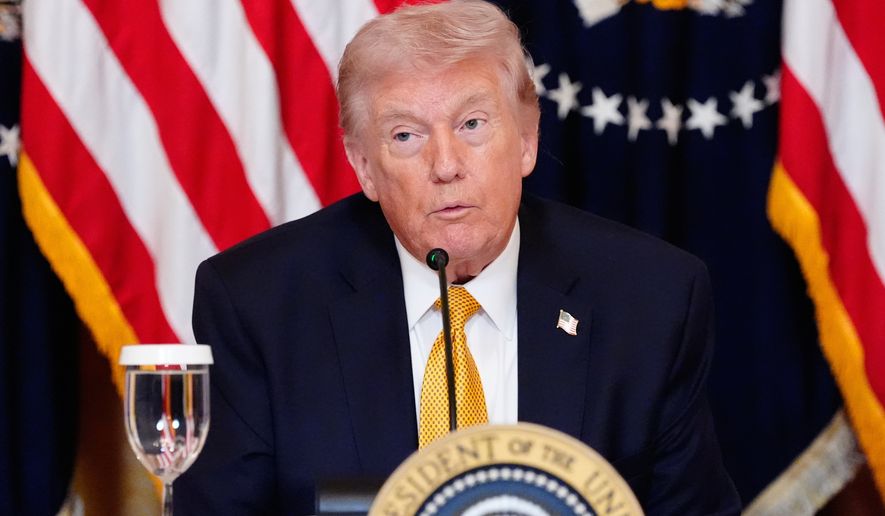

President Trump said Monday he is keeping a close watch on which countries help the U.S. break Iran’s logjam and reopen the Strait of Hormuz to oil traffic.
He said countries should not be dragging their feet, especially if American troops help defend those nations.
“Numerous countries have told me they are on the way. Some are very enthusiastic about it, and some aren’t,” Mr. Trump said at the White House.
The president said some countries depend mightily on the strait for their energy needs.
“They should be in here very happily helping us,” Mr. Trump said.
Mr. Trump is lobbying several countries to help the U.S., but some are cool to the idea.
U.K. Prime Minister Keir Starmer on Monday did not officially agree to send any British warships to the Persian Gulf. He said in a news conference that his government is drafting a workable plan to reopen the Strait of Hormuz for business safely, but asserted that his country would not be “drawn into a wider war.”
Japanese leader Sanae Takaichi issued a similar statement on Monday when addressing the Japanese parliament.
The president said there is a roster of countries willing to help the U.S., although he did not list them during his White House event.
“We’ll be announcing them,” Mr. Trump said. “We’ll give you a list.”
Mr. Trump said he spoke to French President Emmanuel Macron and graded him as an “eight” in terms of cooperation, on a scale of one to 10.
“Not perfect — but it’s France,” Mr. Trump said.
Mr. Trump decided to join forces with Israel and launch the operation against Iran on Feb. 28 because he wanted to dismantle Iran’s missile program, stop it from getting a nuclear weapon and end Tehran’s support for terror proxies in the Middle East.
Iran retaliated by striking oil-rich Gulf countries and closing down the Strait of Hormuz, a key channel for tankers carrying oil and other products.
Mr. Trump said the war is going well overall.
“They have been literally obliterated,” Mr. Trump said.
Mr. Trump said forces have struck more than 7,000 military and commercial targets across Iran. He also said the U.S. set back Iran’s ability to fire missiles.
“They don’t have too many missiles left,” Mr. Trump said.
The president said Iran seems to want to negotiate a deal to end the war, but he was not sure who was leading the country.
“They’re all dead. We don’t know who we’re dealing with,” Mr. Trump said.
Iran’s foreign minister said Sunday that Tehran has not sought negotiations with the U.S.
Mr. Trump also said he approved of Israel’s bombardment of Iran-backed Hezbollah targets in Lebanon.
“Hezbollah is a problem,” Mr. Trump said.
Mr. Trump also said the U.S. destroyed everything on Kharg Island, a key oil hub in Iran, while saving the oil “pipes,” though he might reconsider.
“We can do that on five minutes’ notice. It will be over,” Mr. Trump said.
Stocks rose on Monday because oil prices eased in recent days, though the Brent crude benchmark was still trading over $100 per barrel.
The International Energy Agency recently facilitated the release of 400 million barrels of oil from stockpiles in the U.S. and other member nations.
IEA Executive Director Fatih Birol said Monday his agency will consider future releases if necessary.
“We still have a lot of stocks left,” Mr. Birol said. “We can do more later as and if needed.”
However, he said stockpile releases are “not a lasting solution.”
“The single most important thing for a return to stable flows of oil and gas is the resumption of transit through the Strait of Hormuz.”
• Vaughn Cockayne contributed to this story.
• Tom Howell Jr. can be reached at thowell@washingtontimes.com.

Please read our comment policy before commenting.