



OPINION:
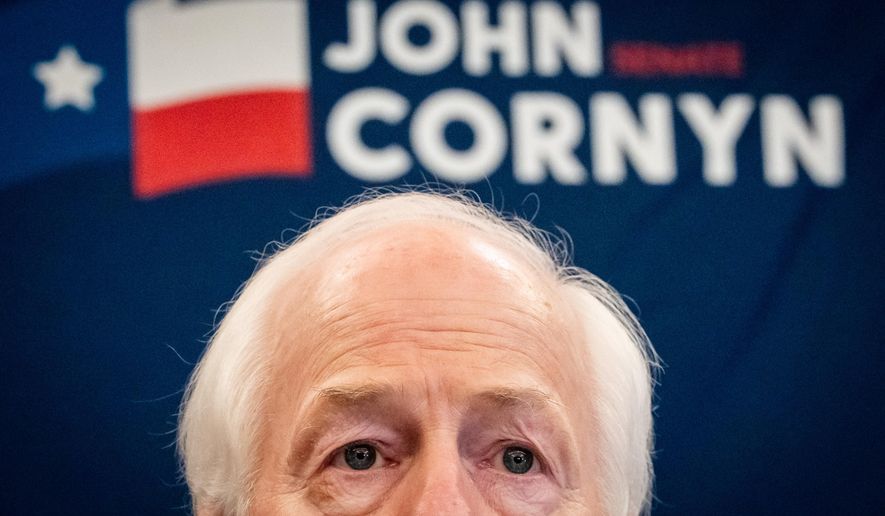
Sen. John Cornyn, Texas Republican, wrote a letter a week ago to the editors of the New York Post explaining that, after 24 years in the Senate, he had come to the sudden and startling epiphany that Senate Rule 22 — the filibuster — had to go. Why? To preserve America, pass the SAVE Act and, most important, ensure that President Trump endorses him in the runoff in Texas for the Republican nomination for the Senate.
In all fairness, he didn’t actually mention that last reason, but given the importance the president has placed on the SAVE Act — and the fact that Mr. Cornyn’s Republican opponent, Ken Paxton, has said he will leave the race if the SAVE Act becomes law — it seems reasonable to connect the dots, tell the truth and shame the devil.
The SAVE Act is the Republican version of election reform, centered mostly on the idea that people should produce some sort of photo identification before being allowed to vote (not controversial, except among congressional Democrats), as well as a practical ban on mail-in voting, support for which is a bit less emphatic.
Mr. Trump has decided to fight on this ground. He said he will not sign any other legislation into law until the SAVE Act is presented to him. That might be a challenge, given that almost all Senate Democrats oppose it in its current form (and any form, really) and, consequently, the chances of getting 60 votes in the Senate are remote.
There are a lot of opinions about the filibuster, most of them not well-formed. Mr. Cornyn’s letter to the Post did not help. He focused on the fact that the Senate Democrats could have (but did not) change the rule when they last held the majority in the Senate. I’m not quite sure what point he was trying to make, but it didn’t help his overall argument.
His main point — that the president should endorse him — was obvious although unstated.
The simple truth is that the filibuster is designed to protect senators from votes they would rather not take and to require a certain amount of bipartisan acceptance of whatever the Senate might be preparing to do.
Most senators understand that and the fact that the rule gives them outsized leverage with respect to process. Without it, the world’s greatest deliberative body would be reduced to a smaller, older, less interesting version of the House of Representatives.
One of the most striking features of the Senate is that it has few close votes. Votes are routinely 77-23 or 82-18. That is primarily because the 60-vote threshold tends to guarantee that, whether the Senate plans to vote for or against a measure, every senator has accepted the process that has led to the vote.
It ensures that minority voices are accommodated during the consideration of legislation. That’s good for everyone because pretty much everyone sitting in the Senate has been, is now or will be in the minority.
The filibuster has been chipped away at over the years and now no longer applies to judicial and executive branch nominees (thank you, Harry Reid). Three current Supreme Court justices would not have been confirmed without Reid’s change. Over time, these changes will no doubt result in more political and less competent judges and appointees.
That is reflected in confirmation votes, the only final votes in the Senate that skate by with 52 or 53 senators voting in the affirmative.
In short, absent Rule 22, the legislative process would become less protective of the minority, less precise and less fair, and it would result in worse product. It would be yet another step toward Congress’ emasculation and eventual reduction to irrelevancy.
Another, and an equally accurate way to look at it, is that the filibuster allows senators to evade difficult votes. It is most helpful to senators when they don’t want to vote the way their constituents want them to vote, allowing them to hide behind procedural objections.
All sorts of senators — including Sen. Elizabeth Warren, Massachusetts Democrat, and Sen. Jesse Helms, the late North Carolina Republican — have used the filibuster to avoid votes on issues such as police reform and gas taxes. The last time the Democrats held the majority in the Senate, the 60-vote requirement helped “moderate” Democratic senators avoid votes on voting rights legislation, packing the courts, gun control, tax increases, etc.
From a partisan point of view, it would probably be better in the long run for the Republicans if Rule 22 disappeared.
Right now, eight Democratic senators represent states that are reliably Republican. Only one Republican, Sen. Susan M. Collins of Maine, represents a state that is definitively Democratic. In a Senate where voting histories were straightforward and senators could not hide behind process, Republicans would routinely (if not almost always) have 52 to 60 senators.
In short, it is easy and not entirely wrong to characterize the filibuster as anti-democratic.
It would have been helpful had Mr. Cornyn offered a meaningful exegesis of the pros and cons of Senate Rule 22. Unfortunately, that was beyond the scope and purpose of his missive. He just wants the president to endorse him so he can return to the Senate, with or without the filibuster, and make it an even 30 years in Washington.
• Michael McKenna is a contributing editor at The Washington Times.

Please read our comment policy before commenting.