



OPINION:
Last week in these pages, Sen. Kevin Cramer, North Dakota Republican, offered a few thoughts about my column on his attempt to create the foundation for a tax on carbon dioxide. That would be, of course, a de facto tax on energy.
I started with the simple assertion that the report language attached to an appropriations bill received little public scrutiny.
Where did that crazy idea come from? Well, it turns out that it came from Mr. Cramer himself, who let E&E News know that he had imposed a “cone of silence” around his legislation and that it had taken “tremendous discipline” to remain quiet about including that language in the appropriations bill.
The senator apparently didn’t like his interview with E&E, so in his column, he pointed out that he had tried previously to insert the language in a more open fashion, which apparently failed. The most recent and most successful attempt was, by the senator’s own admission, considerably stealthier.
All that might lead a disinterested observer to conclude that perhaps the idea in question is unsavory enough that it cannot and has not been able to stand the disinfectant that is bright sunlight.
The lesson learned, apparently, is that the legislation can’t stand scrutiny, so the best thing to do is avoid talking about it as much as possible. There is probably a good reason for remaining as silent as possible.
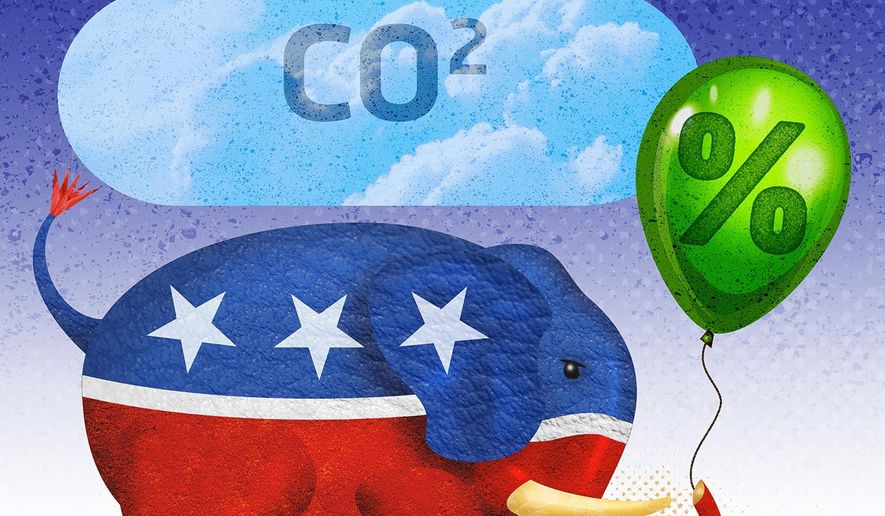
The report language requires the Department of Energy to study the amount of carbon dioxide emitted by cement plants, refineries, utilities, steel mills, etc. The nominal purpose of the exercise is to make it clear that American industry is the most energy-efficient in the world and to use that clarity to persuade the Europeans not to impose a carbon dioxide border tax (or tariff) on our goods based on carbon dioxide emissions.
The actual outcome of the exercise, whether intentional or not, is that it will establish the precedent of the U.S. government either imposing or recognizing the validity of a price (in this case, a carbon dioxide border tax) based on emissions of carbon dioxide.
Those who favor this legislation want to create a foundation, attaching a government-subsidized price to carbon dioxide emissions, that will lead directly to a tax on carbon dioxide, or, as normal people like to call it, a tax on energy.
Don’t get confused. It doesn’t matter whether we produce the same amount and quality of goods with fewer or more carbon dioxide emissions than the Europeans. Once we accept that it is legitimate to impose (or accept) border taxes based on greenhouse gas emissions, the precedent of placing a price on those emissions — taxing them, making people pay more for energy — will have been established.
That’s not a byproduct or an accident of this effort. It is the singular goal.
Mr. Cramer has been working on this for quite some time. He should understand that the entire purpose of the exercise is to pave the road for pricing carbon dioxide emissions and the eventual imposition of a domestic energy tax.
If he believes that this effort to sanction border taxes on carbon dioxide will not and should not lead to any type of broader energy tax, then he should make that clear. In October 2023, the senator sponsored a resolution against a domestic carbon dioxide tax. Voters would welcome the clarity that would be provided by a reassertion and expansion of that resolution to include border taxes on carbon dioxide.
For those worried about the Europeans imposing a border tax on American goods based on carbon dioxide, we have the salutary example of the maritime sector. There, the International Maritime Organization was supposed to impose a carbon dioxide tax on ship fuel in 2025. That lasted until Secretary of State Marco Rubio, Energy Secretary Chris Wright and Transportation Secretary Sean Duffy issued a joint statement that accurately described the International Maritime Organization proposal as a “neocolonial export of global climate regulations.”
The tax survived about 10 minutes once President Trump found out about it. Who can doubt that European efforts to impose a backdoor energy tax on the U.S. would fare about the same? It’s difficult to imagine Mr. Trump would be enthusiastic about opening the door to a damaging and regressive energy tax, especially during and immediately after an election focused on economics and affordability.
Members of Congress might want to reflect on why so few of their fellow citizens have confidence in them. As a body, Congress is unable or unwilling to balance a budget, declare war, fund the government, address the debt, maintain regular order or do anything one might expect from a legislative body (and that citizens receive regularly at the state and local levels).
There is no public demand at the moment for a tax, or its precursor, on energy that will drive up prices and harm those — families, workers, the poor, those on fixed incomes and local institutions such as hospitals and schools — least able to pay more for energy.
Consequently, it is difficult to understand why Congress is spending valuable time on an effort that is destined to fail.
• Michael McKenna is a contributing editor at The Washington Times.

Please read our comment policy before commenting.