



A version of this story appeared in the daily Threat Status newsletter from The Washington Times. Click here to receive Threat Status delivered directly to your inbox each weekday.
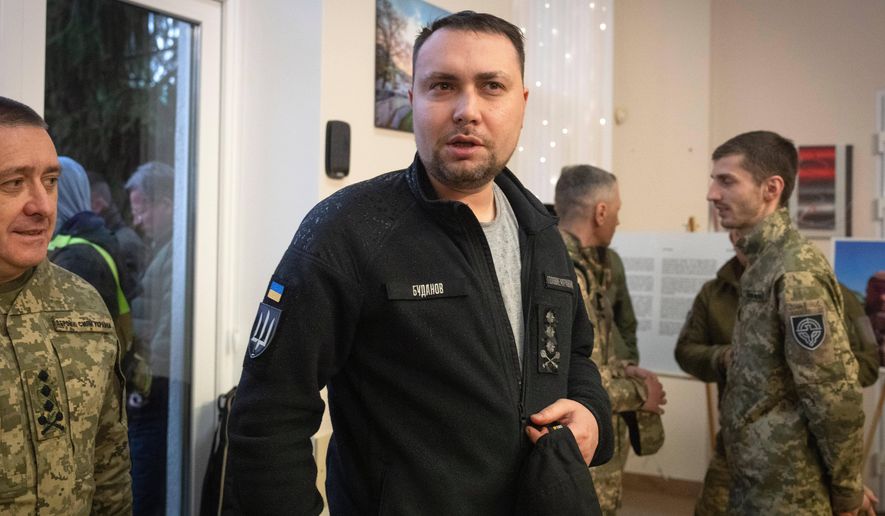
KYIV, Ukraine — Lt. Gen. Kyrylo Budanov, 40, has operated in a realm deliberately removed from Ukraine’s public political life for most of the war against Russia. As head of the Defense Intelligence of Ukraine, the GUR, he oversaw a service whose successes are at times hard to quantify, with their full extent often discovered long after the fact, if ever.
Still, it was his name, invariably, that would come up after explosions in the occupied Crimean Peninsula, or after yet another assassination of a high-ranking Russian officer.
Although rumored to harbor political ambitions, the spy chief wielded his power from the shadows, focusing on the task at hand: securing victory for Ukraine against Russia and its invading armies.
His appointment as head of the presidential office now brings that power into full view.
President Volodymyr Zelenskyy’s Jan. 2 announcement naming Gen. Budanov to one of the most politically exposed posts in the Ukrainian system, alongside the removal of Lt. Gen. Vasyl Maliuk — who led the SBU, Ukraine’s top security agency — could prove to be more than a mere reshuffle of Mr. Zelenskyy’s inner circle.
Gen. Budanov offers the Zelenskyy administration more than his battlefield acumen. He reportedly has a strong relationship with key U.S. officials. He learned spycraft in a CIA-backed program and recuperated from an injury earlier in the war at Walter Reed National Military Medical Center in Washington’s Maryland suburbs, The New York Times reported.
Some observers speculate that Mr. Zelenskyy is testing whether a wartime intelligence figure can be integrated into the machinery of civilian governance without compromising operational effectiveness or political control.
It’s a tall order as Russian forces renew their assaults in the country’s east and diplomatic pressures are brought to bear on Kyiv.
Mr. Zelenskyy presented the move as a wartime necessity. Announcing the appointment, he said Gen. Budanov’s experience and authority would enable the presidential office to focus more directly on security matters and the negotiation process, arguing that this alignment was necessary given the stage the conflict had reached.
The message appears to have been calibrated to both domestic and foreign audiences. As the war remains mired in bloody attritional warfare and Washington increases pressure for peace talks, Kyiv is signaling that its political center will now be run by someone steeped in the logic of security rather than political brokerage.
After nearly four years of full-scale war, Ukrainians consistently express far higher trust in the military and security services than in any other political institutions.
Gen. Budanov’s public standing, shaped by successful intelligence operations and a reputation for blunt realism, is a political asset for Mr. Zelenskyy while the wartime president is under enormous pressure from Washington to hold long-delayed elections.
The appointment also marks a clear break with the era of Andrii Yermak, whose tenure came to symbolize the hypercentralization of power within the Zelenskyy administration.
Mr. Yermak’s growing unpopularity at home, combined with mounting irritation among Western partners, particularly in Washington, had turned him into a liability as Ukraine sought to preserve external support while navigating internal crises.
He was dismissed after a broader political shake-up in Kyiv, including high-profile anti-corruption investigations, at a time when Mr. Zelenskyy could least afford additional friction.
For Ukrainian political analyst Volodymyr Fesenko, Gen. Budanov’s promotion should be understood primarily through the prism of presidential power.
“From the standpoint of President Zelenskyy’s interests, this is a logical and fairly strong step,” he told The Washington Times. Gen. Budanov, he said, enters the administration not as a technocrat but as “a war hero, a person with a mostly positive reputation,” a profile that immediately reinforces Mr. Zelenskyy’s authority within the system.
Mr. Fesenko emphasized the symbolic importance of the move.
“The very fact of Budanov’s appointment refutes the popular version that Yermak continues to run the office after his dismissal, but does so behind the scenes,” he said.
Relations between the two men had long been strained, with Mr. Yermak repeatedly urging Mr. Zelenskyy to remove Gen. Budanov. Installing Gen. Budanov in Mr. Yermak’s former position signals that Mr. Zelenskyy retains control over the levers of power in Kyiv.
Yet the decision carries risks that go beyond elite rivalries.
The office of the president already wields enormous informal authority, often eclipsing parliament and ministries in practice. Bringing an intelligence chief into that role raises the prospect of further militarization of civilian governance. Mr. Fesenko warned that under Gen. Budanov, the office could begin to function, informally and without legal changes, as a de facto central military administration.
Such a shift, he said, would likely meet resistance across the state apparatus, including within the office itself, where bureaucratic and political interests are deeply entrenched.
Some observers see a more subtle political calculation at play.
Olga Rudenko, editor-in-chief of The Kyiv Independent, argued on social media that the appointment may serve a dual purpose for Mr. Zelenskyy.
“On Zelenskyy’s part, appointing Budanov means neutralizing a key political rival,” she wrote. “It will tie Budanov to this administration’s brand, including potentially to an unpopular peace deal, which can slash his personal rating, earned by successful intel operations.”
Her assessment reflects a broader reading in Kyiv that Gen. Budanov’s move into overt politics may cost him the nonpartisan aura that made him popular in the first place.
That analysis is shared by another Ukrainian journalist, who wished to remain anonymous: “The only consolation is that his rating will plummet so quickly that after Zelenskyy, no one will remember him in a positive light,” he wrote to The Times. “And although Telegram cannot be considered a social barometer, I fail to see any joyful reactions to his appointment in my bubble.”
For Gen. Budanov, the transition is fraught with uncertainty. Intelligence work rewards secrecy, autonomy and narrow operational focus. Running the presidential office requires constant negotiation and bureaucratic management and exposes the head of the office to political fallout.
“This is an absolutely new job for him, mostly bureaucratic and political,” said Mr. Fesenko, adding that the position is widely perceived as toxic and prone to conflict.

Please read our comment policy before commenting.