


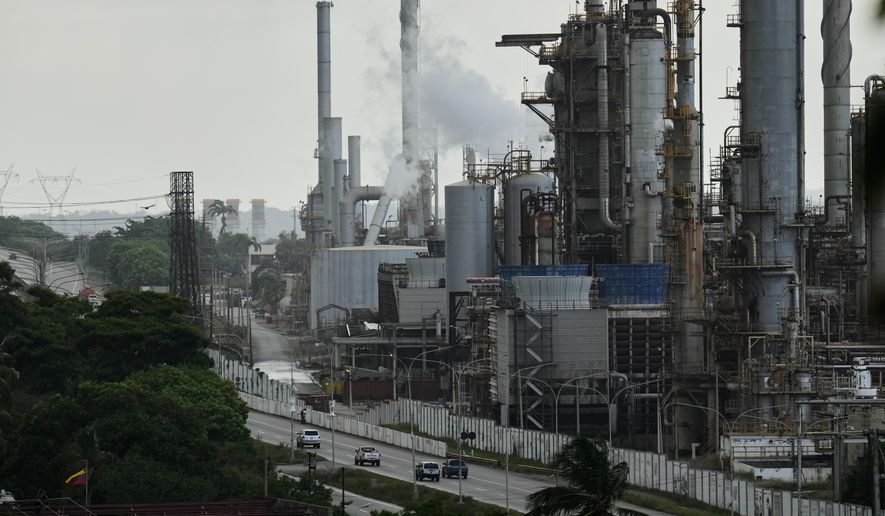

The Trump administration said Wednesday that it is marketing Venezuelan crude oil for sale and will control the flow of crude from the South American country “indefinitely,” as U.S. forces seized two sanctioned tankers in Atlantic waters.
The administration is enlisting private companies and financial institutions to facilitate the sale of oil. It insists that the aggressive efforts will benefit everyone.
“All proceeds from the sale of the Venezuelan crude oil and products will first settle in U.S.-controlled accounts at globally recognized banks to guarantee the legitimacy and integrity of the ultimate distribution of proceeds,” White House press secretary Karoline Leavitt said. “Those funds will be disbursed for the benefit of the American people and the Venezuelan people at the discretion of the United States government.”
She said the U.S. will roll back some sanctions on Venezuelan oil to facilitate the sales.
Moves to control the crude supply from Venezuela, which has the world’s largest known oil reserves, followed the U.S. military’s weekend raid to capture President Nicolas Maduro in Caracas.
Mr. Maduro was flown to New York to face an indictment on narco-terrorism charges, leaving Venezuela in the hands of an interim government.
SEE ALSO: Trump says Venezuela will buy only U.S. products with new oil money
Secretary of State Marco Rubio said the fast-moving actions this week are part of a broader plan to stabilize Venezuela under acting President Delcy Rodriguez while using its oil reserves as leverage to ensure American interests.
“It’s not just winging it,” Mr. Rubio told Capitol Hill reporters Wednesday.
He said oil profits will benefit regular people and “not corruption, not the regime.”
On Dec. 16, President Trump imposed a “total and complete blockade” on sanctioned Venezuelan oil tankers.
On Wednesday, the U.S. intercepted and boarded a Venezuela-linked oil tanker, now registered under Russia, in the North Atlantic after multiple weeks of pursuit.
The Treasury Department-sanctioned oil tanker, formerly known as the Bella 1 and now named Marinera, defied the U.S. maritime blockade of sanctioned vessels. The tanker was reportedly being shadowed by a Russian submarine when U.S. authorities seized it.
SEE ALSO: Energy boss Wright says U.S. will control Venezuelan oil flow ‘indefinitely’
The U.S. Coast Guard, which had a warrant to seize the ship, attempted to board the Bella 1 off the coast of Venezuela last month. The ship was accused of breaking U.S. sanctions and shipping Iranian oil. It then changed its name and re-registered as a Russian vessel.
Attorney General Pam Bondi said members of Bella’s crew could face prosecution.
“As a consequence of failing to obey the Coast Guard’s orders, members of this vessel are under full investigation and criminal charges will be pursued against all culpable actors,” Ms. Bondi said on X.
The U.S. seized a second ship Wednesday in the Caribbean, Homeland Security Secretary Kristi Noem said.
The ship, called the Motor Tanker Sophia, recently docked at an oil port in Venezuela and wasn’t transmitting location data.
The Marinera seizure could raise tensions between Washington and Moscow.
The Russian Foreign Ministry told state news agency Tass that the vessel was operating in full compliance with international maritime law and was receiving “disproportionate” attention from the U.S.
Russia had reportedly sent at least one naval vessel to escort the tanker.
Meanwhile, Energy Secretary Chris Wright said he is working with the interim government in Caracas to sell stored oil, rebuild infrastructure and stabilize production.
“Indefinitely, going forward, we will sell the production that comes out of Venezuela into the marketplace,” he said at a Goldman Sachs energy conference in Miami. “If we control the flow of oil, the sales of [that] oil and the flow of the cash that comes from those sales, we have large leverage. But without large leverage, as we’ve seen in the last 25 years, you don’t get change.”
Mr. Wright described the state of Venezuelan oil infrastructure as “not good,” signaling a long project ahead.
Mr. Trump said Tuesday that the interim Venezuelan government will turn over 30 million to 50 million barrels of sanctioned oil to the U.S.
The oil, the president said, “will be taken by storage ships and brought directly to unloading docks in the United States.”
His focus on oil will likely fuel skepticism about U.S. motives.
Some Venezuelans cheered the ouster of Mr. Maduro, who is viewed by many in the West as an illegitimate leader. Others denounced American interference as an ugly throwback to an imperialist era in which outsiders cared more about their natural resources than their well-being.
Senate Minority Leader Charles E. Schumer, New York Democrat, accused Mr. Trump of abandoning his push to put “America first” in his actions overseas.
“How does spending years and potentially billions of taxpayer dollars in Venezuela help families pay their rent, their mortgages, their grocery bills, their electric bills, their health care bills?” he wrote on X.
The Trump administration insists U.S. intervention will benefit Americans and Venezuelans.
“We want to change the game in Venezuela, fix the country so it’s a productive member of the Western Hemisphere, so it’s an ally of the United States and a major supplier of oil to the world,” Mr. Wright said. “But the old ways weren’t working.”
Mr. Trump’s moves in Venezuela are reverberating around the globe.
U.S. lawmakers and European leaders in NATO are concerned that Mr. Trump will use military force to seize Greenland, a part of the Kingdom of Denmark, given recent rhetoric from Mr. Trump and his top aides.
“Threats and intimidation by U.S. officials over American ownership of Greenland are as unseemly as they are counterproductive,” said Sen. Mitch McConnell, Kentucky Republican. “And the use of force to seize the sovereign democratic territory of one of America’s most loyal and capable allies would be an especially catastrophic act of strategic self-harm to America and its global influence.”
Mr. Rubio said Mr. Trump’s preference is to purchase the Arctic island.
“President Trump’s been talking about this since his first term,” the secretary of state said.
Danish officials have rejected those offers and are taking military action seriously.
Ms. Leavitt said Mr. Trump does not like to signal his plans.
“That’s not something this president does. All options are always on the table for President Trump,” she said.
Ms. Leavitt said diplomacy is always the first option, though she noted that Venezuela and Iran have found out the hard way that Mr. Trump is ready to use military force if talks fail.
• Mary McCue Bell can be reached at mbell@washingtontimes.com.
• Tom Howell Jr. can be reached at thowell@washingtontimes.com.

Please read our comment policy before commenting.