



A version of this story appeared in the daily Threat Status newsletter from The Washington Times. Click here to receive Threat Status delivered directly to your inbox each weekday.
NEWS AND ANALYSIS:
Among the major military failures exposed during the U.S. raid against Venezuela was the inability of a high-technology Chinese radar system to operate.
Extensive Russia anti-aircraft missiles and radar also were rendered useless.
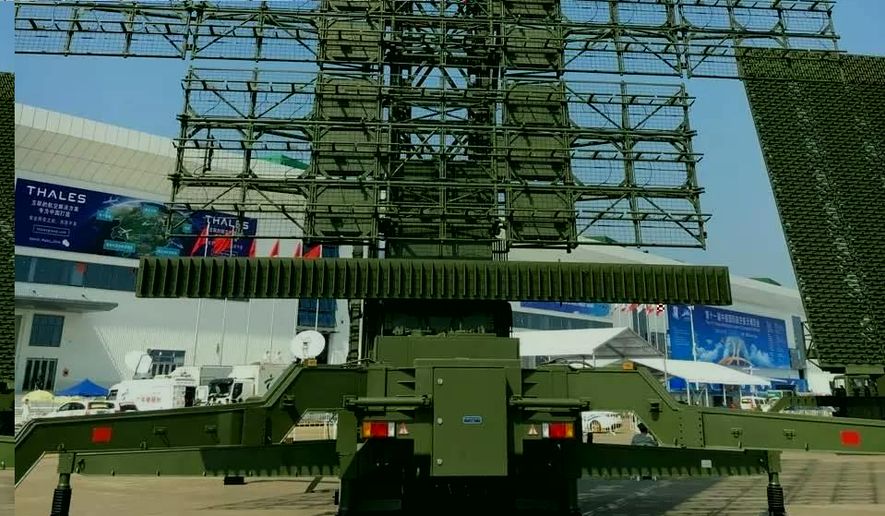
The Chinese radar system in question is the JY-27A system that Beijing sold to Caracas and markets elsewhere as capable of detecting low-observable aircraft. This is a key sensor capability the Chinese military wants for use in countering F-35 and F-22 stealth jets and B-2 and future B-21 stealth bombers in any future conflict with the U.S.
However, U.S. military forces on Saturday demonstrated highly effective mission SEAD — suppression of enemy air defenses — in the opening minutes of the lightning-fast raid. Forces knocked out both the Chinese radar and extensive Russian air defense missile systems.
Asked about the failure of the Chinese equipment in Venezuela, Chinese Foreign Ministry spokesman Lin Jian appeared temporarily at a loss for words before declining to address the issue.
“China firmly supports Latin America and the Caribbean region’s status as a Zone of Peace,” Mr. Lin said Monday in Beijing in response to a Japanese reporter who asked why Chinese military equipment appeared to be “of little practical use” during the raid.
The Y-27A is a long-range air surveillance and guidance radar the Chinese claim is resistant to jamming while being highly reliable and mobile. The Very High Frequency radar uses an active phased array antenna.
Its manufacturer, the state-owned China Electronics Technology Group Corporation, has said the radar can detect stealth aircraft like the F-22 up to 310 miles away.
Details on exactly how the Venezuelan military’s Chinese and Russian air defenses were rendered useless has not been made public.
Chairman of the Joint Chiefs of Staff Gen. Dan Caine told reporters the operation involved “meticulous” planning and execution by air, ground, space and naval forces.
As U.S. warplanes approached Venezuelan shores, the joint forces began “layering different effects” from space, cyberspace and intelligence units, he said.
“The force included F-22s, F-35s, F-18s, EA-18s, E-2s, B-1 bombers, and other support aircraft, as well as numerous remotely piloted drones,” Gen. Caine said, noting that the early strikes dismantled and disabled air defenses allowing special operations commandos to enter without resistance on helicopters.
The EA-18 “Growlers” were reportedly key electronic jamming and communications systems used in the SEAD mission.
According to online military analyst Shanaka Anslem Perera, the Maduro government spent about $2 billion on Russian S-300 air defense missiles along with support radar and communications that were linked to the Chinese JY-27A system.
Moscow also supplied the Pantsir-S1, a gun-missile hybrid weapon engineered to knock out drones and low-flying helicopters — like those that penetrated Venezuelan airspace during the raid.
“None of them fired. Not one,” Mr. Perera stated on Substack.
Yu Tsung-chi, a retired major general from Taiwan and former president of the Political Warfare College at Taiwan’s National Defense University, said Beijing’s military capabilities are designed more for messaging than actual combat.
“A system built to look modern on paper and intimidating in propaganda falls apart under the demands of real combat,” Gen. Yu told the Epoch Times.
Rick Fisher, a China expert, said the Trump administration must press the regime in Caracas to have the Venezuelan military sell surviving Chinese and Russian air defense weapons to the U.S. to help boost SEAD capabilities for future operations.
“It is now crucial to convince the new Venezuelan leadership to sell the range of available Chinese and Russian weapons to the United States, to better save lives when China attacks Taiwan and to deter Chinese arms sales in the Western Hemisphere,” said Mr. Fisher, who is with the International Strategic and Assessment Center.
The American military successfully neutralized the China-Russia air defense system.
“But that does not mean that China’s Integrated air defenses will not work on the Taiwan Strait,” Mr. Fisher said. “It is now critical to obtain examples of the Chinese and Russian radar to better understand their structure and software to devise even better countermeasures.”
Permitting a large purchase of Venezuela’s Chinese and Russian-origin weapons should be a major first U.S. test of Venezuela’s new government, he said.
In addition to the radar, China also has supplied Venezuela with ground combat systems including VN-16 amphibious assault vehicles and VN-18 infantry fighting vehicles, and rocket artillery systems.
The weapons have been shown in recent Venezuelan military parades.
DNI offers grudging support for Venezuela raid
Director of National Intelligence Tulsi Gabbard broke her silence on Tuesday regarding the U.S. military raid in Venezuela and offered tepid support.
In a post on X, Ms. Gabbard appears to have backed away slightly from earlier anti-interventionist remarks on U.S. involvement in Venezuela.
After several days of avoiding comment on the daring raid to capture Venezuelan President Nicolas Maduro, Ms. Gabbard offered “kudos” to U.S. military service members and intelligence personnel who took part in what she called a “flawless” military action dubbed Operation Absolute Resolve.
“President Trump promised the American people he would secure our borders, confront narcoterrorism, dangerous drug cartels, and drug traffickers,” she said.
The post Tuesday followed news reports highlighting her much different position as a former progressive Democrat.
In 2019, Ms. Gabbard posted on then-Twitter that “The United States needs to stay out of Venezuela. Let the Venezuelan people determine their future. We don’t want other countries to choose our leaders — so we have to stop trying to choose theirs.”
When she ran for president in 2020, Ms. Gabbard also called for an end to “regime change wars.”
Ms. Gabbard is a former Democrat congresswoman from Hawaii and a lieutenant colonel in the Army Reserve.
She endorsed Mr. Trump in late 2024 despite political views that raised eyebrows among some conservative Republicans.
In October 2020, she co-sponsored congressional legislation that would have required the U.S. to drop criminal charges against National Security Agency leaker Edward Snowden.
Ms. Gabbard left the Democratic Party in 2022 and joined the Republicans, changing her views to support many GOP topics, including on abortion and gun control, questioning environmental policy, and opposing transgender athletes in women’s sports.
She once said: “When it comes to the war against terrorists, I’m a hawk, [but] when it comes to counterproductive wars of regime change, I’m a dove.”
Asked about Ms. Gabbard’s views on the raid, a DNI spokeswoman referred Inside the Ring to her post on X.
Chinese communist calls for Venezuelan-style raid on Taiwan
Li Yi, a former Chinese university professor, took to social media to praise President Trump for the successful military raid in Venezuela and criticized Beijing for failing to conduct a similar operation against Taiwan.
Mr. Li, an outspoken influencer who in the past called on China to invade Taiwan and favors global Chinese imperialism, stated in a post on X that Mr. Trump used the techniques of ancient strategist Sun Tzu against Venezuelan President Nicolas Maduro.
The U.S. military in Venezuela followed the dictum that “if you want to catch a thief, catch their king first. It is brilliant,” Mr. Li said, quoting Sun’s “The Art of War.”
To Beijing, Mr. Li then said: “You need to learn quickly. You can’t even catch the Taiwanese president. And yet you mocked Trump. You are so shameless.”
“How long have you been f——— around with Taiwan without doing anything? Can’t even unify China,” he said.
Mr. Yi, 64, is a U.S.-educated sociologist who was a researcher at China’s Renmin University and director of the Taiwan Research Institute at Fuzhou University.
The dissident overseas Chinese social media outlet The Great Translation Movement, which reposted Mr. Li’s video rant, said he was taken into custody by Chinese authorities for the comments.
Other reports from Taiwan say Mr. Li is outside of China and possibly living in the U.S
He could not be reached for comment.
• Contact Bill Gertz on X @BillGertz.
• Bill Gertz can be reached at bgertz@washingtontimes.com.

Please read our comment policy before commenting.