



OPINION:
Three months into his first term, President Trump was dining with Chinese President Xi Jinping at his Mar-a-Lago club in Palm Beach, Florida, when he authorized the firing of 59 U.S. Tomahawk missiles at the Al Shayrat air base in Homs, Syria.
“I was sitting at the table. We had finished dinner. We’re now having dessert. And we had the most beautiful piece of chocolate cake that you’ve ever seen, and President Xi was enjoying it,” Mr. Trump later said. Mr. Trump recalled that Mr. Xi paused about 10 seconds after learning the news and then responded via an interpreter that, in the case of “anybody that was so brutal and uses gases to do that to young children and babies, it’s OK” to respond with force.
Mr. Trump had warned Syrian President Bashar Assad not to use nerve agents on his own people, but Mr. Assad didn’t listen. The air base targeted by U.S. forces was the same one Mr. Assad used to launch his assault and store Syria’s chemical weapons and air forces.
“It is in the vital national security interest of the United States to prevent and deter the spread and use of deadly chemical weapons,” Mr. Trump said of the attack in an address to the nation after the fact. “Years of previous attempts at changing Assad’s behavior have all failed and failed very dramatically. As a result, the refugee crisis continues to deepen, and the region continues to destabilize, threatening the United States and its allies.”
For the remaining three years of Mr. Trump’s first term, the world was quiet. Dictators, authoritarians and hostile world leaders, including Mr. Xi, were stunned by Mr. Trump’s decisive, surgical action to use U.S. military force to enforce red lines.
In October 2019, under Mr. Trump’s leadership, U.S. forces killed Islamic State group founder and leader Abu Bakr al-Baghdadi in a raid in northwestern Syria. Then, on Jan. 3, 2020, Mr. Trump authorized a drone strike in Baghdad that killed Iranian Maj. Gen. Qassem Soleimani, the head of Iran’s elite Quds Force.
There was no retaliation by America’s enemies. Instead, world leaders seemed to wait for Mr. Trump to leave office before they dared take hostile action.
Under President Biden’s feckless leadership, Russia invaded Ukraine, Iranian-backed Hamas attacked Israel, and China flew a spy balloon over the continental U.S. with impunity.
On Saturday, Mr. Trump once again reminded the world that he governs differently from his predecessor.
In a mere two-hour, 20-minute mission by air, land and sea, the U.S. military was able to capture illegitimate Venezuelan dictator Nicolas Maduro and his wife at their Caracas safe house and then transport them to New York City for American justice.
“This was one of the most stunning, effective and powerful displays of American military might and competence in American history,” Mr. Trump said in a press conference Saturday about the carefully planned and executed attack. “And if you think about it, we’ve done some other good ones, like the attack on Soleimani, the attack on al-Baghdadi, and the obliteration and decimation of the Iran nuclear sites just recently in an operation known as Midnight Hammer, all perfectly executed and done.”
The attack, like the one in Syria during Mr. Trump’s first term, was fast, conducted with pinpoint precision and greenlit while Mr. Trump was on holiday at Mar-a-Lago. It was shocking but well telegraphed.
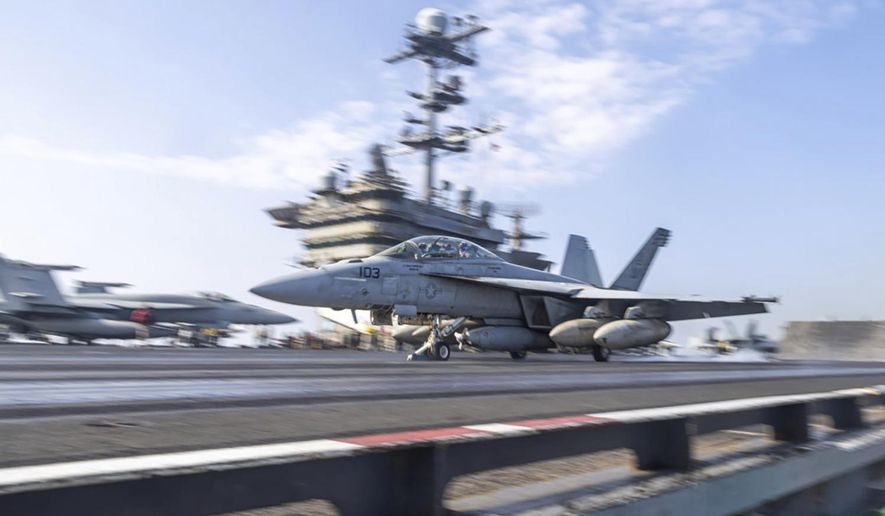
For months, thousands of U.S. troops have deployed in the region on aircraft carriers and warships. The U.S. has been blowing up dozens of small boats ferrying drugs and has seized sanctioned oil tankers as Mr. Trump has repeatedly accused Mr. Maduro of drug trafficking and narco-terrorism. In the weeks leading up to the attack, Mr. Trump indicated that a U.S. land strike in Venezuela was possible.
China, Russia and Iran all had been working with the Maduro regime as Venezuela devolved into a permissive operating environment for them and transnational criminal networks to undermine the U.S. interests in its own hemisphere. China sold and implemented Venezuela’s air defense system. Hours before the American attack, a high-level Chinese delegation met with Mr. Maduro at his palace.
“The No. 1 thing we care about is the safety, security, well-being and prosperity of the United States,” Secretary of State Marco Rubio said Sunday on NBC’s “Meet the Press” about the attack. He reiterated that the U.S. wouldn’t tolerate drug trafficking in the region, Iran’s Hezbollah presence there or Venezuela’s using its oil industry and resources to “enrich all our adversaries around the world.”
Mr. Trump was sure to drive the message home. “The United States military is the strongest and most fearsome military on the planet, by far, with capabilities and skills our enemies can scarcely begin to imagine,” he said Saturday.
He continued: “We will secure our borders, we’ll stop the terrorists, we will crash the cartels, and we will defend our citizens against all threats, foreign and domestic. Other presidents may have lacked the courage or whatever to defend America, but I will never allow terrorists and criminals to operate with impunity against the United States. This extremely successful operation should serve as a warning to anyone who would threaten American sovereignty or endanger American lives.”
America’s enemies were all listening. Most, if not all, were left stunned, bewildered and in awe of American might and resolve. That was precisely the message Mr. Trump wanted to convey.
• Kelly Sadler is the commentary editor at The Washington Times.

Please read our comment policy before commenting.