



A version of this story appeared in the daily Threat Status newsletter from The Washington Times. Click here to receive Threat Status delivered directly to your inbox each weekday.
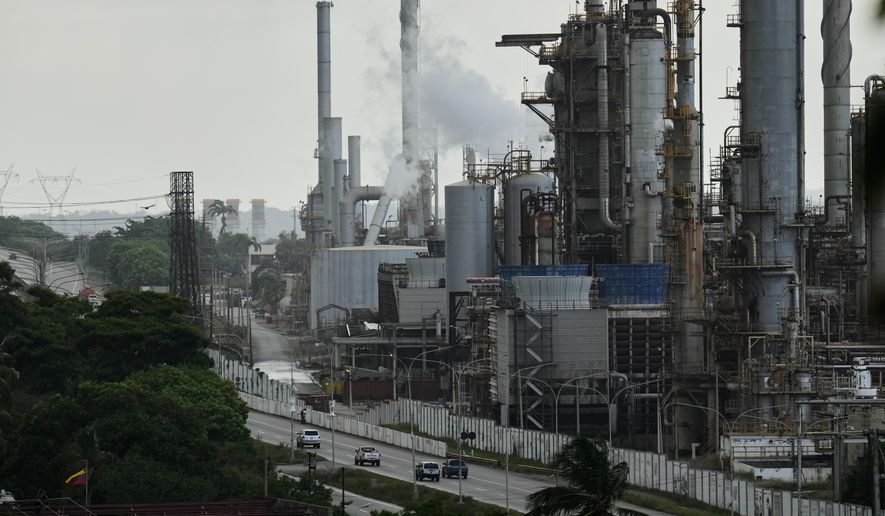
Venezuela’s state-run oil company is reducing production as a U.S. military blockade severely strains the country’s fuel storage capacity, underscoring the Trump administration’s significant economic leverage over the new leaders in Caracas.
How the administration plans to use that leverage is one of the key questions hanging over U.S. policy in Venezuela, although analysts stress that fixing the outdated, underperforming oil industry in the South American nation will require years of sustained commitment from Washington.
As Venezuela’s government-run PDVSA oil company released the reports of production cuts Monday, the country’s former leader, Nicolas Maduro, appeared in federal court in New York City to face narco-terrorism and other charges after U.S. Special Forces captured him in a daring weekend raid in Caracas.
In the days since that raid, the Trump administration has made clear that it intends to take a direct role in overseeing the oil sector in Venezuela, which, despite having the world’s largest proven oil reserves at more than 300 billion barrels, has had reduced production in recent years because of mismanagement, crumbling energy infrastructure and a slate of tough U.S. economic sanctions.
U.S. oversight of Venezuela’s oil sector could provide Washington with a powerful tool to advance its own interests in the Western Hemisphere and beyond.
Analysts caution that many questions remain unanswered about the administration’s long-term plan for Venezuela’s oil and the role U.S. companies will play in it. Politics and security issues aside, specialists say it will take at least several years and tens of billions of dollars in investments to rebuild the country’s badly degraded energy infrastructure.
“The U.S. has a lot of leverage but has a choice of whether and how to use it,” said Rachel Ziemba, an adjunct senior fellow at the Center for a New American Security who specializes in the intersection of economic and security issues.
“In order to actually have U.S. companies go in, there would have to be both predictability on the domestic governance structure and royalties … as well as some clarity with whatever is going to happen with the regime,” she said in an interview. “For major increases [in oil production], we’re talking about years and definitely tens of billions of dollars.”
The administration has indicated its intention to open Venezuela’s energy resources to U.S. companies, some of which have the refining capacity necessary to handle the heavy crude produced in Venezuela. Only one American company, Chevron, operates in Venezuela under a special U.S. license and as part of a joint venture with PDVSA.
The Venezuelan state-run oil company is cutting its crude oil production because the country is running out of storage capacity, Reuters reported, a direct result of the U.S. blockade on oil exports.
Oil exports fund more than half of Venezuela’s annual federal budget, meaning a continued blockade would have devastating economic impacts for the country. Still, Venezuela has indicated that it may try to circumvent that blockade. At least 16 Venezuelan oil tankers appear to have attempted to evade the U.S. quarantine and sail on to their destinations, The New York Times reported Monday.
On the governance side, the Trump administration clearly intends to use its power over Venezuelan oil to influence the tack of Delcy Rodriguez, who was formally sworn in Monday as the country’s interim president.
Secretary of State Marco Rubio said Sunday that U.S. influence over the country’s oil sector is what the Trump administration means when it says it plans to “run” Venezuela in the short term.
“What we are running is the direction that this is going to move moving forward, and that is we have leverage. This leverage we are using, and we intend to use. We started using [it] already,” he told ABC’s “This Week” program. “You can see where they are running out of storage capacity. In a few weeks, they’re going to have to start pumping oil unless they make changes.”
The U.S. could use its leverage to pressure Venezuela to clamp down on drug trafficking and illegal immigration, or to stop its purchases of arms from Russia and its economic cooperation with communist China.
The administration also could use its leverage in Venezuela to impact the politics elsewhere in the region, such as in Cuba, which relies heavily on Venezuelan oil. About 4% of Venezuela’s oil exports went to Cuba in 2023, according to U.S. government data.
Venezuela produces only about 1 million barrels per day, accounting for less than 1% of the total global output.
China is by far Venezuela’s largest customer, accounting for more than two-thirds of Venezuelan oil exports, recent data shows.
As an overall share of China’s oil imports, Venezuela is a small-time player, providing about 470,000 barrels per day. That pales in comparison with China’s imports from Russia, about 2.2 million barrels per day, as well as Beijing’s imports from Middle Eastern nations and other suppliers.
That doesn’t mean there aren’t immediate effects on China’s geopolitical calculus stemming from the U.S. capture of Mr. Maduro and its direct role in Venezuela’s future.
“What’s more important for China is what this symbolizes and signifies for broader Chinese investment in the Western Hemisphere,” Ms. Ziemba said.
• Ben Wolfgang can be reached at bwolfgang@washingtontimes.com.

Please read our comment policy before commenting.