


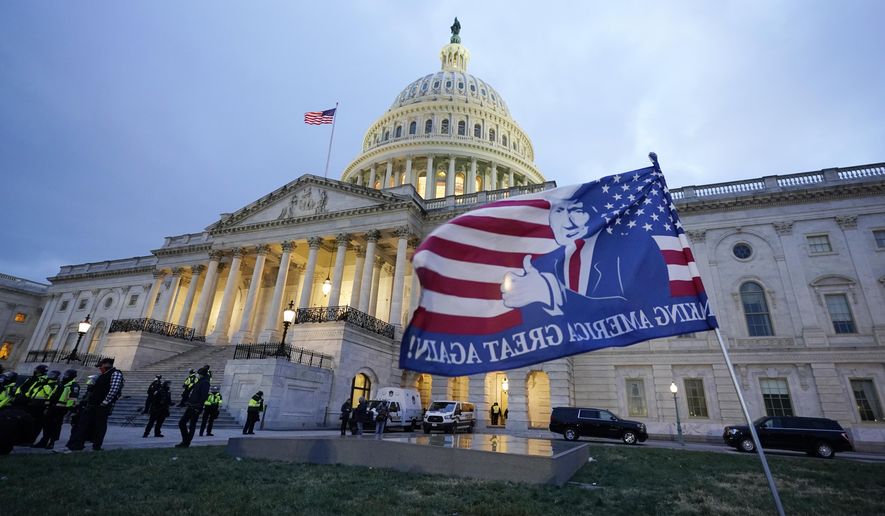

Many people thought President Trump was in big trouble and could even land in prison after the Jan. 6 riot unfolded in Washington five years ago.
Instead, he is entering the second year of another White House term and is rewriting the narrative around the Capitol clash that shocked the world.
Mr. Trump has pardoned more than 1,000 people of offenses related to the riot while commuting the sentences of 14 others. He hopes to recast the rioters as victims of overzealous prosecution after what he still characterizes as the “rigged” election of 2020.
His Republican allies on Capitol Hill have launched an inquiry into the Democratic-led investigation that faulted Mr. Trump’s action for the riot. It focuses on potential security failures.
Five years on, Mr. Trump has largely neutralized Jan. 6 as a political liability. Americans are focused on other topics, such as immigration and economic worries, that propelled Mr. Trump back to the White House after the 2024 election.
“My sense is that only a small percentage of Americans would hold up as valorous what actually happened on Jan. 6: a violent invasion of the Capitol building, the desecration of civic monuments, leading to multiple deaths of law enforcement officers and a near attack on an eminently decent and patriotic vice president,” said Russell Riley, professor and co-chair of the Presidential Oral History Program at the University of Virginia’s Miller Center.
“But the ugliness of five years ago bears little now on the cost of rent or opportunities for decent employment,” he said. “It is that reality that permits President Trump to reconstruct the history of that day largely with impunity.”
Democrats from a former select committee that investigated the riot are set to reconvene Tuesday for a special hearing that focuses on “ongoing threats to free and fair elections” and new crimes committed by people who were pardoned for Jan. 6 offenses.
Mr. Trump and the White House have not announced any plans to acknowledge the Jan. 6 anniversary.
“President Trump is focused on issues the American people actually care about,” White House spokeswoman Abigail Jackson said. “The Trump administration is securing historic investments for domestic job growth, deporting criminal illegal aliens, driving down violent crime, restoring the economy and more.”
Some developments related to the 2021 riot cut across party lines. The Democratic and Republican national committees were targeted with pipe bombs at their Washington headquarters around the time of the Jan. 6 riot.
The bombs did not detonate and were discovered during the afternoon when rioters stormed the Capitol, but investigators only recently arrested a suspect.
Prosecutors said Brian J. Cole Jr. told investigators that he was frustrated by possible tampering of the 2020 election and targeted both parties because they were “in charge.”
He is being detained pending trial.
Mr. Trump spent the weeks after his November 2020 loss to Joseph R. Biden complaining about alleged fraud and urging states to reexamine their tallies.
He gave a fiery speech on the White House Ellipse on Jan. 6, 2021, in which he vowed to “never concede” the election. He urged Vice President Mike Pence to block the certification of the election, which would have sent the issue back to the states.
Mr. Trump told supporters to go to the Capitol “peacefully and patriotically.”
All hell broke loose on the other end of Pennsylvania Avenue when lawmakers attempted to begin the certification process. Rioters clashed with police and breached the Capitol.
Lawmakers were taken to secure locations as rioters filtered through the Capitol.
In surreal scenes, protesters rummaged through lawmakers’ belongings. A deadly clash erupted when a Capitol Police officer shot Ashli Babbitt, an Air Force veteran who was among those trying to force their way through a broken window near the Speaker’s Lobby.
The Biden Justice Department and D.C.’s Metropolitan Police Department said the officer’s actions were justified.
In May, Mr. Trump’s Justice Department approved a nearly $5 million settlement in the wrongful death lawsuit brought by Babbitt’s family.
Mr. Trump faced a political low point in 2021 and 2022, staring at lagging relevance and the likelihood of criminal prosecution. His Gallup favorability had hit a personal low of 34% when he left office.
Yet he managed to turn his indictments into a rallying cry for his base. He then leveraged Americans’ dissatisfaction with an aging President Biden and Vice President Kamala Harris, who had put together a presidential campaign on short notice, to win a second term.
Democrats hammered Mr. Trump as a threat to democracy, while the Republican Party standard-bearer focused on the economy and price inflation. Pocketbook concerns prevailed, and Mr. Trump was inaugurated on Jan. 20, 2025, inside the building that his supporters had stormed four years earlier.
“Trump’s goal was never simply to rewrite the narrative. It was to return to office. In that, he succeeded,” said Henry W. Brands, a professor of history at the University of Texas at Austin.
The government’s approach to Jan. 6 changed immediately.
Mr. Trump had the Justice Department quash an indictment from special counsel Jack Smith that accused him and his allies of conspiring against American voters after the 2020 election.
Mr. Smith told lawmakers in closed-door testimony last month that the riot at the Capitol “does not happen” without Mr. Trump. He characterized the president as the “most culpable and most responsible person” for trying to overturn the results of the 2020 election.
“These crimes were committed for his benefit. The other co-conspirators were doing this for his benefit,” Mr. Smith said.
Mr. Trump also fulfilled his pledge to pardon Jan. 6 offenders, who complained of ill treatment in the D.C. Jail while their cases languished.
“This proclamation ends a grave national injustice that has been perpetrated upon the American people over the last four years and begins a process of national reconciliation,” Mr. Trump said in his Day 1 order.
Mr. Trump also triumphed politically over those who voted to impeach him during Jan. 6-related proceedings or tried to convict him in the Senate.
Only two House Republicans who voted to impeach, Reps. David Valadao of California and Dan Newhouse of Washington, remain in the House. Mr. Newhouse is set to retire rather than seek reelection.
Only three of the seven Republican senators who voted to convict — Susan M. Collins of Maine, Lisa Murkowski of Alaska and Bill Cassidy of Louisiana — remain in the Senate.
Democrats say Americans must remember the Jan. 6 tragedy and the bravery of officers, including Brian Sicknick, who died of a stroke the day after being assaulted during the riot. Four other officers died by suicide within several months of the riot.
House Minority Leader Hakeem Jeffries, New York Democrat, marked the fifth anniversary of the attack by pointing to the “heroic” actions of Capitol Police officers, many of whom were injured in the riot.
“In the years since that disgraceful day, far-right Republicans in Congress have repeatedly attempted to rewrite history and whitewash the events of January 6th. Our country has been indelibly scarred,” Mr. Jeffries wrote in a Dec. 29 letter to fellow lawmakers.
Capitol Hill Republicans are still working to reshape the narrative of what happened on Jan. 6, 2021.
During the Biden administration, House Democrats established a House select committee to investigate the events of that day.
Panel hearings featured a parade of legal experts and former administration officials who gave unflattering testimony about Mr. Trump’s actions after his 2020 loss or described their efforts to convince Mr. Trump that he had run out of legal options to reverse the outcome.
Mr. Trump and his Republican allies said the panel cherry-picked witnesses and evidence, and some Democrats worried that the Capitol Hill process delayed the prosecution of Mr. Trump, giving eventual indictments a partisan veneer and grist for Mr. Trump’s comeback.
Rep. Barry Loudermilk, Georgia Republican, announced in September that he would lead a panel under the House Judiciary Committee to focus on security issues around the riot.
“Republicans will continue to pursue the facts in an objective manner no matter where they lead,” Mr. Loudermilk said. “The American people deserve a complete and accurate account of the security failures that occurred on Jan. 6 so this level of security failure never happens again.”
Mr. Loudermilk’s office said the committee is “up and running” and has sent letters to about a dozen federal agencies and private companies seeking information regarding Jan. 6.
Its goal is to ensure that the security failures of that day never happen again and to determine whether intelligence gathered ahead of the Capitol riot was correctly interpreted and disseminated.
It also wants to find “missing” data from the Democrats’ committee.
Mr. Brands said Mr. Trump won his second term, so efforts by his Republican allies amount to a political distraction from voters’ worries about the economy, a potential war with Venezuela or other matters.
“Trump got what he wanted, with reelection,” he said. “The rest of the GOP has to worry about future elections.”
Mr. Riley said he does not expect the new committee to significantly sway public opinion.
“There will undoubtedly be news cycles when disclosures excite those on the right or the left. But it is unlikely to create any new heroes or demons,” he said. “There is too much film on this and too many court records to rewrite significantly the history of that date.”
Craig Shirley, a presidential historian and biographer of Ronald Reagan, said Republicans are leaning into an image of being the “pro-security” party ahead of this year’s midterm elections.
He does not think Republican are courting risk in dredging up the Jan. 6 riot because the focus has shifted away from the protesters and toward Democrats who investigated Mr. Trump and his supporters.
“You were seen as an instigator five years ago, and now you’re a victim,” Mr. Shirley said. “It’s an astonishing turnaround. I think that’s a good example of how the culture has changed.”
• Tom Howell Jr. can be reached at thowell@washingtontimes.com.

Please read our comment policy before commenting.