



A version of this story appeared in the daily Threat Status newsletter from The Washington Times. Click here to receive Threat Status delivered directly to your inbox each weekday.
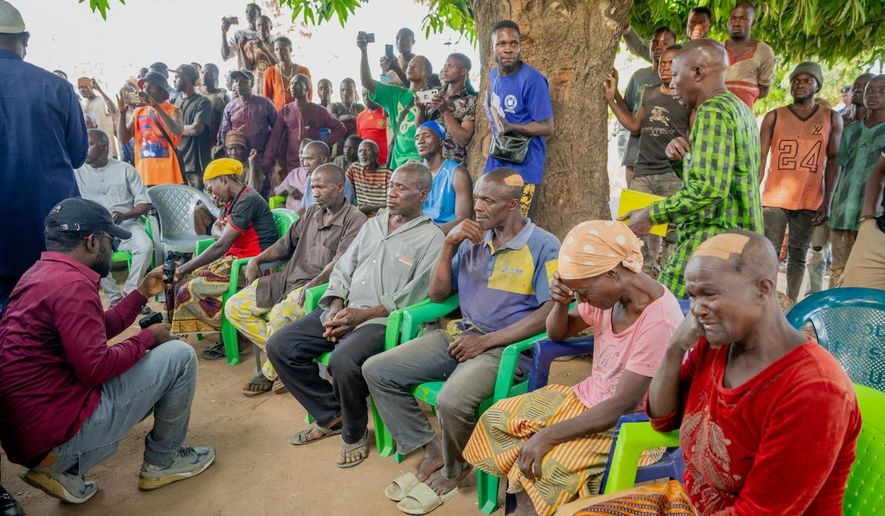
ABUJA, Nigeria — A U.S. military cargo aircraft touched down in Nigeria on Jan. 13, delivering equipment meant to strengthen the country’s fight against jihadi-linked terrorism. Five days later, armed Fulani terrorists stormed three churches in Kurmin Wali, a farming community, and abducted 166 Christian worshippers during Sunday services.
Within the same week, four civilians were seized along a nearby highway and six other residents were abducted in another Sunday attack.
The timing has sharpened a question being asked in Washington and Abuja: Will more weapons disrupt Nigeria’s terrorist networks or reinforce a system that experts say profits from denial and delay?
Open Doors International, which advocates for persecuted Christians around the world, said more than 388 million of them face discrimination and persecution because of their faith. Last week, the organization released its annual tally of the most dangerous countries for Christians. African countries account for six of the top 10, with Nigeria listed as seventh. Of the 4,849 Christians killed worldwide in 2025, Nigerians accounted for 3,490 of them.
Christian Nani, the director of Open Doors, pointed to sub-Saharan Africa as the “special observation” area of the Watch List 2026, particularly because of “fragile governments” that leave Christians exposed to violence.
“The center of gravity of Christianity has shifted to Africa, but it is there that it is primarily under attack,” Mr. Nani told Vatican News.
Africa is home to one-eighth of the world’s Christian population.
Open Doors said 12 states in northern Nigeria have implemented Islamic law, creating a system where Christians live as second-class citizens and where conversion to another faith can be severely punished.
“In Nigeria, Christians suffer significant and severe persecution,” the group said in a statement. “In multiple occasions, hundreds of Christians were killed or displaced because of attacks from Islamic militants.” Many of those militants have roots among the Fulani, a predominantly Muslim nomadic tribe that has ramped up attacks on Christians over the past decade.
On Sunday, Yakubu Dogara, a former speaker of Nigeria’s House of Representatives, acknowledged that Christians are being victimized in parts of the country, particularly in the Muslim-dominated north.
“There are areas, pockets of problems in certain parts of the north that we need to work on,” Mr. Dogara told the Daily Post newspaper. “But I believe that it will demand Christians and Muslims who understand working together to be able to take care of these concerns.”
‘We’ve gotten more aggressive’
U.S. Africa Command says the new approach is about pressure and capability.
“We’ve gotten a lot more aggressive and are working with partners to target, kinetically, the threats, mainly ISIS,” Army Lt. Gen. John Brennan, deputy commander of U.S. Africa Command, told AFP referring to the Islamic State.
He said Washington is expanding intelligence sharing and easing restrictions on military equipment to enable Nigerian forces to act faster.
“From Somalia to Nigeria, the problem set is connected; we’re trying to take it apart.”
The stepped-up cooperation follows U.S. airstrikes on Christmas Day on sites that the Trump administration said were linked to Islamic State-related groups in northwestern Nigeria. The rare move underscored American frustration with jihadi expansion across West Africa.
Last week, officials from the U.S. and Nigeria met in Abuja, the capital, in response to President Trump’s designation of Nigeria as a Country of Particular Concern under the International Religious Freedom Act.
“The objectives of the working group are to reduce violence against vulnerable groups in Nigeria, particularly Christians, and to create a conducive atmosphere for all Nigerians to freely practice their faith,” said a joint statement released afterward. “Participants further emphasized the importance of protecting civilians, particularly members of vulnerable Christian communities, and holding perpetrators of violence accountable.”
Despite the airstrikes, attacks have not slowed.
Government officials dismissed reports of the church abductions as false before the kidnappings were confirmed through on-site reporting by Truth Nigeria and survivor testimony.
In recent years, violence has increased and spilled into the southern states of Nigeria, according to Open Doors.
“Much of it is perpetrated by Fulani militants hiding in the forests. Another contributor to insecurity for Christians in the southeast is the Indigenous People of Biafra, a separatist group trying to carve out their own nation,” Open Doors said. “IPOB has also oppressed and persecuted Christians, particularly Christian leaders who do not conform to their ideological requirements.”
Families say the abductors have demanded 17 motorcycles to begin negotiations, a rare request. Analysts suggest the kidnappers may need the bikes to move such a large group through 20 miles of forest terrain to their Rijana hub near the border with Niger state.
In the same period, Fulani terrorists torched vast rice, yam and cassava fields in Benue state and threatened farmers with death to prevent harvesting.
In Plateau state, seven young miners were killed Thursday by Fulani militants, leading to calls for self-defense.
Rep. Wesley Hunt, Texas Republican, called the persecution of Christians in Nigeria “one of the greatest moral crises of our time.”
“For years, radical Islamic terrorists like Boko Haram have murdered, raped and burned entire villages simply because men, women and children refused to renounce their faith in Jesus Christ. America cannot be silent in the face of such evil,” Mr. Hunt said in November after signing on to a congressional resolution condemning the treatment of Christians in Nigeria.
Alex Barbir, an American missionary who spoke to TG News, told mourners during the burial of the seven miners, “Do not watch yourselves be slaughtered by terrorists. You must defend yourselves.”
In Borno state Friday, Boko Haram insurgents killed a pastor and four other residents in a village raid.
Terrorism that pays
Nigeria’s government has sought to counter growing international scrutiny by contracting DCI Group, a Republican-linked lobbying and strategic communications firm, to reframe its security record in the U.S.
Seun Ambrose, a global affairs analyst, told Truth Nigeria that the move reflects a government focused on optics rather than outcomes.
“It suggests a government under pressure that cares more about how it appears to Western capitals than about dismantling the terror economy on the ground,” Mr. Ambrose said.
SBM Intelligence, a security intelligence firm, confirmed that ransom payments in Nigeria from July 2024 to June exceeded $1.8 million, while total demands surpassed $33 million.
At an estimated $4,000 per victim, analysts within the Truth Nigeria project estimate that the 176 captives in southern Kaduna represent at least $704,000 in anticipated revenue from a single cluster of attacks.
“What we’re seeing is [a criminal] economy that continues to function even as new weapons arrive,” Mr. Ambrose said. “Terrorism in Nigeria is financed, recycled and normalized.”
Airpower vs. ground reality
Some analysts question whether intelligence flights and airstrikes alone can disrupt armed groups embedded in rural areas where state authority is weak or absent.
Dave Oladapo, a security analyst, told Truth Nigeria, “Air support can kill militants, but without sustained ground enforcement, these networks adapt, regroup and return.”
Local journalists and residents say militant casualties from recent strikes are unverified. Asked about the effectiveness of the operations at the U.S.-Nigeria security meeting in Abuja, Mohammed Idris, Nigerian information minister, described the effort to AFP as “a work in progress.”
Critics say Nigeria’s deeper problem is not capability but intent.
Former presidential candidate Gbenga Hashim said the initial denial of the Kurmin Wali kidnapping on Jan. 18 reflects a pattern that undermines security cooperation.
“Suppressing information has become a substitute for decisive action,” Mr. Hashim told journalists. “Communities are pressured into silence instead of protected.”
Analysts warn that denial erodes trust, weakens intelligence gathering and benefits armed groups, the very outcome foreign partners say they are trying to prevent.
A test for Washington
Nigeria’s government says the U.S. has pledged to deliver long-delayed equipment, including drones, helicopters and spare parts purchased over the past five years.
“We want Nigerians to know this partnership is working,” the information minister told AFP.
In Washington, Nigeria remains designated a Country of Particular Concern for religious freedom violations, a status that continues to drive congressional scrutiny.
“This moment is a test,” Mr. Oladapo said. “If weapons arrive and terror profits continue, the conclusion abroad will be simple: The problem isn’t resources. It’s resolve.”
As negotiations loom and captives remain in forest camps, experts warn that without enforcement replacing denial, terrorist groups will continue to calculate risk and profit.
“The question is not whether Nigeria has partners,” Mr. Ambrose said. “It’s whether the state intends to dismantle the economy that terror has become.”
• Mary Kiara reports on terrorism from Lagos, Nigeria. Washington Times reporter Mike Glenn reported from Washington.
• Mike Glenn can be reached at mglenn@washingtontimes.com.

Please read our comment policy before commenting.