



A version of this story appeared in the daily Threat Status newsletter from The Washington Times. Click here to receive Threat Status delivered directly to your inbox each weekday.
The Trump administration’s new national defense strategy seeks more accommodation of communist China and a renewal of the Monroe Doctrine in the Western Hemisphere.
The strategy report issued late Friday by the Pentagon calls for greater efforts to defend the U.S. homeland, specifically controlled borders and maritime approaches.
Secondly, the strategy calls for deterring China in the Indo-Pacific through “strength, not confrontation.”
Two other major elements of the strategy reflect President Trump’s focus on forcing allies and partners to do more to support American interests and a desire to revitalize the U.S. defense industrial base.
The strategy states in a section on defending the homeland that in addition to greater border and maritime security, the Pentagon will deploy the Golden Dome missile defense system with a new emphasis on countering drone strikes.
A robust and modernized nuclear deterrent also is a key element.
Hemispheric defense will include U.S. guarantees of military and commercial access to key terrain such as the Panama Canal, Gulf of Mexico and Greenland, the latter currently at the center of a dispute between the U.S. and its NATO allies.
Canada and states in Central and South America will be engaged with the goal of convincing them to defend shared interests in the region.
“And where they do not, we will stand ready to take focused, decisive action that concretely advances U.S. interests,” the report said.
“This is the Trump Corollary to the Monroe Doctrine, and America’s military stands ready to enforce it with speed, power, and precision, as the world saw in Operation ABSOLUTE RESOLVE,” the operation to snatch Venezuelan President Nicolas Maduro.
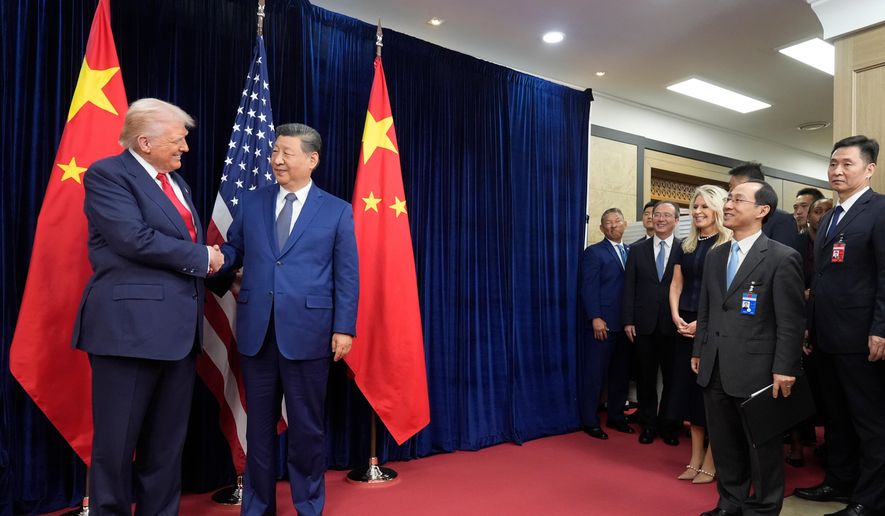
On the China portion of the strategy, Mr. Trump seeks stable ties with Beijing to include fair trade and “respectful relations” in part through the president’s efforts at direct engagement with Chinese President Xi Jinping, the report said.
“We will be strong but not unnecessarily confrontational,” the 34-page strategy report states. “This is how we will help to turn President Trump’s vision for peace through strength into reality in the vital Indo-Pacific.”
Chinese leaders in recent months have demanded that the United States adopt “respectful mutual relations” as a condition for stable ties and favorable trade relations.
The respect has been interpreted by analysts as a U.S. acceptance of China’s communist system, which is being exported through several Beijing global initiatives.
U.S. negotiations with China on various fronts will be carried out from positions of strength and the Defense Department has been tasked to increase American military power in line with the goal, the report said.
’Our goal … is not to dominate China’
Following decades of on-and-off military exchanges with the People’s Liberation Army that sought closer relations, the Pentagon again will try to open a wider range of military-to-military communications with the PLA, the report said. The goal will be to support strategic stability and deconfliction and de-escalation of tensions.
Tensions remain high with China over large-scale provocative war games around Taiwan, confrontations with the Philippines in the South China Sea, and threats against Japan and Australia.
The report makes no mention of China’s aggressive activities that in the past were denounced as destabilizing and threatening.
The Pentagon will be “clear-eyed and realistic about the speed, scale, and quality of China’s historic military buildup,” the report said.
“Our goal in doing so is not to dominate China; nor is it to strangle or humiliate them,” the report said.
“Rather, our goal is simple: To prevent anyone, including China, from being able to dominate us or our allies—in essence, to set the military conditions required to achieve the [National Security Strategy] goal of a balance of power in the Indo-Pacific that allows all of us to enjoy a decent peace.”
By contrast, the first Trump administration’s national defense strategy issued in 2018 included tougher assessments of threats from China and Russia describing them as “the central challenge” to U.S. security.
The old strategy stated that China’s large-scale military buildup is seeking regional dominance in the near term and replacement of the U.S. as the most powerful nation in the future.
The more conciliatory strategy described in the report as “realism” contrasts with President Ronald Reagan’s strategy of dealing with the Soviet Union during the Cold War. As president from 1981 to 1989, Reagan said: “My idea of American policy toward the Soviet Union is simple and some would say simplistic. It is this: We win and they lose.”
The realism called for in the new Trump strategy is more aligned with the discredited Cold War policy of “detente” and balance-of-power geopolitics that were rejected by the Reagan administration and led to the toppling of the Soviet Union in 1981.
The defense strategy adopts what the report called a “denial defense” — an approach ddetailed by Elbridge Colby, the current undersecretary of defense for policy, in his 2021 book, “The Strategy of Denial: American Defense in an Age of Great Power Conflict.”
Critics say a denial strategy is a defeatist approach to what many other China policy advocates call the most significant strategic threat facing the United States — an increasingly belligerent and expansionist China.
The strategy report states that the U.S. military will erect a “strong denial defense” along the so-called first island chain. The chain is a string of islands stretching from Japan to the South China Sea near China’s coast.
The China portion of the strategy echoes policy recommendations first made by Mr. Coby in his 2022 book “Strategy of Denial.”
The book argues that if China attains regional domination, the United States will be blocked from Asian markets and, eventually, American security and prosperity threatened.
Mr. Colby, a favorite aide of Vice President J.D. Vance and right-wing commentator Tucker Carlson, believes the United States is not strong enough to win a war against China and therefore limited “realism” policies are needed to deter conflict.
Mr. Colby believes China is preparing for a rapid military action to seize territory such as Taiwan and present it as a done deal.
Mr. Colby in his book stated that he does not favor punishment strategies toward China that would threaten economic or military action.
Instead, he favors positioning U.S. and allied forces that could prevent China from reaching its goals.
Mr. Colby also stated in his book that the military must be ready to fight a limited war with China but avoid escalating to a nuclear conflict.
The Taiwan angle
Taiwan remains the cornerstone of the denial strategy and its freedom from mainland control is key to preventing a collapse of U.S. power in the Indo-Pacific.
As reflected in the White House National Security Strategy released last month, the Pentagon will mount a “strong denial defense” along the China coast, while urging regional allies to do more for collective defense,” the report said.
“In doing so, we will reinforce deterrence by denial so that all nations recognize that their interests are best served through peace and restraint,” the report said.
“This is how we will establish a position of military strength from which President Trump can negotiate favorable terms for our nation.
Bradley Thayer, a China expert, said the new defense strategy contains many positive elements, such as the emphasis on homeland defense and building up the nuclear arsenal.
But Mr. Thayer, co-author of the recent book “Embracing Communist China: America’s Greatest Strategic Failure,” said the strategy differs significantly from the 2018 defense strategy.
“That is most acutely illustrated in the absence of a discussion of Taiwan, which was well referenced in the 2025 NSS, and its contribution to a denial strategy,” he said. “That will be well and sharply noticed in Taipei and Beijing as well as by allies in the region.”
For garnering greater allied support, the strategy calls for increased burden-sharing and giving allies an “essential” role in regional security, but not as the dependencies of the last generation,” the report said.
“Rather, as the Department rightly prioritizes Homeland defense and deterring China, other threats will persist, and our allies will be essential to dealing with all of them,” the report said.
On the defense industrial base, the strategy is seeking to “supercharge” the defense industry, as part of a larger Trump administration effort to revive American industrial power and reduce reliance on foreign industry.
“We must return to being the world’s premier arsenal, one that can produce not only for ourselves but also for our allies and partners at scale, rapidly, and at the highest levels of quality,” the report said.
Mr. Colby is considered a hardliner on China. In 2024 he said he believes Beijing is driven more by nationalist revival than by communist ideology
Retired Navy Capt. Carl O. Schuster, a veteran China watcher, said the strategy like other national defense approaches is short on details because it is meant for guidance and policy documents.
However, one shortcoming is the need for a defining doctrine similar to the approach of Reagan administration Defense Secretary Caspar Weinberger, who advocated only going to war with clear and definable objectives, he said.
“It seems to lack inspiration. It reads like the challenge may be insurmountable but we have to try to do it,” Capt. Schuster said.
“A strategy that recognizes the challenge must inspire the nation to meet it like JFK’s call for putting a man on the moon.”
Chinese spokesmen had no immediate response to the new defense strategy.
In December, Foreign Ministry spokesman Guo Jiakun said in response to the White House National Security Strategy that China and the U.S. will gain from cooperation and lose from confrontation.
“Upholding mutual respect, peaceful coexistence and win-win cooperation is the right way for China and the U.S. to get along with each other and is the only right and realistic choice, he said.
Retired Navy Capt. Jim Fanell, a former Pacific Fleet intelligence director, said the new strategy is an example of the president speaking softly and carrying a big stick in dealing with China.
Capt. Fanell said he supports the new strategy’s policies prioritizing hemispheric defense and the Indo-Pacific region with the same importance, including the denial defense along the first island chain.
Capt. Fanell, co-author of the book on engagement failures with Mr. Thayer, said he remains concerned that seeking greater military relations with the PLA will bolster what he calls “the engagement school” of pro-China policymakers and experts.
“Likewise, with no specific mention of the president’s priorities for shipbuilding, the Golden Fleet or even the word Navy, I remain concerned that the forces within the U.S. government will use this omission as justification to obfuscate and delay our nation’s preparations for a potential conflict that will most likely occur in the maritime domain,” he said.
• Bill Gertz can be reached at bgertz@washingtontimes.com.

Please read our comment policy before commenting.