



A version of this story appeared in the daily Threat Status newsletter from The Washington Times. Click here to receive Threat Status delivered directly to your inbox each weekday.
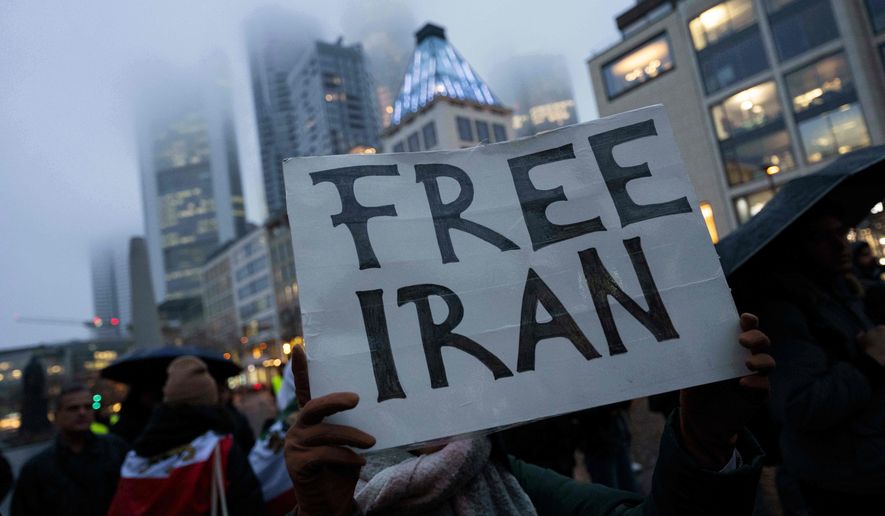
The nationwide protests exploding in the streets of Iran have emerged as one of the greatest threats to the clerics who rule the country since the founding of the Islamic republic in 1979, but after four decades of hard-line theocratic leaders, it’s not clear who will take over if the mullahs fall.
President Trump’s threats of U.S. military strikes on select targets if Iranian authorities kill more protesters have intensified the debate over the future of Iran.
Protests began Dec. 28 with small-scale demonstrations by business owners in Tehran decrying the collapse of Iran’s rial currency. The movement has spread to all of Iran’s 31 provinces over the past two weeks, and the regime is struggling to contain it or cool the tempers of protesters.
The protests have focused on the everyday economic issues of Iranians and have attracted a broad cross-section of ideologies and interests in the country, united in their opposition to the ruling regime but fractured on alternatives.
“[The protest movement] is a reflection of vast, deep anger in Iranian society that erupts, and it does so occasionally, with increasing frequency in the last few years,” said Alex Vatanka, a senior fellow at the Middle East Institute, a Washington think tank. “They’re demanding, essentially, an end to the Islamic republic. The slogans speak for themselves, and the regime so far has not been willing to listen.”
On Tuesday, Mr. Trump announced he had canceled all negotiations with Iranian diplomats and called on Iranian protesters to “take over your institutions.” He promised that “help is on its way.”
SEE ALSO: U.S. moves select personnel from Qatari base as Tehran, Washington threaten strikes
He said the U.S. would take “very strong action” if Iran began hanging arrested protesters.
On Monday, the president imposed an additional 25% tariff on any country conducting business with Iran, potentially putting even more strain on Iran’s faltering economy, which relies heavily on oil exports to China.
China, Brazil, Turkey, India and Russia are Iran’s largest trading partners, combining for more than $10 billion in trade annually, according to data from the Observatory of Economic Complexity. In 2023, Iran had the 36th largest economy in the world and was ranked 92nd in total exports.
The State Department on Tuesday urged U.S. citizens in Iran to leave as soon as possible and to “have a plan for departing that does not rely on U.S. government help.” The U.S. virtual embassy for Iran said citizens should seek refuge in Turkey or Armenia if possible.
Despite the president’s warnings, the crackdown on protesters has become deadlier day by day, according to accounts that have leaked out despite the regime’s news blackout. Internet and phone service inside the country have been blocked.
The U.S.-based Human Rights Activists News Agency estimates that at least 2,000 people have been killed in the protests, most of them civilians, though Tehran has insisted that most of the deaths have been at the hands of “terrorist” rioters. Iran says more than 100 of its security personnel have been killed in the protests.
SEE ALSO: Omani foreign minister: Iran is not in turmoil, regime far from collapse
Reports trickling out of Iran have suggested that Iranian security forces have begun firing automatic weapons at protesters and have deployed tactical snipers on rooftops near demonstrations.
Omani Foreign Minister Sayyid Badr bin Hamad Al Busaidi, who met with Iranian officials in Tehran earlier this week, said casualty reports from Western media sources are inaccurate and do not reflect the reality on the ground.
“The government did a lot in trying to restrain themselves from using violence. I think that is a fact. No one wants to kill their own people,” he told The Washington Times’ Tim Constantine. “I think there’s a lot of exaggeration on the figures.”
In a Tuesday letter to the United Nations, Iran’s ambassador to the United Nations, Amir Saeid Iravani, said that both the “United States and the Israeli regime bear direct and undeniable legal responsibility for the resulting loss of innocent civilian lives.”
Two visions
The decentralized nature of the protests, along with fear of becoming a target for state violence, has stymied the emergence of a singular protest leader in Iran. The Iranian diaspora has narrowed its focus to two options for post-Islamic republic leadership.
Reza Pahlavi, the exiled son of the last shah of Iran, Mohammad Reza Pahlavi, is likely the most recognizable voice of Iranian dissidence. Well before the protests began, he had been calling for regime change from the sidelines and had put his name forward as someone who could lead Iran through a transitory period. The exact composition of a Pahlavi-led Iranian government is unclear.
Mr. Pahlavi’s connection with the deeply unpopular monarchist government run by his father, overthrown by Islamic revolutionaries in 1979, and the lack of detail in his vision for Iran have hurt his leadership chances, experts say.
Still, his name recognition is strong, and several videos from Iran show waves of protesters chanting his name along with anti-Ayatollah slogans.
“If he can convince enough people that they should trust him and he, you know, he might be a gamble, but he’s better than what they have in Iran, then you know his fortunes could turn around quickly,” Mr. Vatanka said.
The People’s Mojahedin Organization of Iran is Mr. Pahlavi’s main rival. The Albanian-based organization began as an Islamic alternative to the current regime in Iran and is categorized as a terrorist organization in Iran. The group, led by Maryam Rajavi, has a controversial history and does not have universal support among Iranians who largely see Iran’s future as secular.
MEK has long-standing connections with U.S. security officials, including former National Security Adviser John R. Bolton, former Secretary of State Mike Pompeo and former Vice President Mike Pence. Still, its stock in Iran is exceptionally low, experts say, with a much smaller chance of capturing a governing coalition than Mr. Pahlavi.
“The MEK name has not been chanted once. … For some in the diaspora, they may look like an option, but when you’re looking at the facts on the ground, that seems far from the case,” said Behnam Ben Taleblu, an Iran expert at the Washington-based Foundation for Defense of Democracies.
How the regime falls
It’s unclear whether Tehran is facing any significant internal pressure from the protests. The regime has increased its aggressive language and tactics in recent days, and no government officials have voiced significant support for the protesters.
Experts say the defection of high-profile officials from the Islamic government, switching sides to join the protests, would be the kind of development that could tip the scales in favor of regime change.
“Folks inside the regime will say: ‘Look, we can’t do this again, because we’ve killed so many more now we’ve created so much hatred for ourselves,’” Mr. Vatanka said. “‘Now the external pressure is growing. The Israelis are not going to give up. The Americans are not going to give up. What we have to do is change course.’”
Others argue that Iran’s security apparatus needs to be sufficiently pressured before any significant regime change can occur. If defections take place within Iran’s security forces, especially as Tehran’s crackdown continues, it could create decisive cracks in the Islamic republic’s control.
“The group to keep your eyes on now is the resolve and the loyalty and the cohesion of Iran’s layered security forces. That is the group that you want to look at for issues with command and control and potential defections and loyalty issues,” Mr. Taleblu said. “Street pressure is necessary, as we’ve seen, but it is not sufficient. Street pressure plus foreign pressure — the security forces have to feel the squeeze, and then they can begin to play that role.”
Mr. Taleblu said targeted U.S. attacks on Iran’s ability to repress the protests could provide necessary momentum to the demonstrations as they enter their third week.
However, it is unclear what U.S. attacks on Iran would entail. Some suspect that Washington could use the chaotic opportunity to further damage Iran’s nuclear and defense infrastructure, which would only marginally assist protesters in toppling Tehran.
Either way, experts say, the ongoing demonstrations are just the latest in a yearslong saga of resistance in Iran and that any further repression by the Islamic republic will only artificially extend the regime’s life.
“This is the latest installation of a story we’ve been seeing for a decade now called Iran’s national uprising,” Mr. Taleblu said. If it is thwarted now or receives no foreign support, the story of that uprising will be prolonged and the shelf life of the regime will be extended.”
• Jeff Mordock contributed to this report.
• Vaughn Cockayne can be reached at vcockayne@washingtontimes.com.

Please read our comment policy before commenting.