



A version of this story appeared in the daily Threat Status newsletter from The Washington Times. Click here to receive Threat Status delivered directly to your inbox each weekday.
OPINION:
In our 50-year-long twilight struggle with the Soviet Union, it was often said — especially by those who leaned politically rightward — that the U.S. overestimated the capabilities of the Russians and consistently underestimated their threat.
It was a short way of communicating that the Red Army looked a lot more imposing than it really was, but at the same time, the goals of the Russians were more ambitious than we appreciated.
The recent strike on Venezuela made me think about that bit of received wisdom.
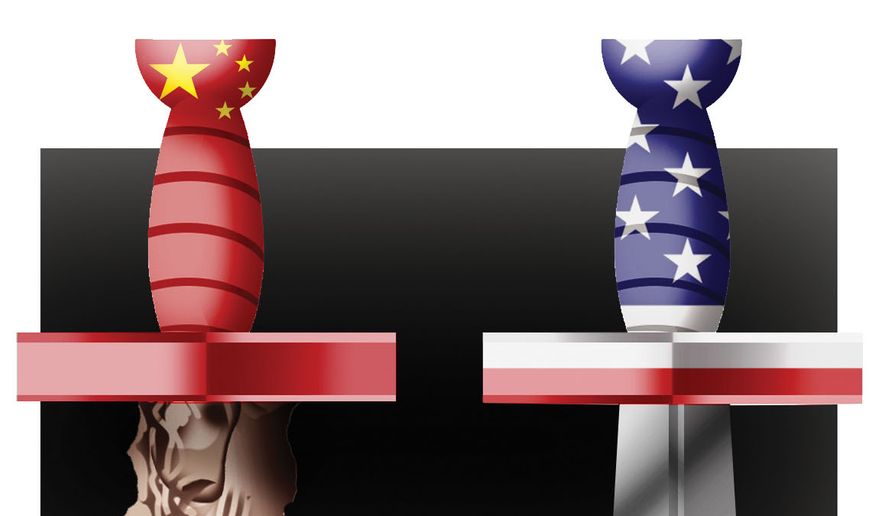
It has been reported that the U.S. armed forces involved in the attack on Caracas included the Delta Force, the USS Gerald R. Ford carrier group, B-1 bombers, F-35s, F-22s, F/A-18s and on and on. On the other side were Venezuelan forces outfitted with Chinese and Russian equipment specifically designed and intended to prevent airplanes from flying over one’s nation. Those systems obviously failed.
More specifically, the Chinese radar system that failed is the JY-27A system that the slaving, genocidal communist regime in China pitched to its clients in Caracas as being able to detect stealthy aircraft. That’s important if you’re trying to keep stealth jets (such as the F-35 and F-22) and stealthy bombers (such as the B-1 and B-2 and eventually the B-21) out of your airspace and away from your soldiers or facilities on the ground.
On Jan. 3, however, it became obvious that the Chinese system and the Russian missile defense systems were of very limited value compared with American hardware, soldiers, airmen and sailors.
In the wake of the successful attack by the United States, there has been a lot of talk about who might be next and which nations should be nervous. Cuba? Sure. Colombia? Eventually. Iran? Always.
The commentariat, with notable exceptions (including The Washington Times’ own Bill Gertz), failed to point out that the crew that should be most nervous is the Chinese Communist Party. China is rapidly coming to some sort of decision about how and when to jump across the Formosa Strait and invade Taiwan. Such a move would bring it into immediate conflict with the United States (and our allies in Japan, the Philippines and Australia).
To be sure, what happened Jan. 3 in Caracas was important to the Western Hemisphere. I don’t want to minimize the importance of knocking over a neighborhood bully in Venezuela, but the most important part of the story may be that the U.S. military, as it usually does, demonstrated that it is superior in weaponry and skill to any other force on the planet. Communist China’s weapons systems had a real-world test, and it was a disaster.
That has to be giving the crew in Beijing, which would like to be global bullies, nightmares.
The simple reality is that the communists in China have not been involved in a legitimate shooting war in 75 years. They have had no real way to test and improve their weapons under battlefield conditions. Every single one of their weapons systems is essentially undergoing a beta test the first time they are used in combat.
Anything that erodes Beijing’s confidence in its own weapons and soldiers and increases its sense of discomfort about invading Taiwan (or anywhere, really) is a good thing. In the big scheme of things, the attack in Caracas may have saved Taiwan and potentially the thousands (or millions) of lives that would have been lost in the course of a war in the Pacific.
Whatever else you might think of President Trump’s adventure in Venezuela, you should consider the very real possibility that it deterred or delayed the very worst impulses of the communists in Beijing.
The United States also should learn a lesson. Gen. George S. Patton, one of the greatest military commanders in American history, once said: “You shouldn’t underestimate an enemy, but it is just as fatal to overestimate him.” We tend to overestimate the ability of communist China. Perhaps we shouldn’t.
• Michael McKenna is a contributing editor at The Washington Times.

Please read our comment policy before commenting.