



The Department of Government Efficiency hasn’t come close to achieving the $1 trillion in cuts pledged at its launch last January, but it has identified billions of dollars in wasteful spending, reduced the bloated federal workforce, and spurred a nationwide effort to streamline and economize government agencies.
In Washington, DOGE continues its work. As of October, it claims to have slashed an estimated $214 billion in federal spending, which DOGE officials say has saved each taxpayer $1,329.
It’s now a scaled-down, decentralized effort to slash government waste.
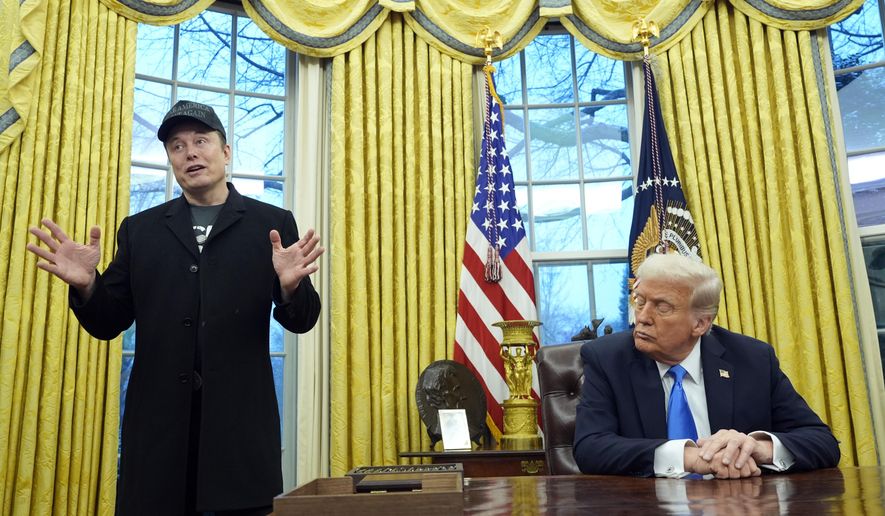
President Trump and Elon Musk, the tech billionaire who headed DOGE for 134 days, will make no more Oval Office appearances. In fact, Mr. Trump hardly mentions DOGE.
Mr. Musk left his job in the administration in June and returned to the private sector, never getting close to the initial $2 trillion in federal spending he hoped to eliminate.
“I certainly think Elon Musk leaving Washington took a lot of the wind out of the sails for the DOGE movement,” said Dominik Lett, budget and entitlement policy analyst at the Cato Institute.
In a December interview, Mr. Musk, who departed DOGE amid intense backlash from the left and numerous court challenges, described his tenure to conservative influencer Katie Miller as “a little bit successful.” Under his leadership, he said, the department stopped $100 billion to $200 billion in “zombie payments” that lacked codes or any explanation for their purpose.
Quantifying all DOGE cuts is almost impossible.
Analysts on the right and the left have challenged Mr. Musk’s estimates. They say DOGE’s reductions are likely much smaller than $214 billion.
The department achieved some indisputable and significant successes in shrinking the size of government.
It single-handedly eliminated the office of the U.S. Agency for International Development, which had unfettered authority to distribute up to $50 billion annually in taxpayer money to programs in other countries.
DOGE also drove a reduction in the federal workforce.
Office of Personnel Management Director Scott Kupor said last month that 317,000 employees would leave the federal workforce by the end of 2025, offset by 68,000 new hires. That’s a net reduction of 249,000 workers.
Staff cuts were ordered across many government departments and agencies.
Layoffs targeted nearly half the Education Department staff amid a broader effort by the Trump administration and Education Secretary Linda McMahon to eliminate the department.
The IRS has shed more than 26,000 employees and aims to reduce the agency’s workforce to fewer than 60,000 employees. That would be a significant decrease from the more than 100,000 IRS workers during the Biden administration.
Government DOGE workers continue to root out and stop spending deemed unnecessary or duplicative across the federal government, but with much less fanfare and, Mr. Lett said, a diminished impact.
“DOGE has taken a back seat in this government recently, and I think that’s disappointing,” Mr. Lett said. “A lot of hardworking people in this administration are still cutting unneeded and wasteful government contracts. That is absolutely worth celebrating. But I think most people can appreciate that DOGE is no longer the tip of the spear.”
DOGE announced on X in December that agencies had cut or reduced nearly 100 “wasteful” contracts that, if fully implemented, would have cost more than $5 billion. The money had been directed to “develop a comprehensive strategic narrative and management approach aimed at the Human Centered Transformation and Enhanced Partnerships” and a Pentagon consulting contract for “strategic transformation and enterprise project support.”
It slashed another $29 million by ending a Commerce Department consulting contract for “providing the necessary staff to perform Program Management, providing planning, analysis, and support in managing projects.”
In November, a Reuters story quoted Mr. Kupor saying DOGE “doesn’t exist,” but Mr. Kupor said his comments were taken out of context.
“DOGE may not have centralized leadership … but, the principles of DOGE remain alive and well: deregulation; eliminating fraud, waste and abuse; reshaping the federal workforce; making efficiency a first-class citizen; etc.,” he said.
The White House did not respond to an inquiry from The Washington Times.
The DOGE effect has undoubtedly subsided, but it is credited with shining a spotlight on government spending that included the inexplicable and the outlandish. It exposed U.S. taxpayer money spent on drag shows in Colombia and Ecuador, transgender clinics in India and Guatemala, electric vehicles in Vietnam, and $122 million for groups aligned with foreign terrorist organizations, among many other eyebrow-raising and costly examples.
The DOGE initiative, led by Airbnb co-founder Joe Gebbia, implemented significant reforms. It overhauled and modernized the federal government’s antiquated retirement system, which for decades was managed from 26,000 filing cabinets stored in a decommissioned Pennsylvania mine.
It’s now a completely digital system that will eliminate the backlog of retirement applications for full benefits that existed under the paper process.
In May, the DOGE team announced that it had removed 12.3 million Social Security numbers associated with birth dates from the turn of the 20th century or older from the system.
Although DOGE fell far short of the optimistic $2 trillion in spending cuts that Mr. Musk initially predicted, Mr. Lett said the effort catalyzed a governmentwide movement to slash spending.
In July, Congress passed a $9 billion rescission package, followed by nearly $1.6 trillion in federal spending reductions included in the Republicans’ sweeping tax cut bill.
The government continues to implement significant reforms to staffing management.
In October, Mr. Kupor announced plans to “revamp” staff hiring and management across the federal government by creating a centralized system that replaces outdated and duplicative technology spread across 119 systems, “none of which integrate effectively with each other.”
The DOGE movement inspired similar cost-cutting and government efficiency efforts at the state level with legislation and executive action across more than two dozen states.
Florida Gov. Ron DeSantis, a Republican, has arguably been the most aggressive among them. He established the state’s Government Efficiency Task Force to audit county governments and identify and eliminate wasteful spending.
So far, the audits have uncovered $75,000 spent by the city of Jacksonville on a “hologram” of Mayor Donna Deegan, $150,000 annually for a company that brings drag shows to the Pensacola city theater, and $572,000 for “unconscious bias training” in Hillsborough County.
• Susan Ferrechio can be reached at sferrechio@washingtontimes.com.

Please read our comment policy before commenting.