



A version of this story appeared in the daily Threat Status newsletter from The Washington Times. Click here to receive Threat Status delivered directly to your inbox each weekday.
The Trump administration rejected continuing to abide by the expired New START agreement limiting U.S. and Russian nuclear weapons, because it fails to curb Moscow’s strategic arsenal and excludes China’s rapid expansion of its nuclear forces, a senior State Department official said Friday.
Thomas G. DiNanno, under secretary of state for arms control and international security, also said President Trump is prepared to resume nuclear testing based on violations of a test ban by Russia and underground blasts carried out by China in violation of a moratorium on testing.
In a speech Friday to the U.N. Conference on Disarmament in Geneva, Mr. DiNanno said the United States will no longer be restrained by one-sided arms agreements that unilaterally hindered U.S. security while allowing Russia and China expand their arsenals with new weapons.
“Today marks the end of one era of arms control, and hopefully the beginning of a new one,” Mr. DiNanno said.

The 2010 U.S.-Russia New START arms accord expired, and its terms allowed for a single five-year extension that also lapsed.
Russia had called for continuing to adhere to the treaty despite U.S. charges that Moscow violated and circumvented the treaty, causing a major U.S. disadvantage.
In explaining the withdrawal of New START, the arms control leader said since the treaty was signed, its limits on warheads and launchers are no longer relevant in 2026 based on China’s rapid expansion of nuclear power “at a scale and pace not seen in over half a century,” Mr. DiNanno said.
Russia, as well, is continuing to build and deploy new and exotic nuclear systems that are not covered by the treaty, he said.
“New START does not allow the United States to credibly uphold both our strategic deterrence commitments to the American people and our extended deterrence commitments to our allies,” he said.
New START, when signed, restricted U.S. and Russian nuclear arsenals to 1,550 warheads along with limits on missile launchers. But the agreement was nullified by China’s large-scale nuclear expansion that Mr. DiNanno called a “breakout” — a large and threatening force buildup.
“This buildup is opaque and unconstrained by any arms control limitations,” Mr. DiNanno said of the Chinese strategic force. “This is the crux of the problem. It is emblematic of the change in the global strategic environment over the last 15 years.”
America is confronted by threats from multiple nuclear powers and as a result, a bilateral treaty with Russia is inappropriate for 2026 and the years ahead, he said.
Russia violated the Intermediate-range Nuclear Forces Treaty and the Open Skies Treaty, prompting Mr. Trump to jettison those pacts during his first administration.
Mr. DiNanno said the George H.W. Bush administration agreed with Russia to sharply reduce tactical or theater nuclear weapons arsenals, but Moscow ignored the cuts and expanded its tactical nuclear arms.
“Russia not only failed to remove or destroy its theater range systems, it modernized and expanded those nuclear forces,” he said.
The result was “the most glaring shortfall” of New START, providing Moscow with a major advantage in thousands of the low-yield nuclear weapons, he said.
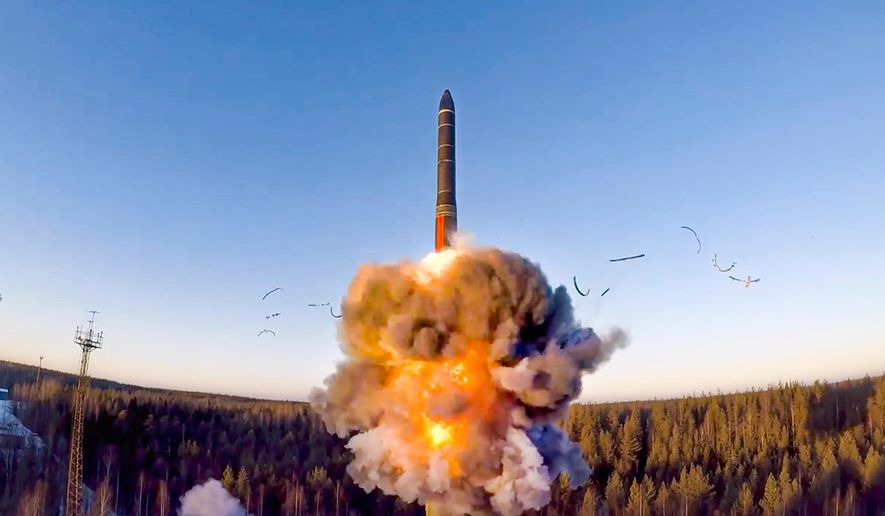
In further undermining New START, Mr. DiNanno said Russia developed novel nuclear systems outside of the treaty. They include the nuclear-powered cruise missile called Skyfall, and a megaton-class nuclear-tipped drone torpedo called Poseidon.
Both weapons were tested in the past several months, Mr. DiNanno said.
Moscow also is developing a space-based nuclear system for use as an anti-satellite weapon that also is not covered by New START. The weapon will violate the Outer Space Treaty that bans deploying nuclear weapons in space.
Conducting a nuclear blast in space to kill satellites poses a significant risk to the entire world, Mr. DiNanno said.
Russia also is helping North Korea with its growing nuclear weapons and missile programs, he said.
The nuclear threats from Russia and North Korea are compounded by China’s growing nuclear arsenal that includes three new large intercontinental ballistic missile fields in western China.
“China continues to deny the evidence of these sites and the extent of its nuclear weapons buildup,” Mr. DiNanno said.
Beijing will have more than 1,000 nuclear warheads by 2030, and Moscow is supporting the buildup by providing weapons-grade fissile material for warheads, he said.
The Trump administration has sought to engage China in arms talks to no avail, he said, noting that China refuses to contribute to disarmament objectives.
Mr. DiNanno said it would be irresponsible to extend the New START limits on the U.S. and Russia while China is outside the accord yet close to reaching those warhead numbers.
The expiration of New START allows the United States to strengthen nuclear deterrence and complete a major nuclear force modernization program.
The multibillion-dollar nuclear arms program includes building new Columbia-class nuclear missile submarines; new Sentinel ICBMs and new B-21 stealth bombers.
To meet the challenge of increased nuclear threats, the U.S. also could redeploy stored nuclear weapons that have been kept in reserve, Mr. DiNanno said.
Other steps to confront nuclear threats could include expanding current forces, diversifying strategic weapons systems and fielding new theater-range nuclear weapons.
On Chinese nuclear testing, Mr. DiNanno noted the president announced in October that the United States would resume underground nuclear tests “on an equal basis” with Chinese and Russian nuclear tests.
All three nations have agreed to a self-imposed moratorium on nuclear tests.
Russia failed its testing moratorium by conducting “super critical” nuclear weapons tests, he said.
“Today, I can reveal that the U.S. government is aware that China has conducted nuclear explosive tests, including preparing for tests with a designated yield in the hundreds of tons,” Mr. DiNanno said.
“The [People’s Liberation Army] sought to conceal testing by obfuscating the nuclear explosions because it recognized these tests violate test ban commitments,” he said.
Chinese nuclear testers conducted the tests using a special method that limited seismic monitoring as part of an effort to conceal the tests. One test was carried out on June 22, 2020, he said.
The fact of serial Russian arms violations and the expansion of worldwide nuclear stockpiles calls for the United States to seek a “new architecture” addressing nuclear threats, Mr. DiNanno said.
The new approach must include exotic Russian strategic weapons and “the breakout growth of Chinese nuclear weapons stockpiles,” he said.
The goal of Mr. Trump, through a new approach to arms control, is to prevent a new nuclear arms race, he said.
As throughout our history, the United States has maintained a willingness to seek strategic stability in arms control arrangements that are verifiable, enforceable and contribute to the security of the United States and her allies,” Mr. DiNanno said.
“What we are proposing is not talks for the sake of talks. With this effort, the United States is looking for meaningful progress based in concrete actions,” he said.
The United States will not stand by idly in the face of growing nuclear threats and will maintain a credible and modernized nuclear deterrent that preserves peace and stability, Mr. DiNanno said.
“In doing so, we will prevent anyone from being able to dominate us or our allies, so that all nations recognize their interests are best served through peace and restraint.”
• Bill Gertz can be reached at bgertz@washingtontimes.com.

Please read our comment policy before commenting.