



OPINION:
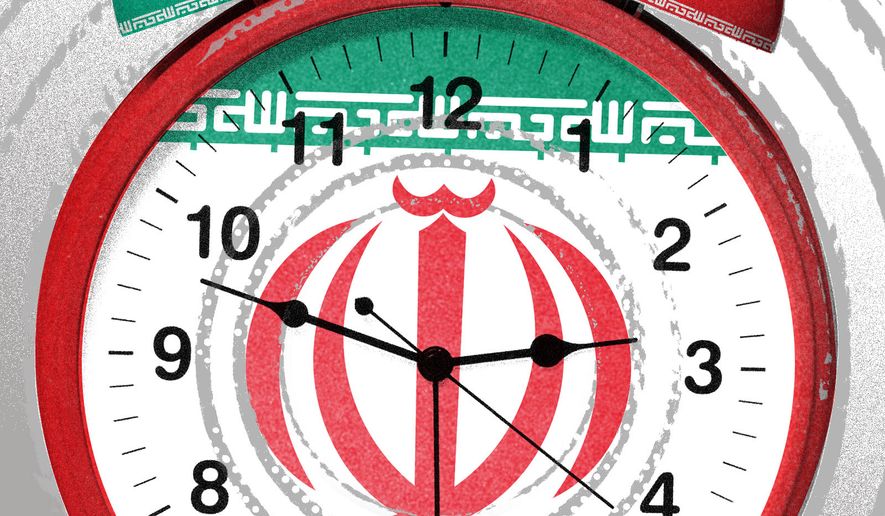
On Friday, President Trump gave the Iranian regime 10 to 15 days to come to the negotiation table or face the consequences. Mr. Trump said, in June, that he would decide on action against Iran within two weeks.
Two days later, he ordered the historic B-2 strike on Iran’s nuclear weapons development facilities.
Mr. Trump has demanded that Iran stop enriching uranium, stop its development of ballistic missiles and end its support to terrorist groups. Iran has never acceded to ending uranium enrichment or developing missiles and will reject the other U.S. demands. So what is the point of negotiating?
It isn’t clear whether Mr. Trump is trying to position us for war with Iran or use the leverage of the U.S. military buildup to get what he wants in negotiations. The president wants to go down in history as a great peacemaker, but the Iranians will never give up their nuclear weapons program or their ballistic missile program peacefully.
Nor will they negotiate in good faith or live up to their obligations under any “peace” deal.
Two big “meanwhiles” are in this mess.
The first is that we have built up our military forces near Iran to a level not exceeded since the beginning of the Iraq War in 2003. We have two aircraft carriers and their battle groups — the USS Abraham Lincoln in the Gulf of Oman and the USS Theodore Roosevelt in the eastern Mediterranean — as well as about 50 ground-based fighters and fighter-bomber aircraft.
The president has said he is considering “limited” strikes on Iran, but the deployment of so many aircraft and ships seems to indicate otherwise.
The second “meanwhile” is the approach the Iranian regime is taking.
To begin with, there’s Iran’s bluster. On Feb. 17, just to prove they could do it, the Iranians closed the Strait of Hormuz for a day. About 20% of the world’s oil and natural gas flows through the channel, making it a critical chokepoint.
More seriously, joint Russian-Iranian military exercises were held in the same area last week. This marks the most serious Russian support for Iran since the B-2 raid in June.
China, which buys approximately 1.3 million barrels per day of Iranian oil (about 80% of Iran’s exports), hasn’t said whether it would fight to keep that oil flowing.
Iran will, of course, try to negotiate a sucker deal with Mr. Trump along the lines of President Obama’s 2015 deal. That agreement left the Iranians in control of nuclear site inspections and excluded U.S. inspectors.
The Iranians may have convinced themselves that Mr. Trump will fall for another bad deal like Mr. Obama’s. They can try, but Mr. Trump won’t fall for it.
The real question is whether Mr. Trump will attack Iran if, in his judgment, the Iranians won’t make a deal with him. Iran has threatened U.S. military bases throughout the region and threatened to destroy Israel in any coming conflict.
If the president orders an attack on Iran, it would begin a larger regional war. Mr. Trump could begin slowly, taking out certain military targets, but the risk of a regional war remains. If he attacks Iran, we will have to go “all in” — excepting nuclear weapons — striking at the ayatollahs themselves, the Islamic Revolutionary Guard Corps and, probably, Kharg Island, which is Iran’s principal oil export zone.
If Mr. Trump destroys Kharg Island, China might not have time to intervene. Chinese intervention in defense of its essential oil supply might be enough to deter an attack on Kharg Island. Mr. Trump may secretly be assuring China that its oil supply won’t be threatened.
Our assembled military forces can’t be left on station indefinitely. The crews of carriers and other ships need to be relieved at some point, as do the crews of ground-based aircraft and their supporting airmen. That creates a deadline independent of the deadline Mr. Trump gave the Iranians.
What the outcome of this crisis will be, only Mr. Trump knows. He may have decided not to attack Iran because of interference from our “allies.”
Our Saudi “friends” have said they won’t allow their airspace to be used to attack Iran. Our British “ally” has announced that RAF Fairford, where U.S. heavy bombers are stationed, and the joint U.S.-British base at Diego Garcia cannot be used to attack Iran, citing “international law.” What nonsense.
Whatever Mr. Trump decides, he needs to do it quickly. Time and international pressure will curtail the period he has to think and decide.
• Jed Babbin is a national security and foreign affairs columnist for The Washington Times and a contributing editor for The American Spectator.

Please read our comment policy before commenting.