


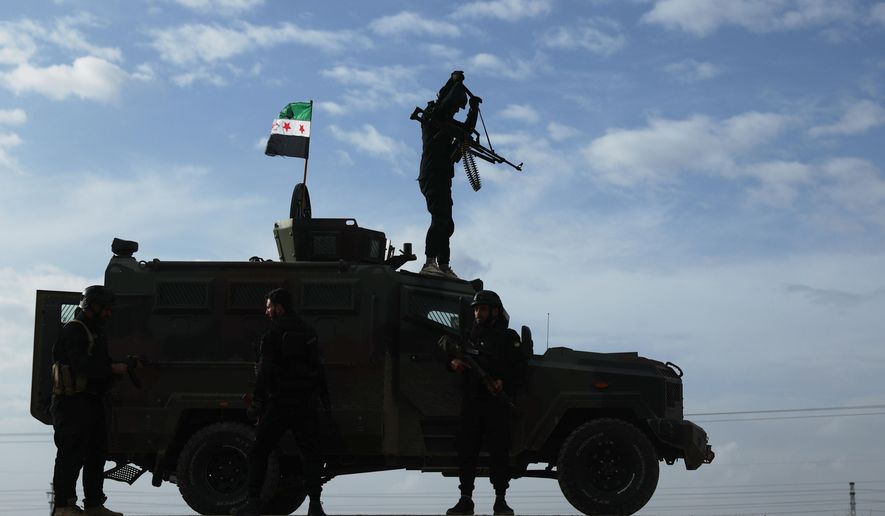

U.S. military personnel began leaving the Qasrak base in northeast Syria on Monday as part of a larger drawdown of U.S. military assets in the region, according to news reports.
The base, located in Syria’s northeastern Hasakah province, was the largest U.S. military outpost in the region and served as a hub for American and allied forces battling the Islamic State over the past decade.
The base also helped in coordinating with the Syrian Democratic Forces, the Kurdish-led militia that became one of America’s key partners in the fight against the Islamic State.
Videos from the province show truck convoys transporting military equipment, including armored vehicles, out of the Qasrak base. It is unclear where U.S. officials plan to house the equipment after it has been moved.
Without the Qasrak base, the only remaining U.S. military base in northeastern Syria is Kharab al-Jir, located near the Iraqi border.
The withdrawal from Qasrak is part of a nationwide pullout that is expected to take place over the next few weeks as Syria takes on a more active role in combating ISIS.
Syria joined the international coalition to fight ISIS late last year after Syrian President Ahmad al-Sharaa met with President Trump.
Earlier this month, U.S. forces pulled out of the base at al-Shaddadi in northeastern Syria and moved a garrison out of the al-Tanf base in southern Syria, on the country’s border with Iraq and Jordan.
U.S. Central Command has not commented on the Qasrak withdrawal, but officials said this month that the drawdown at al-Tanf was completed after a “deliberate and conditions-based transition” assisted by Syrian forces.
The withdrawal of U.S. forces from Syria has sparked concern among some in international security who say that the Islamic State may resurge in the absence of American troops.
After the fall of Syria’s Bashar Assad-led government in December 2024, the Islamic State has aggressively tried to grow its numbers. The group now has at least 3,000 members across Iraq and Syria and has directed most of its anger at Damascus, according to a new United Nations report.
The Islamic State was also behind at least five attempts on Mr. al-Sharaa’s life last year, according to the U.N. report. The group has accused Mr. al-Sharaa, who led an al Qaeda affiliate during Syria’s civil war, of abandoning his Islamist past to align with the U.S.
The Islamic State could see its numbers grow after the release of thousands of ISIS-linked prisoners last week from facilities in the northeast. The SDF, which controlled a prison network in the northeast, handed over control of the facilities to Damascus this month.
Reports indicate that chaos on the ground has led to large numbers of prisoners escaping into Syria, with Damascus having few options for tracking them.
• Vaughn Cockayne can be reached at vcockayne@washingtontimes.com.

Please read our comment policy before commenting.