


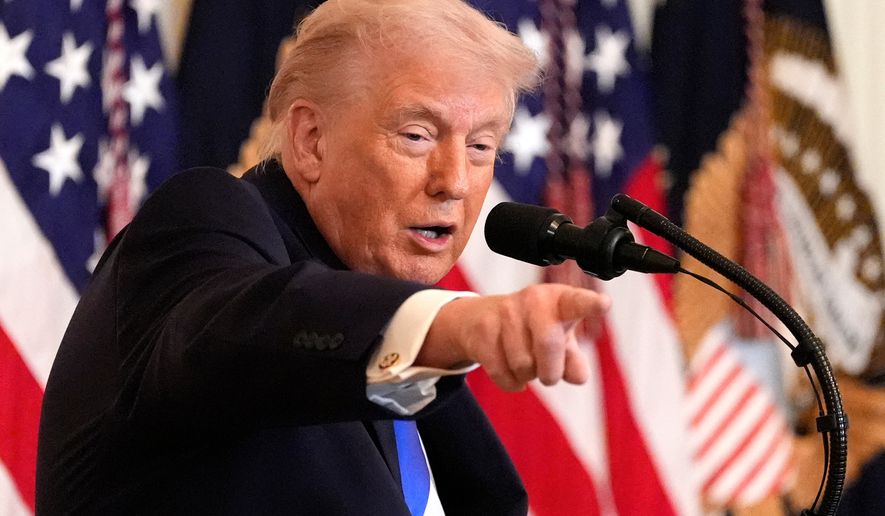

President Trump will stand before Congress and address the nation Tuesday night as a president in desperate need of a reset after a series of domestic setbacks have left his second-term agenda on thin ice.
Mr. Trump plans to use what will likely be his largest prime-time television audience of the midterm election year to make the case that he has lowered the cost of living for everyday Americans. He will combat negative polls about his performance and present himself as a strong leader who can reverse the dire outlook for Republicans in November.
“It’s going to be a long speech because we have so much to talk about,” the president said Monday.
A torrent of setbacks threatens to overshadow his message and put him on the defensive.
Economic growth is stalling, and his poll numbers are dropping. In yet another military action, Mr. Trump has amassed U.S. ships and warplanes poised to strike Iran should it fail to make a nuclear deal with the Trump administration.
Voters’ fury has mounted over the deaths of two American citizens at the hands of federal agents carrying out immigration enforcement raids in Minneapolis. The scandal surrounding files related to deceased sex offender Jeffrey Epstein shows no signs of abating.
The president was forced to walk back his plans to deploy the National Guard to U.S. cities, withdraw troops and officers from Minneapolis and reverse his plans to annex Greenland.
The most significant blow was the Supreme Court’s ruling Friday invalidating Mr. Trump’s use of emergency powers to impose tariffs on virtually all U.S. trading partners. Adding insult to injury, two justices appointed by Mr. Trump sided with the majority to knock down the tentpole of his economic agenda.
The justices will be sitting across from Mr. Trump in the House chamber, creating a potentially awkward situation. After their ruling Friday, the president said, the justices were “barely invited” to hear his speech, which begins at 9 p.m.
“The confluence of all these events makes it extremely difficult for President Trump at a time when the stakes couldn’t be more dire,” said Aaron Kall, director of debate at the University of Michigan. “The Democrats have seized on the issue with less than nine months until the midterms. This is not something you can solve in 90 minutes.”
Mr. Trump’s poll numbers have plummeted to their lowest levels of his presidency, adding urgency to an already high-stakes State of the Union address. A Washington Post-ABC News poll released Sunday found that 60% of respondents disapprove of his job performance, while 39% approve. Meanwhile, an NPR/PBS News/Marist poll found that 60% of respondents say the country is worse off than it was a year ago.
The president clearly has his work cut out for him.
“Trump needs to show Americans he is focused on what families are focused on right now, and that starts with affordability. People are sitting at their kitchen tables talking about grocery bills, housing costs and whether their paycheck goes as far as it used to,” said Jimmy Keady, a Republican political strategist.
“This is an opportunity for the president to remind Americans of what worked before and lay out how his policies will once again deliver real, everyday relief and renewed economic confidence for working families,” he said, referring to the president’s first term.
Mr. Trump does have some strong selling points on the economy. Inflation cooled in January, defying Wall Street expectations. The Dow Jones Industrial Average closed at a record 50,000 for the first time ever earlier this month, and hiring picked up in January.
Yet prices of essential goods remain high, and polls show that Americans remain concerned about the cost of living. In an executive order allowing the import of tariff-free beef from Argentina, the White House noted that the cost of ground beef had hit $6.69 per pound, its highest price since the government began tracking the data in the 1980s.
“When you look at the president’s first term, the economy was his superpower. His economic approval ran well above his overall approval rating, and that has just completely reversed in the second Trump administration, and he goes into the State of the Union with his economic approval rating wildly below his overall approval rating,” said Lindsay Owens, executive director of the Groundwork Collaborative, a liberal economic think tank.
“So really an incredible reversal of fortune for the president and Republicans in Congress, and owing largely to his economic policies and moving us in the wrong direction when it comes to the cost of living,” she said.
Mr. Trump has struggled to stay on message with the economy, preferring to focus on foreign affairs in the Gaza Strip and Ukraine for much of his second term. At the start of the year, the White House planned for Mr. Trump to hold weekly rallies on his record, but he has hosted only one.
The president ruffled some feathers last week when he declared that affordability was no longer an issue. “We’ve solved it, and we’re going still lower, but we solved it,” he said.
Although the high court has dealt a blow to Mr. Trump’s authority to impose tariffs, he has found a way to wield his favorite trade tool. On Saturday, the president invoked a never-before-used provision in U.S. law to impose a 15% across-the-board tariff for 150 days, unless Congress votes to extend it. The tariffs will take effect after midnight Tuesday.
He will likely use some of his 90-minute speech to defend his tariff policy, reviving arguments that it gives the U.S. the upper hand in international relations and can be used to fill the government’s coffers and end wars.
A growing number of Democrats say they will boycott Mr. Trump’s speech. About 20 Democrats are scheduled to attend “The People’s State of the Union” event on the National Mall, hosted by liberal organizations MoveOn and MeidasTouch.
“The economy has been so bad for ordinary families, let’s just do an event where we give the State of the Union the kind of honest description it deserves rather than a propaganda push from the president,” Sen. Jeff Merkley, Oregon Democrat, said on a conference call with reporters.
• Jeff Mordock can be reached at jmordock@washingtontimes.com.

Please read our comment policy before commenting.