


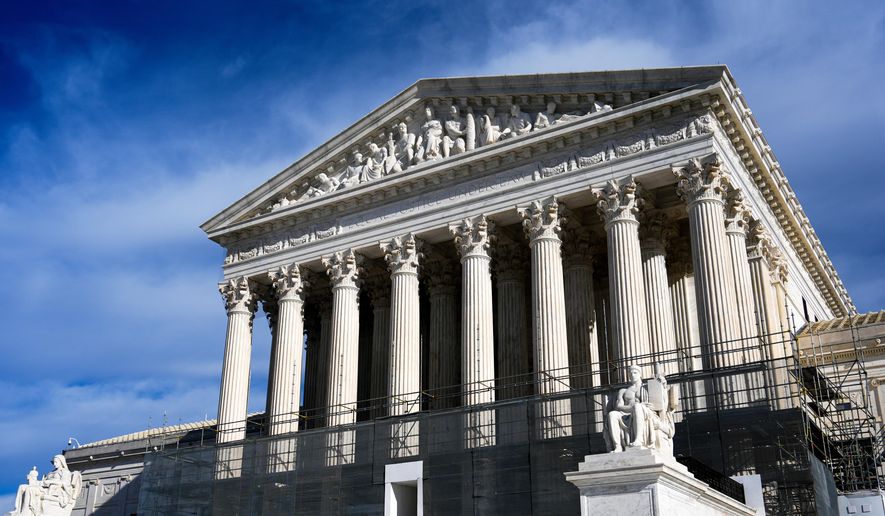

The Supreme Court ruled Friday that President Trump exceeded his powers with his expansive use of tariffs, punching a giant hole in the centerpiece of the White House’s economic agenda.
Led by Chief Justice John G. Roberts Jr., the court, in a 6-3 decision, said the International Emergency Economic Powers Act does not give the president the power to levy large, indefinite tariffs.
The chief justice said they did not decide whether tariffs are proper policy, only that Mr. Trump didn’t have authority under the law he claimed.
“We claim no special competence in matters of economics or foreign affairs. We claim only, as we must, the limited role assigned to us by Article III of the Constitution. Fulfilling that role, we hold that IEEPA does not authorize the president to impose tariffs,” he wrote.
The Constitution gives the power to impose duties, or tariffs, to Congress. Mr. Trump had argued that Congress lent that power to the administration in the 1977 IEEPA. The law doesn’t use the word tariff, but it does grant the power to “regulate” imports, which the president said must have meant tariffs.
Chief Justice Roberts disagreed, invoking what’s known as the Major Questions Doctrine. That’s a judicial stricture that on questions of this level of importance, Congress must be explicit in giving away its powers.
SEE ALSO: U.S. Chamber of Commerce urges swift refunds after Supreme Court trashes Trump’s tariffs
“What common sense suggests, congressional practice confirms. When Congress has delegated its tariff powers, it has done so in explicit terms, and subject to strict limits,” he wrote.
Dissenting were Justices Clarence Thomas, Samuel A. Alito Jr. and Brett M. Kavanaugh.
Justice Kavanaugh said the Major Questions Doctrine shouldn’t apply in foreign affairs, where a president’s powers are particularly robust, and he said he saw enough leeway in the IEEPA to believe it did grant tariff powers.
“Like quotas and embargoes, tariffs are a traditional and common tool to regulate importation,” he wrote.
He also said he believes Mr. Trump could cobble together a significant menu of tariffs using other parts of other laws, so there is room for the president to still operate.
Justice Kavanaugh said the ruling creates all sorts of thorny questions, including whether the government will be required to refund the billions of dollars in duties importers have paid over the last year to comply with the tariffs.
He pointedly noted that the court should stay away from policy disagreements and the words “regulate … importation” suffice to give Mr. Trump the authority he claimed.
“The sole legal question here is whether, under IEEPA, tariffs are a means to ‘regulate … importation.’ Statutory text, history, and precedent demonstrate that the answer is clearly yes,” he said.
He was joined by Justice Alito.
Justice Thomas, meanwhile, said historically Congress would delegate power to the president to regulate foreign commerce — which goes all the way back to the founding.
He cited early trade negotiations with Native Americans.
“The First Congress gave the President the power to ‘prescribe’ ‘rules and regulations’ that would ‘gover[n]’ any person licensed to trade with Indians,” he wrote. “In delegating this power, Congress did not specify or limit what kinds of regulations the President could impose.”
Mr. Trump had warned the Supreme Court not to rule against him, saying the U.S. would be “screwed,” though his top aides say they can backfill his authorities.
“There are a lot of other legal authorities that can reproduce the deals that we’ve made with other countries, and can do so basically immediately,” White House National Economic Council Director Kevin Hassett told CNBC in a recent interview.
Mr. Trump views the levies as a powerful tool to reap U.S. revenue and protect U.S. industries.
He imposed two different buckets of tariffs under IEEPA.
One was aimed at China, Mexico and Canada, which he said hadn’t taken enough action to stem the flow of fentanyl into the U.S. Those levies ranged from 10% to 25%
The other set of tariffs was global and aimed at combating what he called “large and persistent” trade deficits. That includes a baseline tariff of 10%, with higher rates for dozens of specific nations.
Senate Minority Leader Charles E. Schumer, New York Democrat, has said Democrats would not approve changes to the law that would grant Mr. Trump the expansive tariff powers he wants.
After Friday’s ruling, he called on the president to step back from the “reckless trade war.”
“Trump’s chaotic and illegal tariff tax made life more expensive and our economy more unstable. Families paid more. Small businesses and farmers got squeezed. Markets swung wildly,” he said.
The Supreme Court case only impacts tariffs set under IEEPA.
Mr. Trump’s sector-based tariffs on products such as steel, aluminum, cars and furniture were imposed under different authorities and are not impacted.
Friday’s ruling produced a complex mix of opinions spanning 170 pages.
The court’s three Democratic appointees agreed that Mr. Trump went beyond the boundaries of the law, but they said they didn’t need to invoke the Major Questions Doctrine to do so.
Instead, they said strict statutory interpretation showed the law does not give the president such sweeping powers.
Justices Amy Coney Barrett and Neil M. Gorsuch, two Trump appointees, joined the chief justice, a George W. Bush appointee, in full. They also wrote their own opinions.
Justice Gorsuch said he understood the ruling would be disappointing to “those who think it important for the Nation to impose more tariffs.”
But he said they have to take that up with Congress.
“Yes, legislating can be hard and takes time. And, yes, it can be tempting to bypass Congress when some pressing problem arises. But the deliberative nature of the legislative process was the whole point of its design,” he said.
He said those who decry the tariff decision may end up hailing the court the next time it uses the Major Questions Doctrine to block a president they don’t agree with.
It was a point he made during oral arguments, suggesting a Democratic president could issue tariffs on gas-powered cars being imported into the country, citing climate change as an emergency.
Indeed, it was the Major Questions Doctrine that caused the justices to sink President Biden’s $400 billion student loan forgiveness plan.
• Tom Howell Jr. can be reached at thowell@washingtontimes.com.
• Alex Swoyer can be reached at aswoyer@washingtontimes.com.

Please read our comment policy before commenting.