


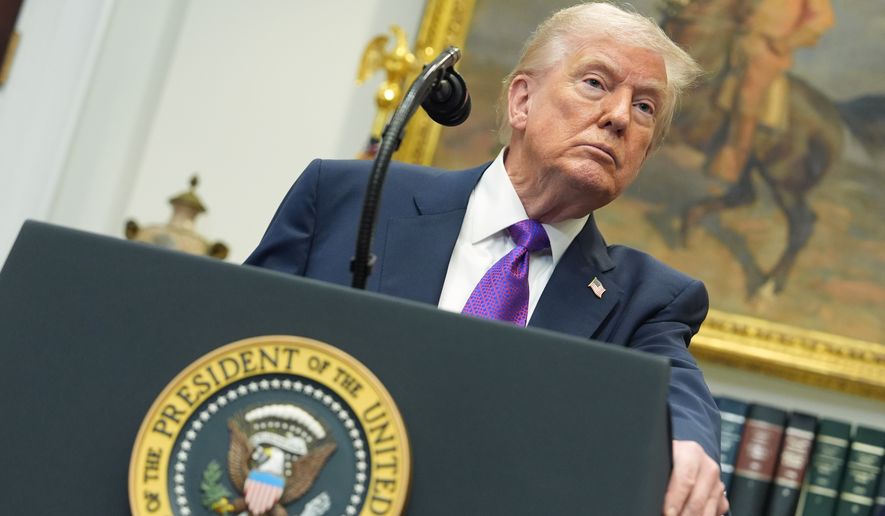

President Trump and his DOGE swung for the fences last year in calling for big spending cuts, but with Congress now done with most of the 2026 budget bills, it’s become clear he barely got the ball in play.
Lawmakers took Mr. Trump’s proposals big and small — from slashing the Education Department to eliminating the Ryan White AIDS program to nixing the Council on Homelessness — and junked them, keeping taxpayer money flowing nearly across the board.
The Washington Times sampled 30 of the programs that Mr. Trump proposed to slash or outright eliminate in his 2026 budget. Only one of the 30 was eliminated. Of the remaining 29, just two were cut by more than half of their previous funding.
The result is a government that continued to spend largely on autopilot, despite Mr. Trump’s high hopes and tough talk.
“Congress largely rejected the discretionary spending cuts President Trump proposed in 2025,” said Dominik Lett, a budget analyst at the Cato Institute.
The new bills just approved for 2026 actually hike spending slightly compared with 2025, and “while some agencies saw modest trims, most funding was held flat or increased,” Mr. Lett said.
It’s a huge comedown from the heady days of a year ago, when Elon Musk helmed the Department of Government Efficiency and its employees were infiltrating agencies throughout Washington, looking for the fat to cut.
Mr. Musk initially said he’d be able to slash $2 trillion out of Uncle Sam’s budget, which is expected to total $7.4 trillion this year. He later downgraded his goal to $1 trillion.
Jessica Riedl, a budget expert at the Brookings Institution, said she figures DOGE’s final tally was about $20 billion.
Some of that was from small changes in public education and woke spending, but most came in cuts to international funding.
Ms. Riedl said the DOGE-inspired cuts could end up reaching $40 billion a year, but that depends on how the federal buyouts play out. If those positions get refilled, or if agencies end up paying contractors to perform those same roles, the savings would be constrained.
Those trims were all the result of Trump executive actions.
The bigger fight was always going to be getting Congress to bless the cuts and write them into law.
And there, Mr. Trump has been nearly shut out.
Last May, the White House submitted a list of about 150 areas and programs it wanted to see slashed or eliminated. They ranged from big dollars, such as cutting $17 billion from the National Institutes of Health and eliminating the $4 billion Low Income Heating Assistance Program, to the tiny, such as shuttering the $17 million-a-year Denali Commission and the $1.65 million that flowed last year to the Office of Navajo and Hopi Indian Relocation.
The Times selected 30 of those programs for review.
It found Congress didn’t significantly increase spending for any of them — which could be considered a real win for Mr. Trump — but it rarely embraced the extent of the trims he wanted to see.
In only one instance — the Navajo and Hopi relocation office — did Congress agree with Mr. Trump’s demand to cancel funding.
In an additional six cases, Congress cut more than 25% of the funding from its previous allocation, but rejected the administration’s plans to shutter those programs.
The remaining 23 programs saw slight cuts or held steady.
Included is the low-income heating program, where Congress allocated $4.045 billion, or roughly the same as in 2024, the last time Capitol Hill wrote specific spending bills. Mr. Trump had said the program was “unnecessary” because states had their own policies to help low-income homes with energy costs.
He said LIHEAP really benefited rich, Democrat-run states that have “anti-consumer policies that drive up home energy prices.”
Mr. Trump called for eliminating the National Endowment for Democracy, but Congress gave it another $315 million for 2026 — the same amount it allocated in 2024.
The president wanted to zero out the National Endowment for the Arts and the National Endowment for the Humanities. Congress instead delivered full funding at more than $200 million apiece, the same as the last time.
Mr. Trump’s best successes came in foreign aid agencies.
He called for eliminating the U.S. African Development Foundation, the Inter-American Foundation and the U.S. Institute of Peace. Congress kept all of them alive, but reduced USADF’s money from $45 million to $12 million; IAF’s budget dropped from $47 million to $29 million; and USIP went from $55 million in the last full spending bill to $20 million in the new one.
The administration last year also secured Congress’ approval of cuts to other foreign aid spending — to the point that State Department spending is down 27% over the past four months compared with the same time frame a year earlier — which corresponds with the final months of the Biden administration.
Mr. Trump’s Office of Management and Budget didn’t respond to an inquiry for this story.
The spending tussles with Congress have produced some bizarre outcomes.
Mr. Trump last year tried to shut down Voice of America, proposing that it be stripped to the bare minimum operations required by law. Then in his 2026 budget he called for cutting its funding from $260 million a year to just $23 million this year — enough to carry out a final shutdown.
Enter a federal judge, who last year ordered that the money keep flowing. Employees aren’t working, but they are getting paid.
Congress, in the new spending bills, called for VOA to get $200 million this year, representing a reduction but envisioning a substantial organization still operating.
Both sides rushed to court anyway, claiming Congress had backed them in the shutdown fight.
“Congress has now emphatically rejected the executive branch’s proposals,” the challengers said, pointing out that Capitol Hill included some strict guardrails on how much the money can be moved around.
But the administration said the cut shows “Congress itself envisions a smaller-scale agency” and said it will have to be up to Mr. Trump and his team to decide what that looks like.
Ms. Riedl, the Brookings budget analyst, said with DOGE now mostly wound down, she expects the budget battles will shift from dramatic budget cuts to smaller skirmishes over spending the money Congress allocated, either through the White House impounding money or carrying out more personnel reductions.
That, she said, will be tougher to track.
It will also shift the focus to courts, where judges will have to decide whether the law allows Mr. Trump’s impoundments and workforce reductions.
“The courts are going to become the place to see what’s happening in the budget,” Ms. Riedl said.
• Stephen Dinan can be reached at sdinan@washingtontimes.com.

Please read our comment policy before commenting.