


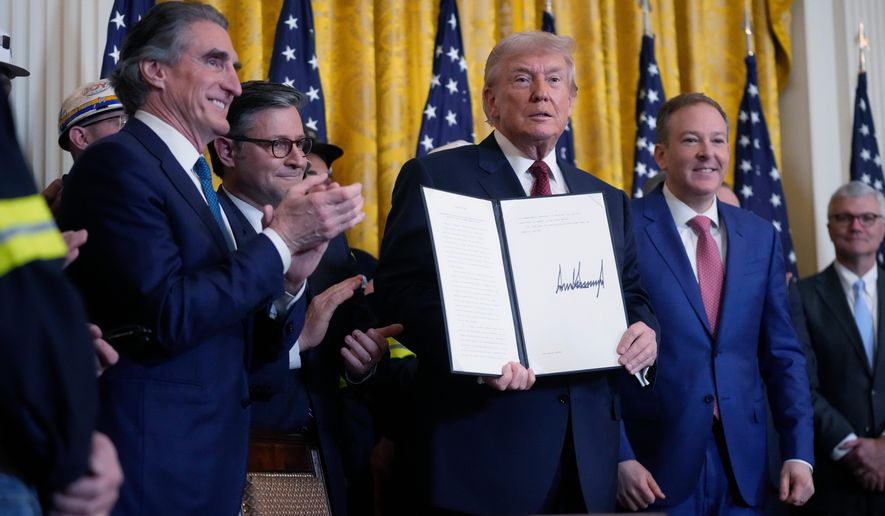

President Trump recently ordered the Department of Defense to prioritize coal energy over other forms of energy, leaning into a personal brand of “Trump capitalism” that is testing decades of Republican free-market orthodoxy.
Blue-collar workers in the struggling coal industry cheered the Feb. 11 move, which ordered the “Department of War,” as Mr. Trump calls it, to enter long-term agreements with coal-fired energy production facilities.
The order describes coal as the most reliable form of energy, though Mr. Trump’s decision to promote coal is fueling a parallel debate: Whether the Republican Party is still the free market party of Ronald Reagan or has evolved into a party willing to put its thumb on the economic scales when it sees fit.
“This is a troubling order that is another example of the federal government implementing industrial policies,” said Wayne Winegarden, a senior fellow in economics at the Pacific Research Institute, a free market think tank. “On net, the Trump administration does not promote free-market principles. They are promoting industrial policy with a Trump twist.”
Efforts to elevate coal over other sources follow Mr. Trump’s aggressive moves to recalibrate trade through tariffs and take government equity stakes in Intel and rare-earth mining firms.
Further, the president leaped into the pharmaceutical market by privately negotiating discounts and offering them through coupons on his Trump Rx website.
The moves are aimed at bolstering American companies and satisfying Mr. Trump’s working-class base with immediate solutions and consumer savings. Yet they are disorienting to Republicans like Sen. Rand Paul, who says trade protectionism leads to “political decimation” for parties that promote it. He also said the government’s stake in chipmaker Intel was a “step toward socialism.”
The White House says critics of Mr. Trump’s approach need some perspective.
Mr. Trump’s tax cuts and deregulations are free-market policies that impact trillions of dollars in economic output, administration officials said, dwarfing tariffs and equity stakes in private companies, which involve far lower dollar amounts.
Equity stakes in private companies amount to around $100 billion, or less than the total revenue impact of Mr. Trump’s no-tax-on-tips policy over the 10-year budget window.
Former House Speaker Newt Gingrich said Mr. Trump is aggressive on economic matters “because he’s more committed to getting things done and getting it to work.”
“He wants the economy to work, he wants to rebuild our industrial base,” Mr. Gingrich told The Washington Times.
Notably, he thinks Mr. Trump’s intervene-when-necessary approach is here to stay among Republicans.
“It’s not just the party, it’s the nature of the world. The fact is, we’ve gotten sucked into a kind of globalism that was explicitly disadvantageous for America, and Trump has broken out of this,” he said.
To be sure, political parties have always evolved.
Democrat John F. Kennedy espoused a supply-side tax cut in the 1960s before Reagan ever did, Mr. Winegarden said.
In the 1990s, Vice President Al Gore argued in favor of the North American Free Trade Agreement in a high-profile debate against independent presidential candidate Ross Perot. His performance was so persuasive that it boosted public support for NAFTA, only for Democrats to turn against it and call for renegotiating it by 2008.
While Democrats morphed into a more protectionist, pro-worker party, Mr. Trump co-opted their evolution with a MAGA movement that emphasized tough immigration policies and trade negotiations to protect American workers.
Tariffs are a key part of that agenda, yet the broad sweep of Mr. Trump’s levies is jarring to Republicans who say trade protectionism should be narrowly tailored to industries such as steel.
A handful of House Republicans recently joined Democrats to kill a measure from Republican leaders that would have blocked votes on measures challenging Mr. Trump’s broad tariff authority.
“I believe in free market principles because I’m a traditional conservative. Even if the leader of the GOP embraces protectionism, price controls, salary caps, etc., that doesn’t mean conservatives should change their positions,” said Rep. Don Bacon, a Nebraska Republican who pushed back on Mr. Trump’s tariffs. “Let’s remember that President Trump was a Democrat most of his life.”
Mr. Gingrich countered that Mr. Trump’s approach aligns with Republican history.
“Go back and look at [William] McKinley, the most popular Republican in the late 19th century — the grandfather of tariff policy,” he said. “There is a lot of Republicanism in what Trump is doing. It’s different from the orthodoxy of the pre-Trump party that evolved, but I think you see that when it’s necessary for national security reasons, we intervene.”
Mr. Gingrich pointed to the creation of RCA after World War I. The company started as a Navy-backed initiative to ensure American control over radio assets, while boxing out foreign intervention.
Today, Mr. Trump is intertwining government and private industry by taking equity stakes in critical industries.
Intel, a massive but struggling microprocessor chip manufacturer, agreed last year to give the U.S. government a 10% equity stake in the company in return for the funding promised under President Biden’s 2022 law to bolster America’s semiconductor industry.
It kicked off a trend in which the administration, citing national security, took equity stakes in private companies rather than the traditional approach of extending government grants and loans.
“President Trump was given a resounding mandate by the American people to smash Washington, D.C.’s obsession with consensus orthodoxy that has let Americans down,” White House spokesman Kush Desai said. “The Trump administration is turning the page on Joe Biden’s economic disaster by implementing traditional free market policies that do work – like deregulation and tax cuts – while rectifying the ‘America Last’ policies that have left Americans behind.”
Mr. Trump’s interventions in the economy, alongside Democrats’ sudden opposition to heavy-handed trade moves, pose interesting questions for both parties.
“Will the Republicans become a party that is anti-trade and promotes industrial policies, or will they return to free market principles? Will the Democrats turn away from democratic socialism?” Mr. Winegarden said. “The elections over the next several cycles will be potentially deciding fundamental principles for the party going forward. It seems like a toss-up for both of them.”
Mr. Bacon argued that reactions to Mr. Trump himself are a key factor for many politicians in how they weigh his economic agenda.
“It is true that when Trump advocates for these policies, some in the GOP immediately support and many Democrats immediately oppose. It’s psychology,” he said.
Mr. Trump’s latest move, to promote coal, leaned heavily into the practical side of energy production. His order states that, as a matter of national security, defense operations need reliable sources of energy under all conditions.
“Coal generation ensures that military installations, command centers, and defense-industrial bases remain fully powered under all conditions — including natural disasters, or wartime contingencies,” the order said.
Opponents of the move tapped into the debate over free markets by layering economic worries on top of their usual environmental concerns. They said the order would distort an energy sector that has moved beyond coal and transitioned to natural gas and renewables.
“Reality doesn’t lie: coal is a rapidly dwindling relic of the past, not a solution for the future,” Julie McNamara, associate policy director of the Climate and Energy Program at the Union of Concerned Scientists. “Forcing the use of increasingly unreliable and relentlessly uneconomic coal plants will risk outages and send high electricity costs higher.”
David Stevenson, director of energy and environmental policy at the Mackinac Center for Public Policy, a free market think tank, said Mr. Trump appeared to be responding to state and federal policies that interfere with the market “by subsidizing and mandating unreliable wind and solar.”
“President Trump is reacting to this by trying to keep reliable coal plants open, which will help avoid blackouts,” he said. “And coal power generation is much cleaner than it used to be because the plants have spent billions on scrubbers and other technology to meet clean air standards and recycle coal ash into cement and asphalt.”
Moving forward, Mr. Stevenson said he hopes both parties embrace free-market principles by refusing to choose winners and losers in the energy sector; writing rational environmental rules; allowing companies to succeed or fail on their own merits; and limiting government involvement in private industry.
• Tom Howell Jr. can be reached at thowell@washingtontimes.com.

Please read our comment policy before commenting.