



OPINION:
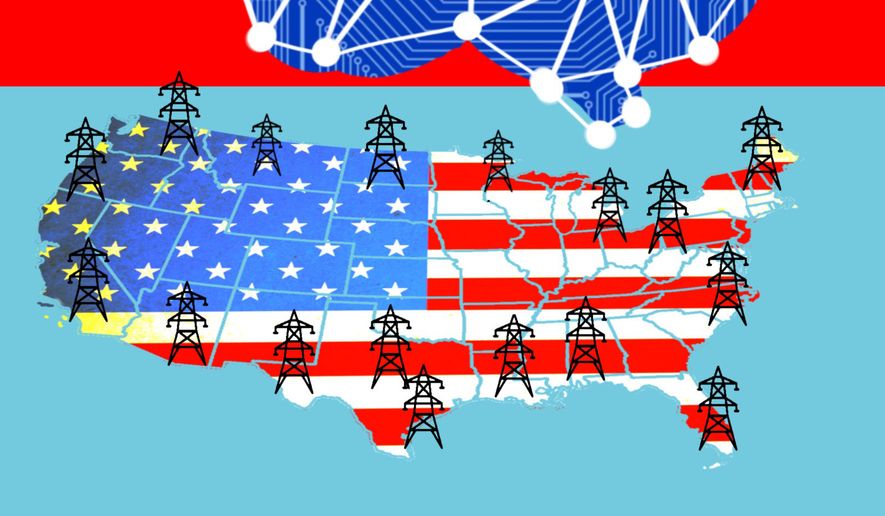
When most Americans think about artificial intelligence, images of computers, robots and futuristic technology come to mind. What they don’t picture is the power plant down the road or the transmission line crossing their community.
In reality, a less-glamorous truth behind AI matters just as much to your family as it does to Silicon Valley. AI runs on energy, and a lot of it. If America cannot build the energy infrastructure to support it, then the consequences won’t be abstract. You won’t see the impact in a lab or a movie. You will see it when small businesses stop expanding, investment moves elsewhere and American communities lose momentum.
The United States is in an intense global race with China for technological dominance. It’s about who can build power plants, supply transmission lines and generate enough energy to keep data centers running.
America risks falling behind not because we lack talent or innovation but because red tape is painfully slowing the process and, too often, stopping projects before they ever break ground.
While we struggle with lengthy approvals and uncertainty, China is moving fast. It has rapidly expanded power generation and data center capacity to support industries that require lots of computing power and resources. Experts estimate that China accounted for more than half of global electricity demand growth in 2024 alone.
That ability to build quickly gives China a strategic advantage we cannot afford to ignore.
There is some resistance to building data centers based on the belief that doing so will increase electricity and water rates. State and local legislators have designed zoning and billing to be entirely offset by these centers. That said, we should always remain diligent to ensure the cost is not passed on to the local population.
Federal and state regulations would merely delay construction without increasing safety or efficiency.
Next week, I’m chairing a hearing in the Science, Space and Technology Committee to ask a simple question: How do federal permitting laws affect the energy and data center infrastructure that powers artificial intelligence? My goal is to investigate whether our laws are producing growth or quietly holding America back.
If we cannot build fast enough, then we risk losing this competition to China for reasons that have nothing to do with talent or ideas and everything to do with our own self-imposed barriers.
AI runs on massive data centers that need reliable electricity, modern transmission lines and a grid that can grow with the demand. Without that foundation, even the most advanced software cannot scale. In today’s global AI race, the ability to build quickly and reliably is becoming just as important as innovation itself.
Here in Georgia, we are already seeing the impacts of this. Growth requires power, and when infrastructure doesn’t keep up, reliability suffers. This means delayed projects and higher construction costs. That is not a data center problem but a build-out problem, and bad federal policy is a huge factor in this gridlock. By streamlining permitting, we can reduce such delays and lower costs.
Energy projects routinely spend years navigating overlapping federal permits, with environmental reviews often taking more than two years. New transmission lines take an average of four years to be approved, and sometimes more than a decade.
In many cases, it takes longer to get permission to build than it does to actually build the project. That is not acceptable.
The consequences are measurable. In 2024, the U.S. completed less than 900 miles of new high-voltage transmission lines. A decade ago, we were building several times that amount each year. Transmission is the backbone of a reliable grid, and without it, energy resources cannot reach growing communities or new industries.
If we want to beat China and keep AI leadership at home, we must fix the problems that make it so hard to build in America. That means advancing next-generation technologies, such as small modular reactors, while supporting existing sources, such as natural gas and renewables. It means pursuing an “all-of-the-above” approach that allows America to build more energy more quickly and at lower cost.
America has almost everything it needs to lead in AI: talent, innovation and entrepreneurial spirit. What we lack is a system that can execute.
For Americans, everyday life is poised to improve drastically through advancements in AI. We lose those advantages if we refuse to modernize how we build infrastructure. This moment demands reform, and I am committed to leading the effort to ensure America can build on time and on budget at the speed this competition requires.
• Dr. Rich McCormick is a decorated veteran and emergency room physician who proudly serves Georgia’s 7th Congressional District in the United States House of Representatives.

Please read our comment policy before commenting.