


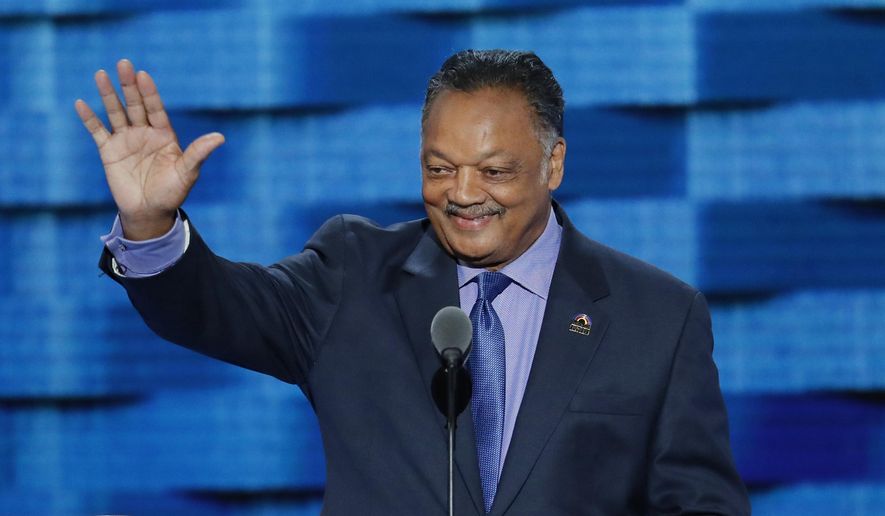

The Rev. Jesse Jackson, who grew up in Jim Crow South Carolina and went on to become a civil rights icon and the first Black male candidate for president of the United States, died Tuesday. He was 84.
His daughter Santita Jackson confirmed that Mr. Jackson died at home, surrounded by family, The Associated Press said.
“Our father was a servant leader — not only to our family, but to the oppressed, the voiceless, and the overlooked around the world,” the Jackson family said in a statement posted online. “We shared him with the world, and in return, the world became part of our extended family.”
Mr. Jackson was hospitalized briefly in November for his progressive supranuclear palsy, or PSP, a rare neurological disorder with symptoms similar to Parkinson’s.
In 2017, doctors considered his symptoms consistent with Parkinson’s until PSP was diagnosed in April at the Mayo Clinic.
He had been managing PSP for almost a decade, but the disorder’s progression left him in a wheelchair, and he could no longer speak, family members told AP in November.
SEE ALSO: Trump praises civil rights leader Jesse Jackson upon his death: ‘A good man’
His last public appearance was at the 2024 Democratic National Convention in Chicago.
Mr. Jackson’s death leaves the stage mostly bare of the famous Black Americans who were with the Rev. Martin Luther King Jr. when he was assassinated in Memphis, Tennessee, and who stand as the founding fathers of the civil rights struggle that began in the 1960s and became one of the major themes of modern America.
Although considerably younger than King and at times perceived as more aggressive and polarizing, Mr. Jackson was nonetheless among the most prominent Black figures in late 20th-century America.
He launched two bids for president, in 1984 and 1988. His second marked the most successful campaign of any Black politician until Barack Obama secured the White House 20 years later. In the 1988 battle for the Democratic Party nomination, Mr. Jackson won nearly 7 million votes, with victories in seven primaries and four caucuses.
In a remarkable career arc, Mr. Jackson rose from an out-of-wedlock son in Greenville, South Carolina, to an international hostage negotiator as a U.S. special envoy, to the first elected “shadow senator” from the District of Columbia. His civil rights work earned him the highest civilian honors on two continents. He received the U.S. Presidential Medal of Freedom in 2000 and a Legion of Honor citation from France in 2021.
He was born in October 1941, two months before the U.S. was attacked at Pearl Harbor and entered World War II. The son of a sometime boxer and a woman who soon married another man, Mr. Jackson often noted that his drive for success was forged in a childhood in which he was teased as a bastard son. He regarded the boxer and his adopted parent, Charles Henry Jackson, as fathers, and took the last name of the second man as a teenager.
PHOTOS: Celebrity deaths in 2026: The famous faces we've lost
A terrific high school athlete, Mr. Jackson won a Big Ten football scholarship to the University of Illinois, which he chose over a professional contract with minor league baseball. He left Illinois after two years for unclear reasons and transferred to historically Black North Carolina Agricultural and Technical State University, where he earned a bachelor’s degree in sociology in 1964. He earned a graduate school scholarship at the Chicago Theological Seminary.
Although he would be ordained as a Baptist minister in 1968, Mr. Jackson never completed his graduate degree as he was drawn into the civil rights battles that erupted across the South. After his 1960 arrest at a sit-in at a segregated library in Greenville, South Carolina, Mr. Jackson went on to become a member of King’s Southern Christian Leadership Conference, the premier civil rights organization of its day.
Stationed in Chicago, Mr. Jackson began to build a power base through high-profile work in boycotts and other protests, leading what the SCLC called Operation Breadbasket.
He was in Memphis on April 4, 1968, the day King was fatally shot on a hotel balcony. There was debate for years over the precise locations of the SCLC leaders in relation to King.
Those disputes presaged battles between Mr. Jackson and Ralph Abernathy that would divide the SCLC after King’s assassination. Mr. Jackson served as the SCLC’s national director beginning in 1967, but after consolidating his position in Chicago, he was dogged by never-proved rumors that he was dipping into SCLC funds. He left the group in December 1971 to launch his People United to Save Humanity (later altered to “serve humanity”).
PUSH and a group Mr. Jackson began in 1984, the Rainbow Coalition, would provide the backbone of his political support in his presidential campaigns before the two eventually merged in 1996.
Mr. Jackson stepped down as leader of his Rainbow/PUSH organization in 2023, and his son Yusef Jackson took over as chief operating officer in 2024.
In 1983, Mr. Jackson was a key figure in the election of Harold Washington as Chicago’s first Black mayor. The following year, Mr. Jackson made his own foray into politics.
Although few of his specific campaign planks were formally adopted in the party’s platforms, Mr. Jackson’s increasing political profile did much to push the Democratic Party throughout the 1980s. In 1992, Bill Clinton was afraid that Mr. Jackson, regarded as one of the leading figures of the party’s liberal wing, would launch a campaign to his left, but Mr. Jackson instead wound up becoming a close adviser to the Clintons over the next decades.
His career was not without controversy. At times, Mr. Jackson found himself in trouble for antisemitic remarks, such as when he called New York City “Hymietown,” and he was criticized for his relationship with Nation of Islam leader Louis Farrakhan. Both of those issues deeply wounded his first presidential bid. Although Mr. Jackson managed to mend fences with some Jewish figures, his slurs and support for Palestinian causes meant his relationship with the Jewish community was rocky.
On the international stage, Mr. Jackson served as a hostage negotiator on several occasions. In the summer of 1984, he traveled to Havana and secured the release of nearly two dozen arrested Americans. He repeated those duties and that success in visits to Syria later that year, Baghdad with Saddam Hussein in 1991 and Belgrade during the Kosovo war in 1999.
At the close of the 20th century, Mr. Jackson was elected as the first shadow senator for the District, a largely ceremonial post whose chief duty is to lobby for the nation’s capital to become the 51st state. He held that office from 1991 to 1997.
His star waned somewhat in the 21st century, though he remained famous and occasionally spoke to huge crowds around the world.
He endorsed Mr. Obama’s election in 2008, although he was captured on tape being sharply critical of Mr. Obama for “talking down to Black people” and, at another time, accused him of “acting like he’s White.”
Mr. Jackson is survived by his wife, Jacqueline Brown, and six children, including sons Rep. Jonathan Jackson, a Democrat who represents Illinois’ 1st Congressional District, and former Rep. Jesse Jackson Jr., who is seeking reelection to return to his 2nd Congressional District seat in Illinois.
* This article is based in part on wire service reports.

Please read our comment policy before commenting.