



OPINION:
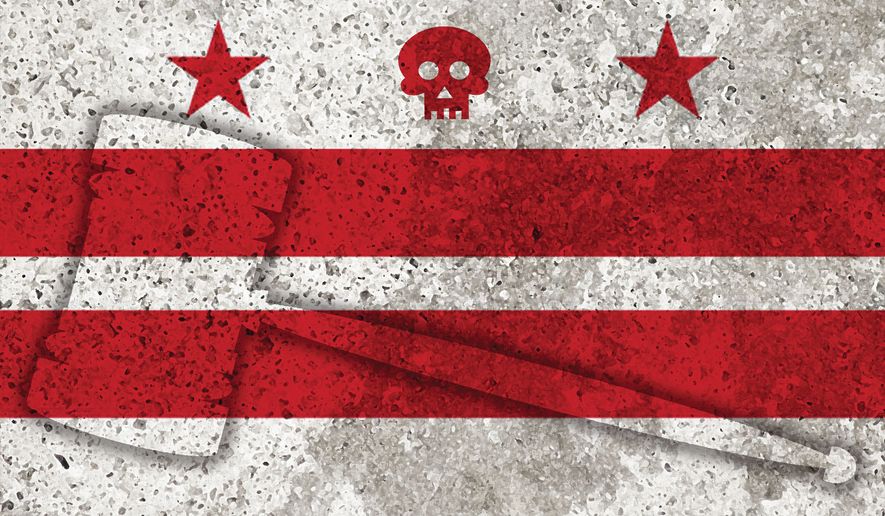
The District of Columbia needs the death penalty, and Congress should restore it.
Consider the terrorist-style attack committed only blocks from the White House just before Thanksgiving. On the afternoon of Nov. 26, a gunman fatally shot one National Guard member and grievously wounded another outside the Farragut West Metro Station.
Rahmanullah Lakanwal, the man charged with the crimes, had traveled across the country from Washington state.
Even given the heinous, premeditated nature of these actions, D.C. officials have said categorically that the death penalty isn’t appropriate. That’s because local officials abolished it in 1981 and have since refused to restore it.
Recognizing this injustice, President Trump has done what he can with the tools available. On his first day back in office, he issued an executive order requiring the attorney general to “pursue the death penalty for all crimes of a severity demanding its use.”
He followed up almost eight months later by issuing a presidential memorandum “directing the attorney general and the U.S. Attorney for the District of Columbia to fully enforce Federal capital punishment laws to deter and punish the most heinous crimes in our Nation’s capital.”
As a practical matter, this means that the U.S. attorney for the District of Columbia, who enforces both federal and D.C. laws, must charge any death-deserving crimes under federal law. He or she must bring those cases in federal court, not under D.C. laws in ostensibly local courts. (A good argument can be made, though, that D.C. local courts are, at bottom, exercising federal judicial power, which raises several constitutional concerns, but that’s a conversation for another day.)
It’s an imperfect solution designed to deal with the inadequacy of local laws. The instances in which the federal death penalty can be sought are limited, and the factual predicates can sometimes be difficult to show even in otherwise heinous murders.
Take, for example, federal prosecutors’ recent efforts to seek the death penalty against Luigi Mangione, who stands accused of gunning down an insurance company CEO in the middle of New York City to prove a political point. Because New York state law does not allow for the death penalty, federal prosecutors stepped in to charge Mr. Mangione under federal law and to seek the death penalty under it.
A judge recently quashed those efforts, finding (somewhat absurdly) that the legal predicates had not been met.
This underscores some of the problems D.C. prosecutors may face as they try to shoehorn what are essentially local murder cases, even gruesome and depraved ones, into a federal framework that might not always be a neat fit. To alleviate these problems, Congress should amend D.C. laws to allow for the death penalty when the defendant’s crime is exacerbated by certain aggravating factors.
Of course, Congress should undertake a comprehensive rewrite of D.C. laws, but beginning by reinstating the death penalty under local law would be a good start.
Congress also could consider allowing a nonunanimous jury to recommend a death sentence. For instance, Florida recently amended its laws to allow a jury to recommend death as long as a supermajority of jurors, at least eight, agree. (This could pose a problem, though, if D.C. courts are indeed exercising federal judicial power. If the current arrangement stands, then this also should be permissible.)
For now, federal prosecutors in the District of Columbia say the death penalty is still on the table for Mr. Lakanwal, but it will require filing a superseding indictment that includes federal charges allowing it to be imposed. If he is convicted, then his crimes certainly seem deserving of the ultimate punishment.
• Zack Smith is a senior legal fellow and manager of the Supreme Court and Appellate Advocacy Program at The Heritage Foundation.

Please read our comment policy before commenting.