


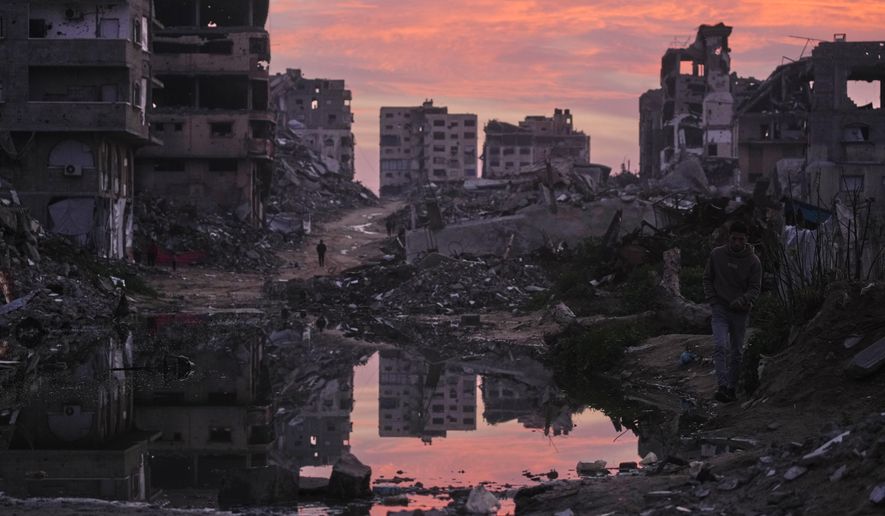

President Trump announced his Gaza peace plan in September 2025 as a 20-point framework to end the war between Israel and Hamas.
The plan called for an immediate ceasefire, release of Israeli hostages held by Hamas, withdrawal of Israeli forces to pre-agreed lines, and full humanitarian access to Gaza. The agreement came into effect on Oct. 10, 2025, and was endorsed by U.N. Security Council Resolution 2803 in November.
The plan also envisions demilitarization of Gaza, deployment of an international stabilization force, transitional governance by Palestinian technocrats under international supervision, and large-scale reconstruction.
However, implementation has faced significant challenges. The Associated Press has reported that Gaza’s Health Ministry says 586 Palestinians have been killed since the ceasefire began in October, and that key elements of the agreement — including the international force and longer-term governance arrangements — remain unresolved and under discussion. The plan’s vague language regarding a “pathway toward a future Palestinian state” has drawn skepticism about its genuine prospects.
The Board of Peace, initially conceived to oversee Gaza’s reconstruction, has evolved into something more expansive. Trump chairs the body, which was formally established at the World Economic Forum in Davos on Jan. 22, 2026, when leaders from more than 20 countries signed its charter.
According to NPR and Reuters, the board’s charter goes far beyond Gaza, describing itself as “an international organization that seeks to promote stability, restore dependable and lawful governance, and secure enduring peace in areas affected or threatened by conflict.” The charter does not mention Gaza specifically.
Countries seeking permanent membership must pay $1 billion, a provision that has drawn criticism. Major Western countries including France, Germany, the United Kingdom, Italy, Norway, Sweden, Slovenia, Greece and Ukraine have declined to join, with France citing concerns that it “raises serious questions” regarding “the principles and structure of the United Nations.”
Army Chief of Staff Gen. Maruli Simanjuntak announced Monday that Indonesia is preparing 5,000 to 8,000 troops focusing on engineering and medical units, though details remain under negotiation and deployment timing is uncertain. Indonesia’s announcement represents the first specific troop commitment to the peacekeeping force.
The commitment is particularly significant because Indonesia, the world’s largest Muslim-majority nation with more than 270 million people, has never maintained formal diplomatic relations with Israel and has consistently supported the Palestinian cause. Indonesian public opinion polls show approximately 80 percent hold unfavorable views of Israel.
President Prabowo Subianto has stated Indonesia will only establish diplomatic relations with Israel after Israel recognizes an independent Palestinian state.
The deployment would mark the first time an outside military force has maintained a presence in Gaza since 1967. However, questions remain about the force’s composition and mandate. Israeli Prime Minister Benjamin Netanyahu has expressed skepticism about certain Arab forces entering Gaza.
Secretary of State Marco Rubio previously indicated the force would comprise troops from countries Israel is “comfortable” with, though Indonesia’s lack of diplomatic ties with Israel raises complications for coordination and implementation.
This article was constructed with the assistance of artificial intelligence and published by a member of The Washington Times' AI News Desk team. The contents of this report are based solely on The Washington Times' original reporting, wire services, and/or other sources cited within the report. For more information, please read our AI policy AI policy or contact Steve Fink, Director of Artificial Intelligence, at sfink@washingtontimes.com
The Washington Times AI Ethics Newsroom Committee can be reached at aispotlight@washingtontimes.com.

Please read our comment policy before commenting.