


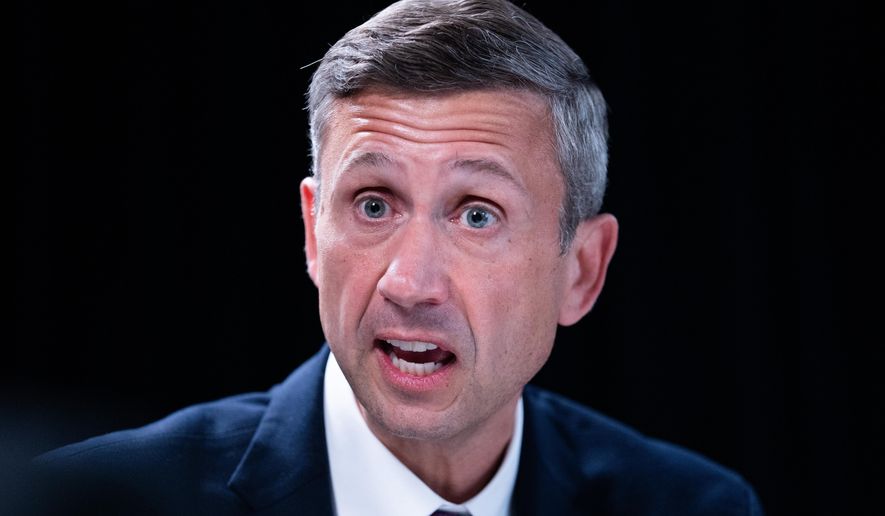

Democratic National Committee Chair Ken Martin’s push for party unity ran headlong Thursday into thorny and simmering internal fights over how far the party should go in condemning the Israeli government’s military actions in the Middle East, the pro-Israel lobby and federal immigration enforcement efforts.
The committee rejected a proposal condemning the American Israel Public Affairs Committee’s involvement in Democratic primaries and broader political influence and punted on a pair of resolutions related to Israel and the Middle East — moves that angered the party’s left flank.
It did pass proposals calling for the dismantling, not “abolition,” of U.S. Immigration and Customs Enforcement and urging Congress to scrap state and local law enforcement cooperation with ICE under 287(g) agreements.
Gathering at the DNC’s spring meeting in New Orleans, the party’s resolutions committee worked through more than two dozen proposals covering opposition to the SAVE America Act, condemnation of the Trump administration and support for labor, Puerto Rico statehood and NATO.
The resolutions now head to the full DNC for a vote.
The biggest flash points over the nonbinding resolutions centered on Israel and immigration, which exposed divisions inside and outside the room. Congressional candidates and grassroots activists are demanding that the party take a harder line against Israel and abolish ICE.
SEE ALSO: Democrats strategize removing Trump from office to stop Iran war
The Middle East proved particularly intractable.
The resolutions committee declined to act on a pair of proposals targeting U.S. policy toward Israel and instead referred them to the Middle East Working Group, created in August. Critics have dismissed the panel as a stalling mechanism.
The committee shot down the resolution targeting AIPAC spending in Democratic primaries despite pleas from members.
Rep. Ro Khanna, California Democrat, said the resolution failed after two likely 2028 Democratic presidential contenders lobbied against it. He blasted their opposition as “out of touch.”
“Let me be pretty clear, anyone who hopes to lead this party must condemn and reject AIPAC money, and anyone who hopes to lead this party must be against another dollar going in military aid to Israel,” he said on X.
The measure, introduced by Florida DNC member Allison Minnerly, was framed around dark money in Democratic elections and called out the pro-Israel lobbying group’s influence over candidates who took positions on the conflict in the Middle East.
Ms. Minnerly argued that 75% of Democrats support blocking further weapons transfers with unconditional military aid to the Israeli government and that the party needs to take a harder look at who is shaping its candidates’ positions.
“I believe that there is a merit to calling out different PACs with intention, putting face and name to the forces that influence our elected officials this moment,” Ms. Minnerly said.
Opponents argued that the committee had addressed dark money broadly through an earlier resolution and that singling out one organization was counterproductive.
“We have also agreed that it is not efficient to consider individual organizations one by one, because there are too many to name,” said Arkansas DNC member Lottie Shackelford, who urged a no vote.
New Jersey’s Peg Schaffer said targeting AIPAC would damage the committee’s credibility. “We can’t pick on the Jews and expect this committee to be respected,” she said.
Afterward, Mr. Martin weighed in.
“Let’s be clear on what really happened: Today, the Resolutions Committee voted to pass a resolution condemning the corrosive influence of all dark money in Democratic primaries,” he said on X. “We had various resolutions that focused on different industries and groups, and instead of going one-by-one, we passed a blanket repudiation.”
The other referred resolutions included measures that would recognize a Palestinian state, condition U.S. weapons transfers to Israeli military units credibly implicated in human rights violations, and call for an independent investigation into a U.S.-Israeli airstrike on a girls’ school in Iran.
The fight over a resolution calling for the abolition of ICE proved equally divisive. The measure passed, but only after the language was watered down.
Members voted to strip “abolition” from the title and replace it with language calling for an overhaul of the agency, as well as condemning the Trump administration’s use of ICE as the president’s “own personal domestic army.” A separate amendment urging Congress to revoke the 287(g) program also was adopted.
The changes satisfied neither flank.
Jeff Strater, a Texas DNC member, voted against the resolution as amended. He said the ICE culture “killed people” and that nothing short of abolition would do.
“I do think the system needs to be dismantled,” Mr. Strater said. “The agency’s culture, the structure and all elements of it need to be abolished and started over again.”
From the other direction, Idaho’s Terri Pickens argued that red-state Democrats couldn’t afford the harder line. “Some of us have really red states and are doing a lot of work in really red states,” she said. Restructuring language “adequately reflects the moment.”
Colorado’s Stephanie Beal responded by noting that her state party passed abolish-ICE language with 97% support. “I think watering down the word ’abolish’ at this point is failing to meet the moment,” she said.
Oregon’s Nathan Soltz, son of a Salvadoran immigrant, closed out the debate by invoking his mother, who carried her naturalization certificate to his wedding in October out of fear.
“As clearly as I can, for my mom, on behalf of all Oregon Democrats … I need to say clearly, f—- ICE, f—- MAGA and leave us the f—- alone,” said Mr. Soltz, drawing cheers from the room.
• Seth McLaughlin can be reached at smclaughlin@washingtontimes.com.

Please read our comment policy before commenting.