



OPINION:
Jimmy Young would be proud of Dawn Staley.
Young was a Philadelphia fighter — a slick heavyweight counter-puncher who would land the blows his opponent never saw coming.
Staley, a Philadelphia native, landed a subtle body shot on rival Geno Auriemma that would be the knockout blow.
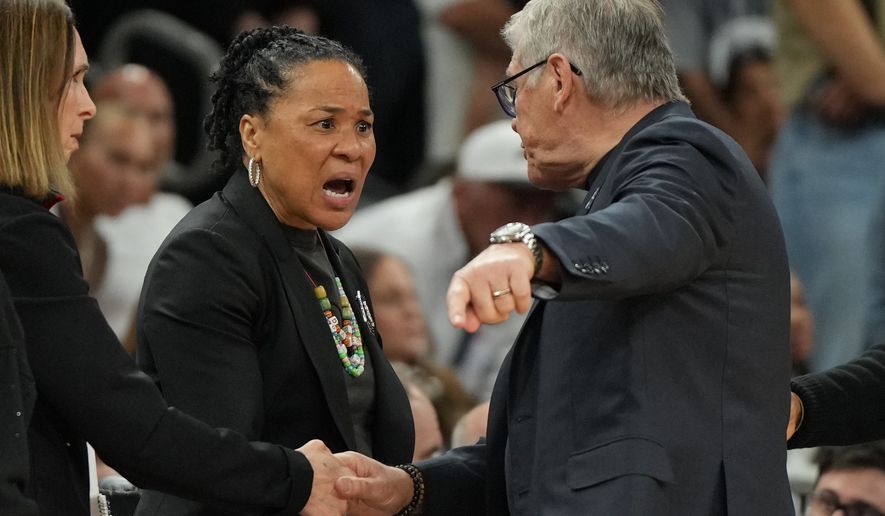
The argument between Staley, the South Carolina coach, and Auriemma, the UConn coach, at the end of the Huskies’ NCAA Women’s Final Four loss to the Gamecocks on Friday night had blown up like a heavyweight title fight.
When the game ended, Auriemma walked toward Staley for what everyone expected would be the traditional post-game handshake. But Auriemma was visibly upset with Staley, claiming she failed to do the customary pre-game handshake (even though she did shake hands, just not at center court). They had to be separated, but Staley stayed composed, compared to the ranting Auriemma.
The fight was on, and in the media ring, Auriemma was outmatched.
His post-game comments were small and petty. When asked by reporters what he said to Staley, Auriemma’s answer was, “I just said what I had to say.” Asked again, he responded, “I said what I said and obviously she didn’t like it. I just told the truth.”
Auriemma grew even smaller when he issued this statement through UConn: “There’s no excuse for how I handled the end of the game vs. South Carolina. It’s unlike what I do and what our standard is here at Connecticut. I want to apologize to the staff and the team at South Carolina. It was uncalled for in how I reacted.”
Nowhere did he mention Staley.
The South Carolina coach issued a statement Tuesday, after speaking to Auriemma. It was there that Staley, in between presenting her rival with flowers, laid Auriemma out on the canvas:
“I spoke with Geno, and I want to be clear — I have a great deal of respect for him and what he’s meant to this game. One moment doesn’t define a career, and it doesn’t change the impact he’s had on growing women’s basketball. The standard at UConn is what it is because of him, and that’s something this game has benefited from.”
Auriemma has won 1,288 games since coming to UConn in 1985. He’s won 12 national championships. He has been named Naismith College Coach of the Year eight times.
Who would possibly suggest a brief post-game confrontation in a semifinal tournament game would define his career?
Dawn Staley did.
With the short attention span of today’s media, that would have been only a sentence in Auriemma’s biography, to go along with his battles with Tennessee coach and rival Pat Summitt. Heck, neither one of these teams actually won the national championship. UCLA did it with a 79-51 beatdown of Staley’s Gamecocks.
Now it’s a career-defining moment? No, it’s not, Staley said.
A kidney punch. A shot to the liver.
It was a thing of ruthless beauty. Staley had already been celebrated as the noble victim in a column by Jerry Brewer in The Athletic:
“In one incident, she revealed all of her: the intensity, the tenacity, the grace and the responsibility. She didn’t let the nastiness sprawl. She recovered quickly and saw the bigger picture. With South Carolina and UCLA set to play in Sunday’s national championship game, the sport needed someone to lower the temperature. Of course, Staley would do it.
“For the past decade, she has been the face, the voice and the conscience of women’s basketball. It’s a weight to carry, and she is far from perfect. She can be petty. She can be stubborn. Like all coaches, she must feel in control at all times. Yet when it really matters, Staley puts basketball ahead of herself.”
And now, here was the conscience of women’s basketball, saving Auriemma’s legacy by declaring “one moment doesn’t define a career.”
Auriemma threw in the towel, following Staley’s statement with another apology: “This morning, Dawn Staley and I spoke about our interaction after the game last Friday. I apologized to Dawn, her staff and her team. I’ve lost more games in the Final Four than any coach in history. But Friday I lost something more important. I lost myself.”
He lost, all right.
• Catch Thom Loverro on “The Kevin Sheehan Show” podcast.

Please read our comment policy before commenting.